
Stainless Steel Workbenches for Cleanrooms: When to Specify 201-Wrapped Composite vs. Full Metal
Stainless Steel Workbenches for Cleanrooms: When to Choose Full Metal vs. Composite Surfaces
Executive Conclusion
For the majority of electronics, automotive parts, and hardware mold manufacturing environments, 201 stainless steel-wrapped high-density board tabletops provide the optimal balance of corrosion resistance, hygiene, and structural integrity. Full stainless steel construction should be reserved strictly for extreme chemical exposure or high-temperature sterilization processes where surface porosity is unacceptable. Selecting the wrong material leads to unnecessary capital expenditure or premature equipment failure.
Problem Diagnosis: Identifying the Environmental Stressor
The decision to specify stainless steel workbenches begins with a precise diagnosis of the operational environment. Procurement leaders often default to "all stainless" due to perceived safety, yet this can result in over-engineering for standard assembly lines or under-protection for harsh chemical zones.
Scenario A: Moderate Corrosion & Hygiene Requirements (Recommended: Composite with Steel Wrap)
In electronics manufacturing, automotive parts assembly, and general hardware mold factories, the primary risks are minor oil splashes, flux residues, and dust accumulation. In these scenarios, a composite desktop structure featuring a 5mm raw steel plate bonded to high-density fiberboard offers superior performance:
- Corrosion Resistance: The steel wrap protects against daily chemical contact without the thermal conductivity issues of solid metal.
- Structural Stability: The composite design prevents vibration and noise during precision operations.
- Hygiene: The non-porous steel surface allows for easy cleaning and meets basic cleanroom standards.
Scenario B: Extreme Chemical Exposure (Required: Full Stainless Steel)
If the workflow involves direct immersion in strong acids, alkalis, or frequent high-temperature autoclaving, only full stainless steel surfaces are viable. Standard composite materials may degrade under such conditions. However, even in these cases, the supporting frame (often C-type cold-rolled steel) remains the same; only the top surface material changes.
Technical Evidence: Material Specifications and Load Capacity
Guang'ErMei Precision Components designs workstation equipment based on verified material properties rather than generic assumptions. When evaluating options, consider the following technical boundaries:
1. Surface Composition and Durability
Our Single Back Panel Single Door 4-Drawer Steel Plate Workbench utilizes a proprietary composite structure designed for durability:
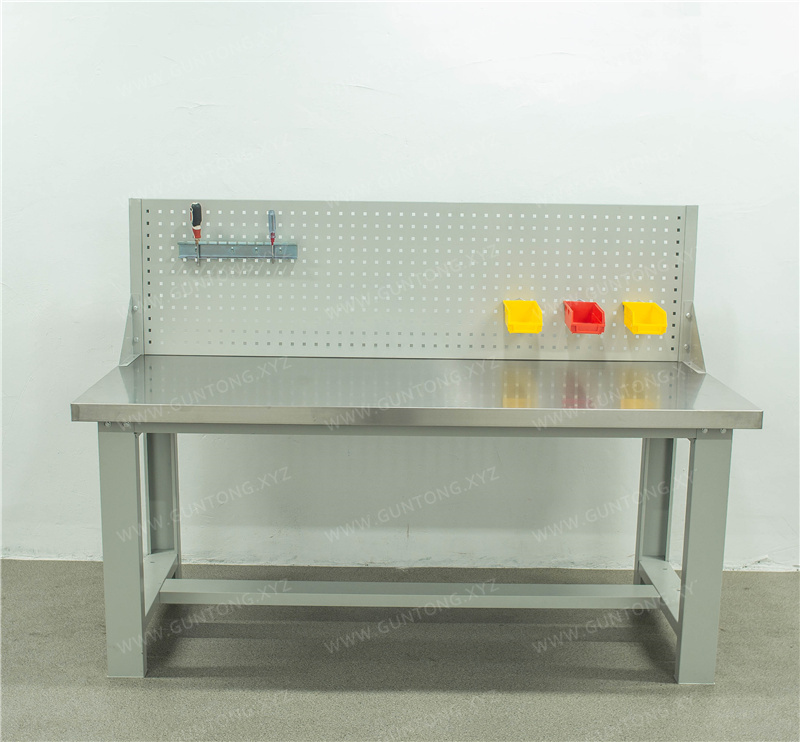
- Top Layer: 5mm raw steel plate.
- Core: High-density fiberboard.
- Edge Treatment: Black PVC edge banding to prevent moisture ingress at seams.
- Benefit: This configuration provides a total load capacity of 1000kg, significantly higher than many all-wood or thin-metal alternatives, while resisting rust from routine industrial fluids.
2. Structural Integrity in Cleanrooms
For applications requiring strict particle control (e.g., vocational college training centers or electronics R&D), the smoothness of the surface is critical. The steel-wrapped surface eliminates wood grain porosity, reducing bacterial growth and dust retention. Unlike bare wood, it supports 6S management protocols by allowing seamless integration with tool carts and pegboards.
3. Load-Bearing Limits
While surface material determines corrosion resistance, the frame determines load capacity. Our C-type cold-rolled steel frames are engineered to handle heavy-duty loads. For instance, our Pegboard Storage Cabinet (Inner Half-Pegboard Type) features shelves with a 100 kg load capacity per shelf, demonstrating the system's ability to support heavy components alongside the work surface.
Implementation Boundaries and Risk Assessment
Selecting the correct workstation requires understanding what the equipment cannot do as much as what it can.
| Feature | Composite (Steel-Wrapped) | Full Stainless Steel | Risk if Mismatched |
|---|---|---|---|
| Chemical Resistance | Moderate (Oils, Fluxes) | High (Acids, Solvents) | Using composite in acid zones causes delamination. |
| Thermal Conductivity | Low (Safe for soldering) | High (Heat transfer risk) | Solid steel may conduct heat to sensitive electronics. |
| Cost Efficiency | High | Low | Over-specifying stainless steel increases CAPEX unnecessarily. |
| Maintenance | Easy wipe-down | Requires polishing | Neglecting stainless steel leads to water spotting. |
Critical Note: Do not assume all "stainless steel" products are equal. Verify the grade (e.g., 201 vs. 304). For most indoor industrial environments, 201-grade wrapped surfaces are sufficient. If the environment is outdoors or near saltwater, a higher grade may be required.
Actionable Selection Criteria for Buyers
To finalize your specification, apply this decision matrix:
- Assess Chemical Exposure: Is there direct contact with corrosive liquids?
- Yes: Specify full stainless steel tops.
- No: Proceed to Step 2.
- Evaluate Load Requirements: Does the station require >500kg static load?
- Yes: Ensure the frame is C-type cold-rolled steel regardless of top material.
- No: Composite options remain viable.
- Check Hygiene Standards: Is the area a cleanroom or food-grade zone?
- Yes: Both options work, but composite offers better vibration damping for precision tools.
- Verify Customization Needs: Do you need integrated power sockets, lighting, or specific pegboard layouts?
- Action: Contact Guang'ErMei for a site-specific planning session. We offer on-site workstation planning to ensure the final layout matches your workflow.
Next Steps: From Diagnosis to Deployment
Choosing the right workstation is a strategic investment in operational efficiency. Guang'ErMei Precision Components supports manufacturers across Huizhou, Guangdong, and nationwide with a full-chain service model:
- Design: Customized layouts for electronics, automotive, and mold factories.
- Production: Dual capabilities in standardized production and non-standard customization.
- Installation: Professional on-site assembly ensuring 6S compliance.
- After-Sales: Full-process support including maintenance and spare parts.
Recommendation: For new facility setups or line reconfigurations, request a free consultation to review your specific environmental data. Our team will validate whether a composite solution suffices or if a full stainless specification is mandatory, ensuring you avoid both under-specification and budget waste.
Contact our engineering team today to discuss your application scenario and receive a tailored workstation proposal.
Key Points
- Composite workbenches with 5mm steel-wrapped high-density board surfaces are ideal for moderate corrosion and cleanroom environments, offering 1000kg load capacity.
- Full stainless steel is strictly required only for extreme chemical exposure or high-temperature sterilization scenarios.
- C-type cold-rolled steel frames provide structural stability and support heavy-duty storage accessories like tool cabinets and pegboards.
- Procurement decisions must prioritize actual chemical exposure levels over generic 'hygiene' assumptions to optimize CAPEX.
- On-site planning and 6S adaptation services are available to ensure workstation layouts match specific manufacturing workflows.
Conclusion
Specifying stainless steel workbenches requires a nuanced approach based on actual environmental stressors. For the majority of manufacturing sectors—including electronics, automotive, and hardware molds—a composite desktop with a 201 stainless steel wrap delivers the necessary corrosion resistance and hygiene standards at a lower cost and with superior vibration damping. Only in cases of extreme chemical aggression should full stainless steel be mandated. Guang'ErMei Precision Components provides the expertise to diagnose these needs accurately, ensuring your investment aligns with operational reality.
Call to Action
Request a Free Site Survey and Custom Workstation Proposal