
Stainless Steel Lab Workbench Configuration: Materials, Structure, and Cleaning Requirements
Who Needs a Stainless Steel Lab Workbench?
Stainless steel lab workbenches serve environments where hygiene, chemical resistance, and structural stability are non-negotiable. Typical buyers include electronics testing labs, pharmaceutical QC rooms, food safety inspection stations, automotive parts testing centers, and vocational college training labs. Unlike standard workshop workbenches built with cold-rolled steel frames and composite desktops, stainless steel lab workbenches must withstand frequent washdowns, resist corrosion from reagents, and maintain a contamination-free surface.
Guang'ErMei Precision Components designs and manufactures stainless steel workbenches alongside its broader workstation equipment line, supporting both standardized configurations and non-standard customization for lab environments across Huizhou, Guangdong, and nationwide delivery.
Core Configuration Decisions: Material Grade and Surface Finish
The first configuration decision is material selection. Stainless steel lab workbenches typically use one of two grades:
- SUS304 stainless steel: Suitable for general lab environments with moderate chemical exposure. Offers good corrosion resistance and is cost-effective for most electronics testing, hardware inspection, and educational training labs.
- SUS316 stainless steel: Required when the workbench will contact chlorides, strong acids, or saline solutions. Common in pharmaceutical, food safety, and marine testing labs.
Surface finish directly affects cleanability. A brushed or mirror-polished surface reduces particle adhesion and makes wipe-down faster. For cleanroom-adjacent labs, specify a surface roughness (Ra) below 0.8 μm to meet particulate control standards.
Configuration checkpoint: Confirm with your lab manager which reagents will contact the workbench surface. If hydrochloric acid or bleach-based disinfectants are used daily, SUS316 is the safer choice.
Frame Structure and Load-Bearing Design
Lab workbenches carry analytical instruments, microscopes, centrifuges, and sample trays. Load requirements typically range from 200 kg to 500 kg for the desktop, though heavier configurations are possible.
Guang'ErMei's standard workshop workbenches use C-type cold-rolled steel frames rated for 1000 kg total load capacity, with desktops combining 5mm raw steel plate and 45mm high-density fiberboard. For stainless steel lab versions, the frame and desktop shift to full stainless construction, which changes the load-bearing calculus:
- Square tube frames
- (e.g., 50×50×1.5mm or 50×50×2.0mm SUS304/316) provide rigid support for benchtop instruments. Welded joints must be ground smooth to prevent bacterial harborage.
- Panel-frame hybrid structures
- offer higher lateral stability for long workbenches (1800mm or 2100mm lengths) but add weight.
- Adjustable leveling feet
- are essential for labs with uneven flooring or vibration-sensitive instruments.
Configuration checkpoint: List every instrument that will sit on the workbench, note each unit's weight and footprint, and add a 20% safety margin. Share this load map with the manufacturer before finalizing frame thickness.
Desktop Configuration: Flat, Recessed, or Lipped?
Lab workbench desktops come in three common profiles:
- Flat top: Standard for general assembly and inspection. Easiest to clean.
- Recessed top: A shallow perimeter lip (5–10mm) prevents liquids and small parts from rolling off. Ideal for wet chemistry stations.
- Lipped top with drain: Used in washdown-heavy environments. Requires plumbing integration.
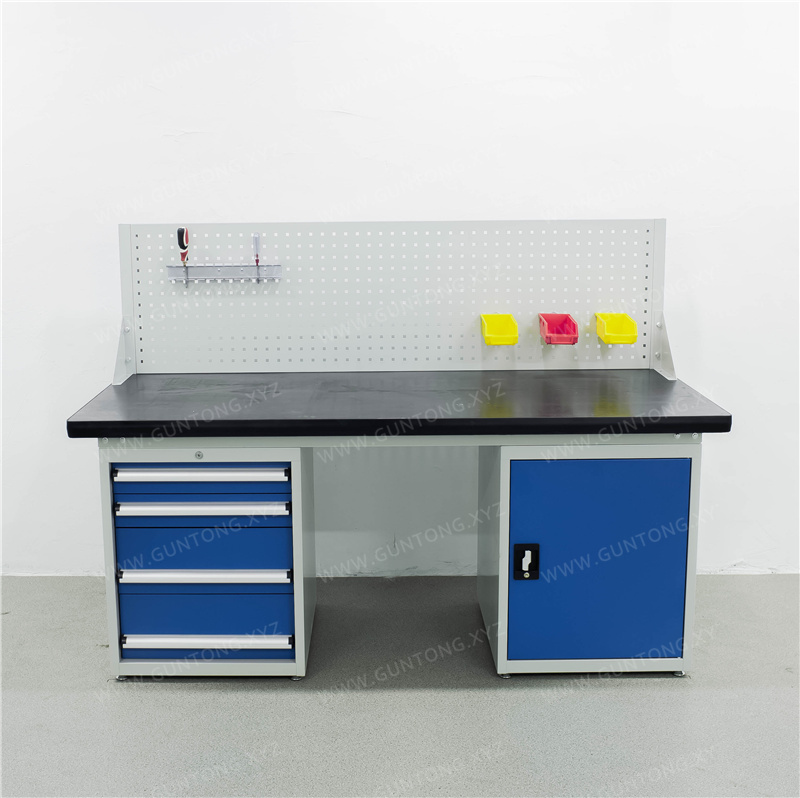
For labs that also need tool storage, Guang'ErMei offers integrated drawer and pegboard configurations. A 4-drawer tiered design, similar to the company's steel plate workbench models, can be adapted in stainless steel for organized reagent and tool storage beneath the work surface. Drawer load capacity in standard models reaches 80 kg per drawer with 85% extension travel.
Cleaning and Maintenance Requirements
Stainless steel lab workbenches require disciplined cleaning to maintain corrosion resistance:
- Daily: Wipe with a neutral pH detergent and microfiber cloth. Avoid chlorine-based cleaners on SUS304 surfaces.
- Weekly: Inspect weld seams and joints for discoloration or pitting. Early detection prevents structural degradation.
- Monthly: Apply a stainless steel passivation solution if the workbench is in a high-humidity or salt-air environment.
Risk boundary: Using abrasive scouring pads or steel wool on stainless steel surfaces creates micro-scratches that trap contaminants and accelerate localized corrosion. Specify cleaning protocols in your lab's SOP before the workbench is installed.
Before, During, and After Adoption: Implementation Checklist
Before Ordering
- Audit your lab's chemical exposure profile and instrument load map.
- Decide between SUS304 and SUS316 based on reagent compatibility.
- Determine whether you need integrated storage (drawers, pegboards, under-shelf) or a clean flat surface.
- Confirm floor conditions and whether leveling feet or anchor bolts are required.
During Delivery and Installation
- Verify material certification (mill test certificate) upon delivery.
- Inspect weld quality: seams should be continuous, smooth, and free of porosity.
- Confirm dimensional tolerances against your lab layout drawing.
- Guang'ErMei provides on-site installation support and workstation planning services, including 6S adaptation for lab environments.
After Installation
- Establish a cleaning schedule aligned with the maintenance guidelines above.
- Train lab staff on prohibited cleaning agents and tools.
- Schedule a 90-day post-installation inspection to check leveling, drawer alignment, and surface condition.
When Stainless Steel Is Not the Right Choice
Not every lab station requires stainless steel. If your environment is dry, with no chemical splash risk, a composite desktop workbench (such as Guang'ErMei's 50mm green composite top models with 1000 kg load capacity) may deliver better value. Anti-static workbenches are preferable for electronics assembly areas where ESD protection is the primary concern. Discuss your specific scenario with the manufacturer to avoid over-specifying materials.
Next Steps
If you are configuring a stainless steel lab workbench for a new or upgraded facility, prepare your chemical exposure list, instrument load map, and dimensional requirements before requesting a quote. Guang'ErMei Precision Components supports custom stainless steel workbench design, production, and installation for manufacturing and testing labs across Guangdong and nationwide.