
Single vs. Double Pegboard Workbenches: Selection and Configuration Guide
The Hidden Cost of the Wrong Pegboard Configuration
In high-mix assembly and maintenance environments, a poorly configured pegboard workbench creates a specific, recurring failure: operators spend excessive time searching for tools, or tools are left on the desktop because the pegboard lacks accessible mounting positions. This is not a discipline problem—it is a configuration mismatch. The decision between a single pegboard and a double pegboard workbench determines whether tools stay organized under real production pressure.
Guang'ErMei Precision Components designs and manufactures both configurations for electronics manufacturers, automotive parts producers, hardware mold factories, and maintenance institutions across Guangdong and nationwide. The following comparison is based on actual workstation deployments and product specifications.
What Defines Single vs. Double Pegboard Workbenches
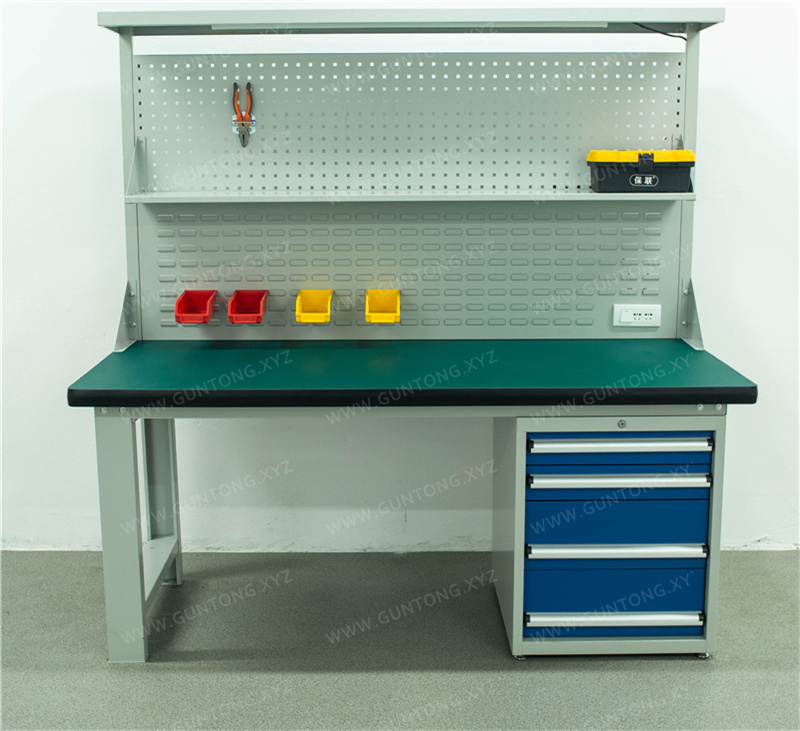
A single pegboard workbench features one vertical panel—typically mounted at the rear of the work surface—with square-hole or round-hole patterns for hanging tools, brackets, and small parts bins. A double pegboard workbench adds a second panel, which may be positioned as an upper extension, a side panel, or a dual-sided configuration for back-to-back operator stations.
Both configurations can be integrated with drawer cabinets, overhead lighting, power rails, and ESD grounding systems. The core difference lies in tool-facing surface area and operator access geometry.
Where Single Pegboard Workbenches Perform Best
Single pegboard workbenches suit scenarios where:
- One operator works per station.*
- A rear-mounted panel keeps all tools within arm's reach without requiring the operator to turn or step aside.
- Tool variety is moderate.*
- Typical applications include electronics assembly with hand tools, soldering stations, or light mechanical repair.
- Ceiling height or overhead clearance is limited.*
- A single panel keeps the workstation profile low, which matters in mezzanine-level workshops or spaces with overhead cranes.
- Budget and floor space are constrained.*
- A single-panel design reduces material cost and footprint while still supporting 6S visual management standards.
For example, a single back panel workbench with a 4-drawer steel plate configuration provides organized tool storage below the desktop and a rear pegboard for frequently used instruments. The C-type cold-rolled steel frame supports heavy-duty total loads, and the raw steel plate composite desktop handles impact-heavy tasks such as fitter work and hardware mold adjustment.
Where Double Pegboard Workbenches Are Necessary
Double pegboard configurations become necessary when:
- Two operators share one bench.*
- A dual-sided pegboard allows each operator to manage their own tool set without interference.
- Tool count is high.*
- Automotive parts maintenance and hardware mold repair often require dozens of wrenches, gauges, and specialty fixtures that a single panel cannot accommodate without overcrowding.
- Tool segregation is required.*
- In maintenance and testing institutions, separating calibration tools from general hand tools on distinct panels reduces cross-contamination and misplacement risk.
- Vertical space is available.*
- Facilities with sufficient ceiling height can accommodate taller pegboard assemblies without obstructing overhead workflows.
Key Comparison Criteria
| Criterion | Single Pegboard | Double Pegboard |
|---|---|---|
| Operator count per station | 1 | 1–2 (depending on layout) |
| Tool capacity (typical) | Moderate tool sets | Large or segregated tool sets |
| Vertical height requirement | Standard profile above desktop | Extended profile |
| Load on frame | Lower; standard frame sufficient | Higher; reinforced uprights recommended |
| ESD integration | Single grounding point | Multiple grounding points required |
| Cost relative to base bench | Lower incremental cost | Higher incremental cost |
| Best-fit scenarios | Electronics assembly, light repair, vocational training | Automotive maintenance, mold repair, shared stations |
Common Configuration Mistakes and How to Correct Them
Mistake 1: Choosing Double Pegboard for Single-Operator Stations
Adding a second panel "for future expansion" often results in unused mounting space that collects dust and obstructs lighting. If current tool counts are moderate and only one operator uses the station, a single pegboard with a well-organized hook layout is more efficient. Expansion can be addressed later by adding a side-mounted auxiliary panel rather than replacing the entire frame.
Mistake 2: Ignoring Drawer and Cabinet Integration
A pegboard alone does not solve tool storage. Small parts, precision instruments, and consumables require enclosed storage. Configuring the workbench with a 4-drawer under-bench cabinet—such as the single back panel single door 4-drawer steel plate workbench—ensures that tools not suited for hanging are stored at the point of use. Drawers in Guang'ErMei's standard configuration feature tiered heights to accommodate different tool sizes and support substantial per-drawer loads.
Mistake 3: Overlooking ESD Requirements in Electronics Applications
In electronics manufacturing, both the pegboard and the desktop must be integrated into the ESD grounding circuit. Anti-static workbenches require conductive surfaces and grounding wires connected to earth. A double pegboard configuration increases the number of grounding contact points that must be verified. Facilities should confirm that the pegboard coating is ESD-compatible and that the frame provides a continuous conductive path.
Mistake 4: Exceeding Frame Load Capacity
Pegboards add weight—especially when loaded with heavy tools like torque wrenches or large fixture clamps. A light-duty workbench frame may not safely support a fully loaded double pegboard plus desktop loads. For heavy-duty applications such as hardware mold repair, specify a heavy-duty frame with C-type cold-rolled steel uprights.
Decision Flowchart: Which Configuration Fits Your Station?
- Count the operators per station. One → single pegboard is sufficient. Two → double pegboard or dual-sided layout.
- Inventory the tools. Moderate count → single panel. High count or segregation needed → double panel.
- Measure vertical clearance. Limited clearance → single panel to avoid obstruction. Ample clearance → double panel is viable.
- Check ESD requirements. If ESD is mandatory, ensure both panels and the desktop are included in the grounding plan.
- Confirm frame load rating. Total load (desktop + pegboard + tools) must remain within the rated capacity with an appropriate safety margin.
Implementation Boundaries and Service Scope
Guang'ErMei Precision Components provides on-site workstation planning, load-bearing design, and 6S adaptation for both single and double pegboard configurations. Standard dimensions include 1500×750×800 mm, 1800×750×800 mm, and 2100×750×800 mm, with custom sizes available for specific production lines. Non-standard customization covers pegboard height, hole pattern (square or round), hook type, and integrated power rail placement.
Service coverage includes manufacturing customers in Huizhou and Guangdong Province, with nationwide delivery and installation support for workstation equipment projects. Full-process after-sales service covers structural warranty, drawer slide replacement, and pegboard accessory replenishment.
Next Steps
If your current workbenches are experiencing tool misplacement, operator congestion, or ESD compliance gaps, the pegboard configuration is a likely root cause. Review your station-level tool inventory and operator count, then compare against the criteria above. For a site-specific assessment—including load calculations and ESD grounding verification—contact Guang'ErMei's engineering team with your floor plan and tool list.