
Pegboard vs Shelf Storage Cabinets: Selection and Configuration Guide
Pegboard vs Shelf Storage Cabinets: Selection and Configuration Guide
The Common Failure: Choosing Storage Without Matching Retrieval Patterns
Many workshops purchase storage cabinets based on available floor space rather than how tools and materials are actually retrieved. The result is cluttered shelves, damaged tools from improper stacking, and wasted time searching for items that should be immediately visible. This mismatch between storage type and retrieval pattern is one of the most frequent causes of workstation inefficiency in manufacturing, maintenance, and warehousing environments.
The decision between pegboard storage cabinets and shelf storage cabinets is not about which is universally better—it is about which configuration aligns with your specific tool types, retrieval frequency, and 6S management requirements.
Understanding the Core Differences
Pegboard Storage Cabinets: Visual Management and Frequent Retrieval
Pegboard storage cabinets integrate perforated panels—typically standard square-hole pegboards—into the cabinet structure. These panels can be positioned on cabinet doors, interior walls, or both, depending on the model configuration.
Key characteristics:
- Tools hang individually on hooks, making each item immediately visible and accessible
- Ideal for hand tools, measuring instruments, and frequently used items
- Supports visual management and 6S compliance through clear tool positioning
- Flexible expansion as tool inventory changes—hooks can be repositioned without modifying the cabinet
Typical applications:
- Maintenance and repair stations where specific tools are needed repeatedly
- Electronics assembly workstations requiring precise instrument access
- Automotive parts maintenance areas with standardized tool sets
Shelf Storage Cabinets: Bulk Storage and Heavy-Duty Capacity
Shelf storage cabinets use adjustable horizontal platforms to store items. These cabinets prioritize load capacity and volume over individual item visibility.
Key characteristics:
- Each shelf typically supports 100 kg load capacity (based on standard configurations)
- Adjustable shelf heights accommodate varying item dimensions
- Suitable for storing boxes, containers, raw materials, and bulky equipment
- Less effective for small, frequently accessed hand tools unless combined with drawer systems
Typical applications:
- Warehousing and logistics areas storing packaged components
- Hardware mold factories keeping spare parts and raw materials
- Vocational training centers storing equipment between classes
Selection Criteria: When to Choose Which
Choose Pegboard Storage Cabinets When:
- Retrieval frequency is high - Tools are needed multiple times per shift
- Visual management is a priority - 6S compliance requires immediate visibility of tool presence and absence
- Tool sets are standardized - Similar tool types across multiple workstations benefit from consistent positioning
- Space is limited - Vertical pegboard use maximizes storage density in narrow aisles
Choose Shelf Storage Cabinets When:
- Items are bulky or heavy - Components, raw materials, or equipment exceeding practical hanging weight
- Retrieval frequency is low - Items accessed weekly or monthly rather than hourly
- Inventory is variable - Storage needs change seasonally or by project
- Container-based storage is used - Parts bins, boxes, or totes require flat surfaces
Configuration Options: Hybrid Solutions
Many workshops benefit from combining both storage types. Guang'ErMei Precision Components offers several hybrid configurations:
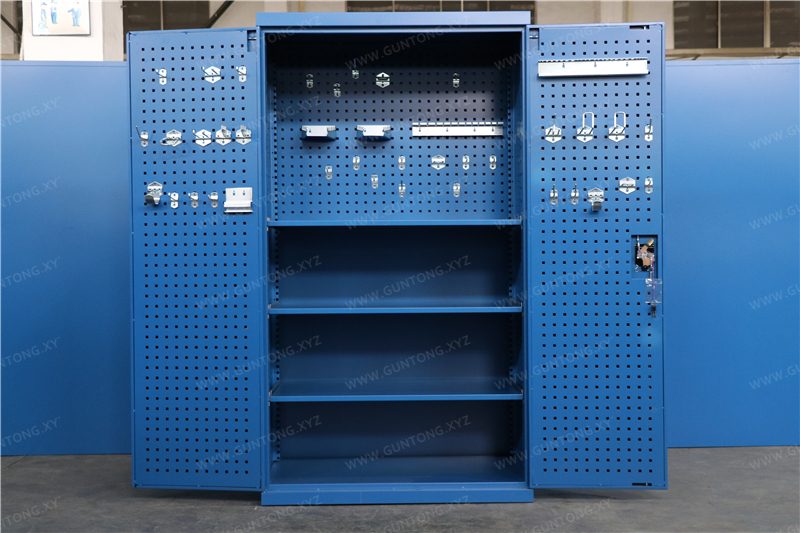
Inner Half-Pegboard Storage Cabinets
This configuration places pegboard panels on the upper interior section and dual pegboard layout on cabinet doors. The lower section uses adjustable shelves for bulk storage. This approach separates high-frequency tools (pegboard) from low-frequency materials (shelves) within a single cabinet footprint.
Specifications example:
- Main body material: cold-rolled steel construction
- Shelf configuration: adjustable shelves with 100 kg load capacity per shelf
- Pegboard: standard square-hole design for flexible hook placement
Drawer-Pegboard Combinations
For workshops requiring both concealed storage and visual tool management, drawer-pegboard combinations offer tiered organization. Drawers store small parts, consumables, or sensitive instruments, while pegboard panels display hand tools.
Example configuration:
- Drawer setup: tiered design for organized storage and retrieval of tools in various sizes
- Drawer load capacity: 80 kg per drawer (based on standard configurations)
- Pegboard integration: Door-mounted or interior panels
- Cabinet body: cold-rolled steel construction
Implementation Boundaries and Risk Factors
Load Capacity Verification
Before specifying any storage cabinet, verify load requirements against manufacturer specifications. Standard shelf configurations support 100 kg per shelf, but actual capacity depends on:
- Shelf material thickness and reinforcement
- Load distribution (concentrated vs. uniform)
- Cabinet frame structural integrity
Risk: Overloading shelves beyond rated capacity can cause permanent deformation or structural failure. Always confirm load ratings with technical drawings before procurement.
Pegboard Hook Compatibility
Not all pegboard systems use standardized hole patterns. Square-hole pegboards (common in industrial applications) require specific hook types different from round-hole or slatwall systems.
Risk: Purchasing incompatible hooks after cabinet installation leads to wasted time and additional procurement costs. Confirm pegboard hole specifications before ordering accessories.
Environmental Considerations
Standard cold-rolled steel cabinets are suitable for most indoor manufacturing environments. However, corrosive environments (chemical processing, outdoor storage, high-humidity areas) may require stainless steel construction.
Stainless steel advantages:
- Resistance to air, steam, water, and weak corrosive media
- Durability in acid, alkali, and salt exposure conditions
- Smooth, safe surface suitable for clean rooms or food processing
Risk: Using standard steel cabinets in corrosive environments accelerates rust and reduces service life. Specify material requirements based on actual environmental conditions.
Decision Checklist for Procurement
Before finalizing storage cabinet specifications, confirm the following:
- [ ] Tool inventory analysis
- - Categorize tools by retrieval frequency and size
- [ ] Retrieval pattern mapping
- - Document how often each tool category is accessed
- [ ] Load requirements
- - Calculate maximum weight per shelf or drawer
- [ ] Space constraints
- - Measure available floor space and ceiling height
- [ ] 6S compliance needs
- - Determine if visual management is required
- [ ] Environmental conditions
- - Assess corrosion, humidity, and temperature factors
- [ ] Future expansion
- - Consider whether tool inventory will grow or change
- [ ] Integration requirements
- - Verify compatibility with existing workstations or storage systems
Next Steps
The choice between pegboard and shelf storage cabinets depends on your specific operational requirements. Guang'ErMei Precision Components provides both standardized products and non-standard customization to match your workshop layout, load-bearing needs, and 6S adaptation requirements.
Recommended actions:
- Conduct a tool inventory and retrieval frequency analysis
- Measure available space and document environmental conditions
- Prepare preliminary specifications including dimensions, load requirements, and configuration preferences
- Contact Guang'ErMei for technical consultation and quotation
Our team supports on-site workstation planning, load-bearing design, and full-process after-sales service from product design and manufacturing through installation and ongoing support.
For technical drawings, custom configurations, or project-specific quotations, contact our engineering team with your requirements. All specifications are confirmed based on final drawings and contracts.