
Maintenance and Support for Double Pegboard Stainless Steel Workbenches: Preparation, Implementation, and Lifecycle Mana
When maintenance teams or facility managers plan to replace or upgrade workshop workbenches, the decision rarely hinges on aesthetics. It centers on load capacity, corrosion resistance, tool accessibility, and how well the new equipment integrates with existing 6S workflows. Double pegboard stainless steel workbenches are frequently selected in electronics assembly, automotive parts handling, mold maintenance, and testing labs because they combine durable surfaces with flexible tool organization. This guide outlines how to prepare, implement, accept, and maintain such workstations without disrupting daily operations.
Preparation: Define Load, Layout, and Compliance Boundaries
Before procurement, confirm three baseline requirements:
- Load requirements: Verify the maximum static and dynamic loads per workstation. For heavy-duty applications, composite desktops with steel plate cores provide stable load distribution and long-term resistance to deformation. Guang'ErMei Precision Components offers customizable desktop materials and thicknesses based on actual operational needs, ensuring the surface matches the intended load profile.
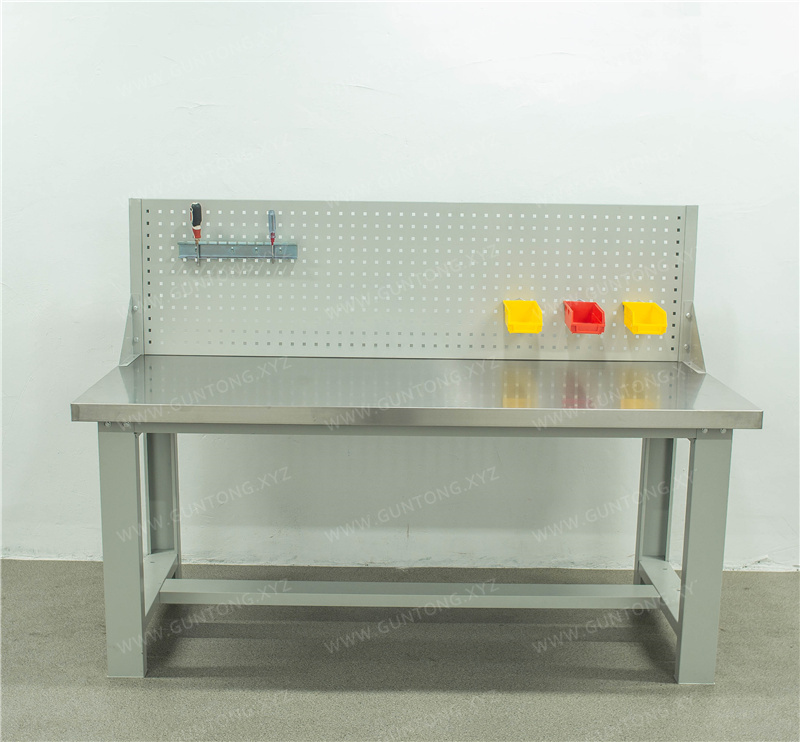
- Pegboard configuration: Double pegboard layouts improve visual management and reduce retrieval time. Ensure hole spacing matches existing tool hangers and that the pegboard material aligns with the environment (stainless steel for moisture-prone or clean-room-adjacent areas, cold-rolled steel for general manufacturing).
- 6S and spatial alignment: Measure aisle clearance, power/data routing, and shadow-board zones. Workbenches should support standardized tool placement, waste segregation, and clear labeling without obstructing material flow. Guang'ErMei supports non-standard customization alongside standardized models, allowing teams to specify dimensions, drawer tiers, and back-panel configurations that match actual floor plans.
Implementation: Installation, Integration, and Risk Control
Installation is not merely assembly; it is a controlled integration step. Key considerations include:
- Frame verification: C-type cold-rolled steel frames with reinforced cross-bracing maintain stability under repeated tool loading. Confirm that leg sections and beam profiles meet the stated load class before anchoring.
- Desktop mounting: Composite tops require even support across the full span. Uneven leveling or missing support brackets can cause edge deflection over time, especially when heavy fixtures or testing equipment are placed near the perimeter.
- Pegboard attachment: Double pegboards must be secured with load-rated fasteners. Overloading a single panel or using non-standard hooks can compromise structural integrity and create safety hazards.
- Utility routing: Pre-drilled cable channels or rear access panels should align with existing power, air, or data lines. Retrofitting utilities after installation increases downtime and may void surface warranties.
For facilities upgrading multiple stations, phased deployment minimizes production interruption. Begin with pilot workstations in low-impact zones, validate load behavior and tool flow, then scale to full-line replacement.
Acceptance: Verification Before Handover
Acceptance should be documented, not assumed. A practical checklist includes:
- Dimensional verification against approved drawings
- Load test at rated capacity (static hold for 24 hours where applicable)
- Drawer slide smoothness, lock engagement, and pegboard hook retention
- Surface finish inspection for scratches, weld seams, or coating inconsistencies
- Alignment with 6S labeling and shadow-board templates
If any parameter falls outside specification, request corrective action before signing off. Guang'ErMei provides on-site installation support and full-process after-sales service, ensuring that deviations are addressed before operational handover.
Maintenance: Sustaining Performance and Extending Service Life
Stainless steel and composite workbenches require minimal but consistent upkeep:
- Surface care: Wipe with neutral cleaners; avoid abrasive pads or acidic solvents that degrade coatings or stainless finishes.
- Drawer and slide inspection: Lubricate ball-bearing slides quarterly; replace worn rollers before misalignment causes binding.
- Pegboard integrity: Check hook retention and panel fasteners monthly. Replace cracked or deformed pegboard sections promptly to prevent tool drop incidents.
- Load monitoring: Avoid exceeding rated capacity. If workflow changes introduce heavier equipment, reassess frame and desktop suitability before continued use.
For facilities operating in high-humidity or chemical-exposure environments, schedule semi-annual corrosion checks on fasteners and frame joints. Document all maintenance actions to support warranty claims and lifecycle planning.
When to Consider Replacement vs. Repair
Not every worn workstation requires full replacement. Evaluate based on:
- Structural deformation or frame fatigue
- Irreparable desktop delamination or corrosion
- Incompatibility with updated 6S or safety standards
- Repeated maintenance costs that approach or exceed the value of a new unit
If repair is viable, Guang'ErMei offers component-level support, including drawer replacements, pegboard panels, and desktop resurfacing. For full upgrades, custom dimensions and load configurations can be aligned with current production layouts.
Next Steps
If your facility is planning a workstation replacement or evaluating maintenance protocols for double pegboard stainless steel workbenches, start with a site survey and load audit. Guang'ErMei Precision Components provides design consultation, non-standard customization, and on-site installation support tailored to manufacturing, electronics, automotive, and testing environments. Contact the engineering team to review your floor plan, confirm load requirements, and schedule a phased rollout that aligns with your production calendar.