
Double Pegboard Stainless Steel Workbench: Technical Principles and Cost-Value Selection Guide
Why Material Structure Matters Before You Compare Prices
When procurement teams evaluate a double pegboard stainless steel workbench, the first instinct is often to compare unit prices. In practice, the real cost drivers sit inside the technical parameters: desktop composite structure, frame load path, pegboard mounting logic, and drawer rail specification. Understanding these principles first prevents under-specification in heavy-use environments and over-specification where a simpler configuration would deliver the same operational value.
A stainless steel top workbench with dual pegboard configuration is typically chosen for environments that require frequent tool access, corrosion resistance, and visual management. The "double pegboard" layout usually means one rear panel and one side or inner-door panel, giving operators two distinct zones for tool shadowing, hook placement, or fixture mounting. This is not a cosmetic upgrade — it directly affects retrieval time, 6S compliance, and the need for secondary storage furniture nearby.
Core Technical Parameters and What They Actually Mean
Desktop Composite Structure
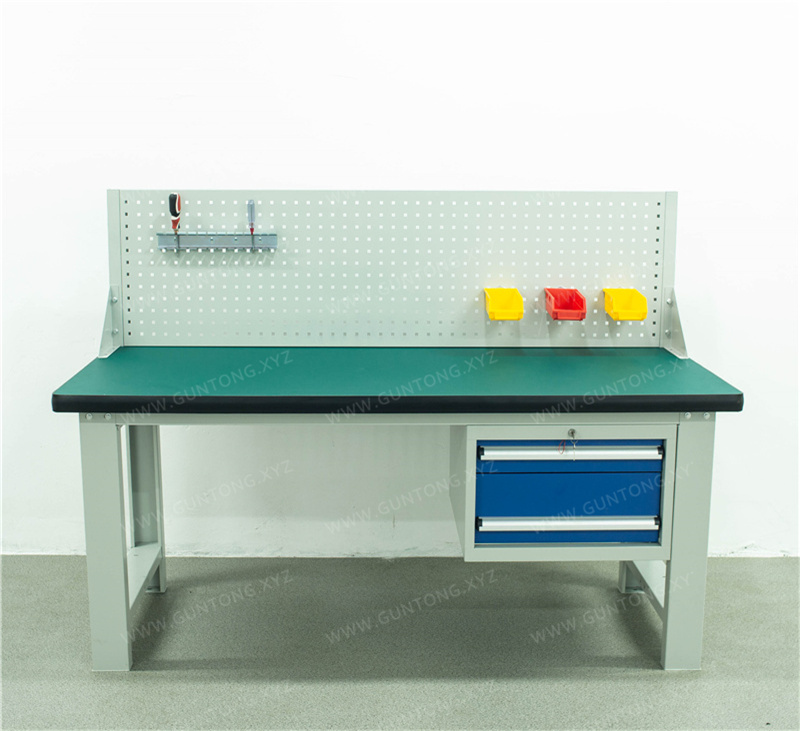
In Guang'ErMei's product line, composite desktops such as the Single Back Panel Single Door 4-Drawer Steel Plate Workbench use a layered structure: a 5 mm raw steel plate bonded to a 45 mm high-density fiberboard core, finished with black PVC edge banding. The steel plate provides surface hardness, spark resistance, and load distribution; the fiberboard core dampens vibration and reduces overall weight compared to a solid steel slab. This composite approach is what allows a total frame load capacity of around 1,000 kg while keeping the desktop thick enough to resist bending under concentrated loads.
For stainless steel variants, the surface layer is replaced with stainless sheet, which shifts the value proposition toward hygiene, chemical resistance, and long-term surface integrity — particularly relevant in electronics assembly, food-adjacent maintenance, or humid warehouse zones.
Frame and Load Path
Guang'ErMei's standard workbench frames use C-type cold-rolled steel sections, typically in a 100 × 50 × 1.5 mm profile. The C-channel geometry gives high moment of inertia in the vertical direction, which is where workbench legs experience the highest bending stress. When a workbench is rated for 1,000 kg overall load, that figure assumes the load is distributed across the desktop rather than concentrated on a single corner. Buyers should clarify with the manufacturer whether the rating is per leg, per shelf, or total system load.
Drawer and Pegboard Integration
A double pegboard stainless steel workbench often integrates drawers beneath the work surface. In Guang'ErMei's configurations, drawer modules use single-rail or dual-rail slide systems with per-drawer load ratings around 80 kg, and drawers can typically open to about 85% of their depth. The pegboard itself is commonly a 500 mm standard square-hole panel, compatible with a wide ecosystem of hooks, bins, and tool holders. The dual-pegboard layout allows separation between high-frequency tools (rear panel, at eye level) and secondary items or WIP holders (side or door-mounted panel).
Connecting Parameters to Cost and Value
Initial Cost Drivers
The unit price of a custom double pegboard stainless steel workbench is driven by:
- Desktop material grade and thickness
- — stainless sheet cost scales with grade (e.g., 201 vs. 304) and gauge.
- Frame section size and welding process
- — heavier C-channel and continuous welds increase material and labor cost but improve long-term rigidity.
- Pegboard quantity and mounting hardware
- — a second pegboard adds panel cost, additional brackets, and assembly time.
- Drawer module count and rail type
- — each added drawer increases cost; heavy-duty rails cost more than light-duty.
Lifecycle Value Drivers
Where the cost equation shifts in favor of a higher-spec workbench is in lifecycle value:
- Reduced replacement frequency
- — a composite or stainless desktop in a 1,000 kg-rated frame can outlast lighter alternatives by years in continuous production use.
- Lower secondary storage cost
- — integrated drawers and dual pegboards reduce the need for separate tool carts or wall-mounted panels nearby.
- Faster operator workflow
- — dual pegboard zones cut retrieval steps, which compounds across shifts and headcount.
- 6S and audit readiness
- — shadow boards and labeled pegboard zones support visual management standards without additional retrofitting.
Selection Criteria for Different Environments
| Environment | Priority Parameters | Recommended Configuration Focus |
|---|---|---|
| Electronics / appliance assembly | ESD control, clean surface, light-to-medium load | Anti-static or stainless top, single pegboard may suffice |
| Automotive parts / hardware mold | High point load, heavy tooling, oil resistance | 5 mm steel plate composite or stainless, double pegboard, heavy-duty drawers |
| Maintenance and testing institutions | Corrosion resistance, flexible tool mounting | Stainless top, dual pegboard, medium-duty drawers |
| Vocational training centers | Durability under varied use, visual teaching aids | Composite or stainless top, double pegboard for demo zones |
| Warehousing and logistics | High turnover, tote handling, rough use | Reinforced frame, steel plate top, pegboard for packing tools |
Implementation and Delivery Boundaries
Guang'ErMei provides end-to-end service from design and manufacturing to on-site installation and after-sales support. Standard dimensions for composite workbenches include 1500 × 750 × 800 mm, 1800 × 750 × 800 mm, and 2100 × 750 × 800 mm. Non-standard sizes, pegboard positions, drawer layouts, and frame reinforcements are available through the customization process.
Key delivery boundaries to confirm before ordering:
- Load rating basis
- — confirm whether the stated capacity is total system load or per-component.
- Pegboard hole standard
- — ensure compatibility with existing hooks and accessories (500 mm square-hole is standard).
- Surface treatment
- — powder coating color and thickness should match facility 6S standards.
- Installation scope
- — clarify whether on-site assembly, leveling, and anchoring are included.
Next Steps
If your facility is evaluating a double pegboard stainless steel workbench for production, maintenance, or training use, the most efficient path is to share your load requirements, available floor space, and tool inventory with the Guang'ErMei engineering team. A configuration review based on actual use conditions will produce a more accurate cost-value picture than comparing catalog prices alone.
For product details, customization options, or to request a site-specific layout proposal, contact Guang'ErMei Precision Components directly.
In addition to the structural considerations already discussed, Guang'ErMei's product line offers several standardized configurations that illustrate how technical parameters translate into operational value. For example, the Composite Top Three-Drawer Workbench uses 100 × 50 × 1.5 mm C-type steel legs paired with a 50 mm thick green composite desktop, delivering an overall load capacity of 1,000 kg while keeping the frame lightweight enough for flexible floor layout. The drawers ride on single-rail slides that allow 85% extension, with each drawer rated at 80 kg — a specification that directly supports 6S tool-shadowing workflows without requiring secondary storage cabinets nearby. Similarly, the Composite Top Four-Drawer Pegboard Workbench combines the same 1,000 kg frame capacity with a rear pegboard panel, giving operators both drawer-based storage for heavier items and pegboard-based visual management for frequently used hand tools. These standardized models, available in 1,500 × 750 × 800 mm, 1,800 × 750 × 800 mm, and 2,100 × 750 × 800 mm footprints, demonstrate that cost-value selection should start from the actual load path and drawer specification rather than from unit price alone.