
Implementation Process for a Single Pegboard 3-Drawer Composite Workbench: From Workflow Diagnosis to On-Site Deployment
Symptom: Workstation Deployment Fails to Deliver Expected Efficiency Gains
In electronics assembly lines, automotive parts testing stations, and vocational training workshops, operators often report that despite installing a new workbench, tool retrieval remains slow, surfaces stay cluttered, and 6S audits consistently flag disorganization. The issue is rarely the workbench itself—it is a misalignment between the workstation configuration and the actual workflow sequence.
A single pegboard 3-drawer composite workbench is frequently selected for its balance of vertical tool visibility and horizontal storage capacity. But when implemented without diagnosing the underlying workflow, even a well-built unit fails to deliver expected efficiency gains.
Cause: Three Common Root Failures in Workstation Implementation
1. Storage Logic Does Not Match Task Frequency
Operators reach for the same 5–8 tools dozens of times per shift. If these tools are stored in drawers instead of on the pegboard, or if the pegboard layout ignores ergonomic reach zones, retrieval time compounds across shifts. The single pegboard on a 3-drawer composite workbench is designed for high-frequency, visually managed tools—misplacing them into drawers defeats the purpose.
2. Load Capacity and Desktop Material Are Under-Specified
Composite desktops—typically 50mm thick green composite structures—are engineered for a total load capacity of 1,000 kg, with C-type cold-rolled steel legs (100×50×1.5 mm). When a workstation is placed in a hardware mold or heavy assembly environment but specified with a lighter-duty frame or thinner desktop, deformation and surface damage occur within months. The composite desktop is not a universal solution; it must be matched to the actual load profile.
3. Drawer Configuration Ignores Component Size Variation
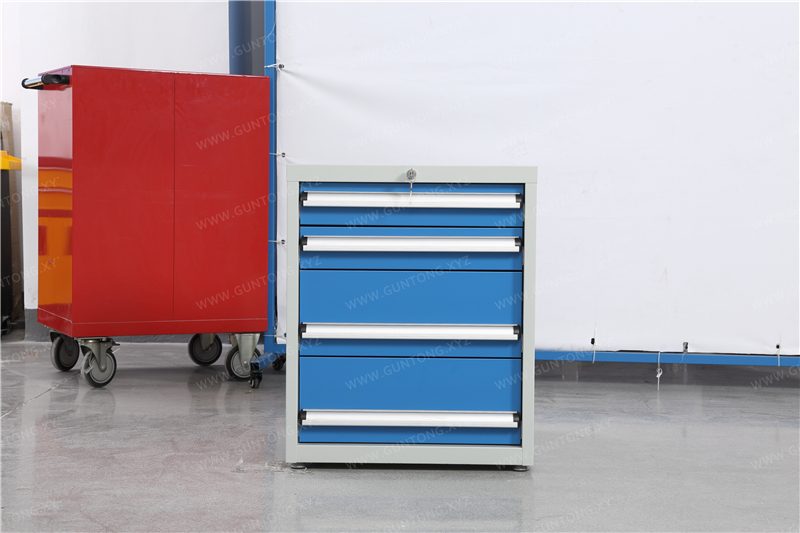
The 3-drawer horizontal configuration on a composite workbench typically uses single-rail slides allowing 85% drawer extension, with each drawer rated at 80 kg. If the workshop stores large fixtures or bulky test jigs that exceed drawer depth or width, operators leave them on the desktop—defeating the storage intent. Drawer height and internal dividers must be validated against actual tool dimensions before procurement.
Checks: How to Verify Before Deployment
Before committing to a single pegboard 3-drawer composite workbench layout, conduct the following checks:
- Task frequency mapping: List the top 10 tools used per shift. Confirm that at least 6–8 of them can be mounted on a standard 500 mm square-hole pegboard within arm's reach.
- Load audit: Measure the maximum static and dynamic load on the desktop during peak operations. Confirm it stays within the 1,000 kg total capacity and that point loads do not exceed desktop material limits.
- Drawer content validation: Weigh and measure the largest items intended for drawer storage. Verify they fit within the drawer's internal dimensions and do not exceed the 80 kg per-drawer rating.
- Spatial flow check: Confirm that the workbench footprint (common sizes: 1500×750×800 mm, 1800×750×800 mm, 2100×750×800 mm) aligns with the aisle width, operator movement path, and adjacent equipment placement.
Resolution: Implementation Boundaries and Configuration Guidance
When the above checks confirm fit, the implementation follows a clear sequence:
- Pegboard zoning: Assign the upper two-thirds of the pegboard to high-frequency hand tools using shadow foam or labeled hooks. Reserve the lower third for less frequent items or temporary staging.
- Drawer tiering: Use the top drawer for small, high-turnover items (calipers, Allen keys, connectors); the middle drawer for medium components; the bottom drawer for heavier or bulkier items. Install internal dividers to prevent mixing.
- Desktop protection: For environments involving soldering, light grinding, or chemical exposure, add a protective mat or stainless steel overlay to the composite surface to extend service life.
- 6S integration: Label each drawer, pegboard zone, and shelf. Include a daily checklist at the workstation for tool return verification.
If the load audit reveals requirements beyond 1,000 kg, or if the tool profile requires more than three drawers or a double pegboard layout, the single pegboard 3-drawer composite configuration is not the correct starting point. Escalate to a heavy-duty steel plate workbench or a custom-configured unit with expanded drawer modules.
Escalation Boundary: When to Move Beyond Standard Configuration
The single pegboard 3-drawer composite workbench is a strong baseline for electronics, light automotive, maintenance, and training environments. However, it reaches its limit when:
- Desktop load consistently exceeds 1,000 kg or involves heavy impact.
- Tool variety requires more than 12 pegboard positions or more than three drawer tiers.
- The environment demands anti-static, chemical-resistant, or cleanroom-grade surfaces.
- Spatial constraints require non-standard dimensions outside the 1500–2100 mm length range.
In these cases, non-standard customization—supported by Guang'ErMei's dual capability in standardized production and custom engineering—becomes necessary. The implementation process then shifts from selection to collaborative design, including on-site measurement, load-bearing calculation, and 6S adaptation planning.
Next Steps
If your facility is evaluating workstation upgrades for manufacturing, testing, or training environments, begin with the diagnostic checks above. Document your task frequency, load profile, and spatial constraints before requesting a quotation. Guang'ErMei Precision Components supports full-chain service from design and manufacturing to on-site installation and after-sales, covering standardized and custom workstation solutions across Guangdong and nationwide.
Contact our technical team with your workflow profile to determine whether a single pegboard 3-drawer composite workbench is the right fit—or whether a heavier, wider, or more specialized configuration is required.