
How Worktop, Frame, and Accessories Impact Industrial Workbench Pricing
Manufacturing buyers evaluating industrial workbenches often encounter a wide price range across seemingly similar products. The variation is rarely arbitrary. It reflects specific configuration choices in worktop composition, frame engineering, and integrated accessories. Understanding these cost drivers helps procurement teams and workshop managers make informed decisions without over-specifying or under-investing.
This guide examines the primary factors affecting industrial workbench prices, using real product configurations from Guang'ErMei Precision Components as reference points. The focus is on practical trade-offs relevant to electronics manufacturers, automotive parts producers, hardware mold factories, and maintenance facilities.
Step 1: Evaluate Worktop Material and Structure
The worktop is the most visible cost variable in any workbench configuration. Material selection directly determines load tolerance, surface durability, and suitability for specific workshop environments.
Composite desktop configurations represent a common mid-range option. A typical setup uses a 50mm thick green composite desktop paired with a C-type cold-rolled steel frame. This combination supports an overall load capacity of 1000kg while keeping material costs moderate. Composite desktops suit general assembly, packaging, and light machining tasks.
Steel plate worktops occupy a higher price tier. For example, a 5mm raw steel plate bonded to high-density fiberboard with black PVC edge banding delivers superior impact resistance and longevity. This configuration is standard in heavy-duty fitter workbenches where tools, dies, or metal components are regularly placed on the surface. The added material cost is justified in environments with high mechanical wear.
Stainless steel worktops command a premium due to material cost and fabrication requirements. They are necessary in cleanroom-adjacent electronics assembly, food-grade packaging lines, or chemical exposure scenarios. Buyers should confirm whether the stainless steel grade (e.g., 304 vs. 201) matches their corrosion resistance requirements before accepting a quote.
Checkpoint: Match worktop material to actual surface wear conditions. A composite desktop is sufficient for 80% of general assembly tasks. Upgrading to steel plate or stainless steel should be driven by documented wear patterns or compliance requirements, not assumptions.
Step 2: Assess Frame Design and Load Capacity
The frame determines structural integrity and long-term stability. Frame specifications are a significant cost driver, particularly when load requirements exceed standard thresholds.
Most standard industrial workbenches use 100×50×1.5mm C-type cold-rolled steel for the legs and cross-members. This profile supports a total load capacity of 1000kg across common dimensions (1500×750×800mm, 1800×750×800mm, or 2100×750×800mm). This specification covers the majority of workshop applications, from electronics assembly to hardware mold maintenance.
When load requirements exceed 1000kg, or when the workbench must support heavy bench vises, press tools, or large dies, the frame must be upgraded. Options include thicker gauge steel, reinforced cross-bracing, or additional leg supports. Each upgrade adds material and fabrication cost.
Exception: A workbench rated for 1000kg total load does not automatically support 1000kg of concentrated point load. Buyers should specify whether the load is evenly distributed or concentrated at specific points (e.g., a 200kg vise mounted at one end). This distinction affects frame engineering and pricing.
Checkpoint: Calculate the actual maximum load, including tools, workpieces, and any mounted equipment. Add a 20% safety margin. If the result is under 1000kg, a standard C-type steel frame is typically sufficient and cost-effective.
Step 3: Factor in Drawer, Cabinet, and Accessory Configuration
Accessories transform a basic work surface into an organized workstation. However, each addition affects the final price through material, hardware, and assembly labor.
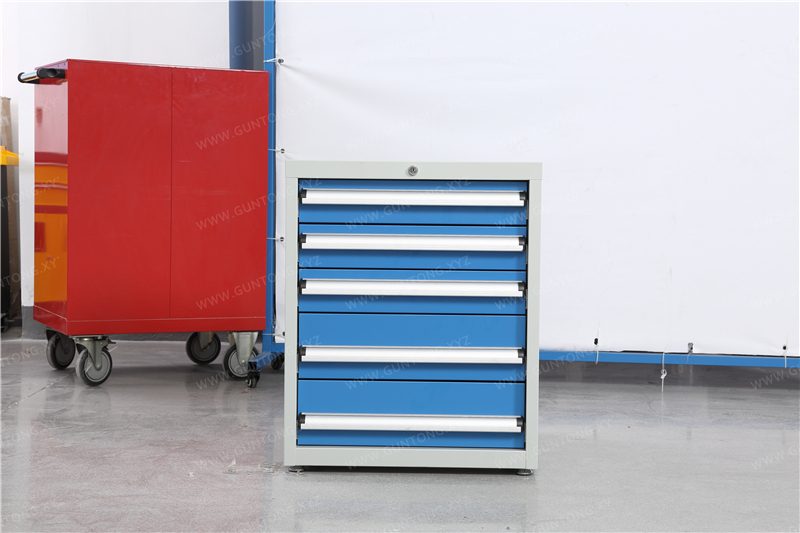
Drawer modules are among the most common accessories. A typical configuration includes horizontal drawers with single-track slides, each supporting 80kg and opening to 85% of full extension. A three-drawer or four-drawer module adds measurable cost but significantly improves tool organization and retrieval efficiency. Drawer panel thickness (commonly 1.0mm or 1.2mm cold-rolled steel) and slide mechanism quality are key price differentiators.
Pegboards and hanging panels offer a lower-cost alternative for tool storage. A square-hole pegboard mounted above the workbench provides flexible hook placement for hand tools, measuring instruments, and small fixtures. Inner half-pegboard storage cabinets combine shelf load capacity (100kg per shelf) with door-mounted pegboard panels, offering a hybrid solution for workshops implementing 6S management.
Tool cabinets integrated into the workbench frame represent a higher investment. A four-drawer tool cabinet with tiered drawer heights (e.g., 100mm and 200mm) allows categorized storage of tools by size and frequency of use. This configuration is common in automotive parts maintenance and hardware mold factories where tool variety is high.
Checkpoint: Prioritize accessories based on daily workflow. If operators frequently retrieve tools from a shared cabinet across the workshop, an integrated drawer module pays for itself in reduced walk time. If tool variety is low, a pegboard may be sufficient.
Step 4: Consider Non-Standard Customization Costs
Standard workbench dimensions (1500mm, 1800mm, and 2100mm lengths) benefit from production efficiency and lower unit costs. Non-standard customization introduces additional expenses in design, tooling, and production scheduling.
Common customization requests include:
- Non-standard dimensions for tight workshop layouts or specific production line integration
- Specialized desktop materials such as anti-static surfaces for electronics assembly or chemical-resistant laminates
- Integrated power and air supply channels within the frame
- Lean pipe connections for modular workstation expansion
Guang'ErMei Precision Components supports both standardized production and non-standard customization, with on-site workstation planning and load-bearing design services. Buyers requesting customization should provide detailed layout drawings and load specifications to receive accurate quotations.
Exception: Customization does not always increase cost. In some cases, removing unnecessary accessories from a standard model reduces the price more effectively than seeking a cheaper standard alternative.
Step 5: Account for Delivery, Installation, and After-Sales Service
The quoted product price is only one component of total acquisition cost. Delivery distance, on-site installation complexity, and after-sales service terms affect the final budget.
For manufacturing customers in Huizhou and Guangdong Province, local delivery and installation are typically straightforward. Nationwide project delivery is supported, but logistics costs vary by destination and order volume.
Installation complexity increases with integrated accessories, multi-bench workstation layouts, and lean pipe connections. Professional installation ensures frame alignment, drawer slide calibration, and load-bearing verification.
Next Action: When requesting a quotation, specify the delivery address, installation requirements, and expected timeline. This allows the supplier to provide a comprehensive quote that includes all cost components.
Decision Summary
| Configuration Factor | Cost Impact | Typical Use Case |
|---|---|---|
| Composite desktop (50mm) | Baseline | General assembly, packaging |
| Steel plate desktop (5mm + fiberboard) | Moderate increase | Heavy fitter work, metal component handling |
| Stainless steel desktop | Significant increase | Cleanroom, food-grade, chemical exposure |
| Standard C-type steel frame (1000kg) | Baseline | Most workshop applications |
| Reinforced frame (>1000kg) | Moderate increase | Heavy dies, press tools, concentrated loads |
| Drawer modules (3 or 4 drawers) | Moderate increase | High tool variety, frequent retrieval |
| Pegboard panels | Low increase | Visual tool management, 6S implementation |
| Non-standard dimensions | Variable | Tight layouts, production line integration |