
How to Determine the Number of Workbench Drawers: A Decision Framework for Workshop Buyers
Objective: Right-Size Drawer Storage for Your Workstation
Manufacturing facilities, electronics assembly lines, and maintenance workshops face a common procurement question: how many drawers does a workbench actually need? Over-specifying leads to wasted floor space and unnecessary cost. Under-specifying forces operators to store tools on open shelves or in remote cabinets, increasing retrieval time and 6S compliance risks.
This guide helps workshop planners and procurement managers determine whether a 2-drawer, 3-drawer, or 4-drawer workbench configuration best fits their operational reality—based on tool quantity, weight requirements, and workflow patterns.
Alternatives: Comparing 2, 3, and 4 Drawer Configurations
2-Drawer Workbenches: Lean Tool Environments
A 2-drawer setup suits workstations where operators use a limited, repeatable set of hand tools—typically fewer than 30 items. Common applications include:
- Electronics assembly benches where soldering irons, tweezers, and multimeters are the primary tools
- Inspection stations with calipers, gauges, and magnification equipment
- Light packaging or testing areas with minimal tool changeover
Guang'ErMei's composite top 2-drawer workbenches use 100×50×1.5mm C-type cold-rolled steel legs and a 50mm thick green composite desktop, supporting an overall load capacity of 1000 kg. The two drawers are mounted in a suspended cabinet configuration, keeping the under-bench area clear for legroom or foot-operated equipment.
Best for: Facilities prioritizing open workspace over enclosed storage, or where most tools hang on overhead pegboards.
3-Drawer Workbenches: Balanced Storage for General Workshops
The 3-drawer horizontal configuration is the most widely deployed format in general manufacturing and hardware mold workshops. It accommodates a moderate tool inventory—roughly 30 to 60 items—organized by category across three tiers.
Key specifications from Guang'ErMei's 3-drawer composite workbench:
- Drawer rail type: Single-track, stamped steel rails
- Drawer opening: 85% extension for full access to rear-stored items
- Per-drawer load capacity: 80 kg
- Overall bench load capacity: 1000 kg
- Standard dimensions: 1500×750×800mm, 1800×750×800mm, or 2100×750×800mm
The three-drawer layout allows operators to separate fasteners, cutting tools, and measuring instruments into dedicated tiers—reducing cross-contamination and search time.
Best for: Automotive parts workshops, hardware mold factories, and vocational training centers where operators manage a varied but predictable tool set.
4-Drawer Workbenches: High-Density Tool Management
When a workstation serves multiple product variants or requires frequent tool changeovers, a 4-drawer configuration provides the density needed to keep all equipment within arm's reach. This is common in:
- Maintenance and repair bays with extensive socket sets, wrenches, and diagnostic tools
- Multi-shift operations where each shift maintains a dedicated tool set
- Automotive parts turnover stations requiring specialized fixtures alongside standard hand tools
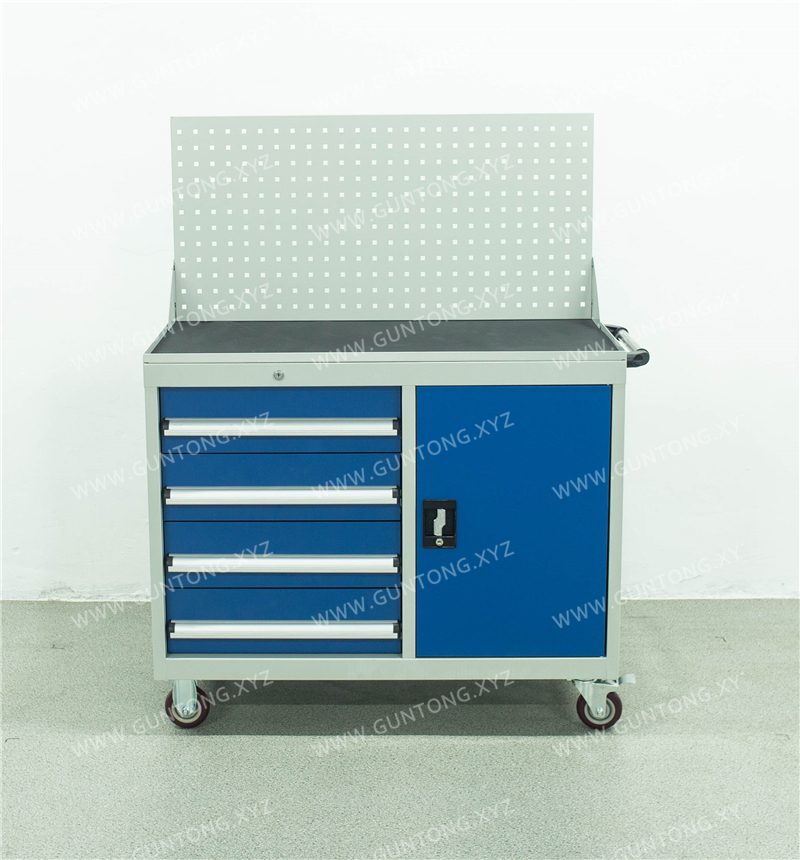
Guang'ErMei's 4-drawer workbenches with pegboard integration combine enclosed drawer storage with a square-hole pegboard back panel for hanging tools. Drawer heights are typically configured as 100mm × 2 and 200mm × 2, allowing separation of small precision tools from bulkier items. Each drawer supports 80 kg on stamped rails, and the overall bench maintains a 1000 kg load rating.
Best for: Maintenance institutions, automotive assembly support stations, and any environment where tool count exceeds 60 items per operator.
Evidence: How to Audit Your Actual Drawer Needs
Before selecting a configuration, conduct a simple workstation audit:
Step 1 — Inventory current tools. Count every item an operator needs within immediate reach. Include hand tools, measuring instruments, fastener bins, and personal protective equipment stored at the bench.
Step 2 — Classify by size and weight. Separate items into three tiers: small (under 500g, such as screwdrivers and gauges), medium (500g–2kg, such as wrench sets), and heavy (over 2kg, such as power tools or fixture clamps).
Step 3 — Map retrieval frequency. Tools used in every cycle belong in the top drawer or on the pegboard. Tools used per batch or per shift can occupy lower drawers. Rarely used items should move to a remote tool cabinet.
Step 4 — Match to drawer configuration.
| Tool Count | Weight Profile | Recommended Configuration |
|---|---|---|
| Under 30 items | Mostly small/light | 2-drawer workbench |
| 30–60 items | Mixed sizes | 3-drawer horizontal workbench |
| 60+ items | Includes heavy tools | 4-drawer workbench with pegboard |
Recommendation: Start With Workflow, Not Furniture
The number of drawers is ultimately a function of how your operators work—not a standalone product decision. Facilities implementing 6S management should treat drawer configuration as part of the broader workstation visual management system. Guang'ErMei supports this by offering workbenches in standardized dimensions (1500mm, 1800mm, and 2100mm lengths) with customizable drawer counts, pegboard integration, and composite or steel plate desktop options.
For non-standard requirements—including anti-static surfaces for electronics manufacturing or stainless steel tops for cleanroom-adjacent environments—custom configurations are available with on-site workstation planning and load-bearing design support.
Boundaries and Considerations
- Drawer load limits are per-drawer, not cumulative. An 80 kg per-drawer rating does not mean the bench frame can support 320 kg of drawer contents plus desktop loads simultaneously. Always verify overall frame capacity.
- Drawer extension matters. An 85% opening ratio means the rear 15% of the drawer remains inside the cabinet. Plan tool placement accordingly.
- Floor leveling is a prerequisite. Uneven floors cause drawer binding and rail wear. Confirm floor flatness before installation.
- Anti-static requirements change the equation. If your environment requires ESD-safe workbenches, drawer slides and desktop materials must both meet static dissipation standards—this may limit configuration options.
Next Steps
If you are planning a workstation rollout or replacing aging benches, start by documenting your tool inventory per station. Guang'ErMei provides on-site workstation planning, load-bearing design, and full-process delivery from manufacturing through installation. Contact the team with your station count, tool audit results, and facility layout to receive a configuration recommendation tailored to your production environment.