
Evaluating Cost and Value in Double Pegboard Stainless Steel Workbenches: Configuration and Lifecycle ROI
Concrete Scenario: Balancing Mobility and Fixed Storage in High-Frequency Assembly Lines
In electronics assembly, automotive parts inspection, and hardware mold maintenance, technicians frequently move between stations while requiring immediate access to calibrated tools and fasteners. The core operational goal is minimizing search time and preventing tool loss without sacrificing workspace stability. When evaluating a double pegboard stainless steel workbench alongside mobile tool carts, the decision hinges on total cost of ownership rather than upfront purchase price. Fixed workbenches anchor repetitive tasks and support heavy fixtures, while mobile units bridge gaps between stations. Understanding where each asset belongs prevents over-engineering and controls capital expenditure.
Goals, Constraints, and Material Choices
The primary constraint in high-throughput workshops is environmental wear combined with strict load requirements. Stainless steel workbenches offer superior corrosion resistance and hygiene, making them ideal for wash-down zones or chemical-exposed testing areas. However, the added material cost must be justified by lifecycle durability. For general machining or dry assembly, composite desktops provide a more cost-effective baseline. Our standard composite configuration pairs a 5mm raw steel plate base with a 45mm high-density fiberboard surface, finished with black PVC edge banding to resist moisture ingress. Both options utilize a C-type cold-rolled steel frame engineered for a total load capacity of up to 1000 kg, ensuring structural integrity under dynamic stress.
When selecting between single and double pegboard layouts, value depends on vertical storage density and retrieval ergonomics. A double pegboard arrangement maximizes wall space for hanging jigs, torque wrenches, and measuring instruments, reducing desktop clutter. Conversely, single pegboard models paired with tiered drawers optimize horizontal reach for frequently used consumables. The choice should align with your station’s footprint and operator posture standards.
Implementation Boundaries: Drawer Mechanics, Casters, and Load Distribution
Mobile tool storage introduces distinct mechanical constraints. Standard four-drawer tool carts typically feature a 500 mm pegboard extension and operate within a 1000 × 500 × 850 mm footprint. Each drawer is rated for approximately 80 kg, utilizing stamped or channel guide rails that allow roughly 85% extension. For heavier components, switching to reinforced channel rails or distributing weight across lower drawers prevents rail deformation and maintains smooth operation. Caster selection is equally critical; standard configurations include two fixed wheels and two swivel wheels with braking mechanisms. If your flooring contains seams or slopes, upgrading to industrial-grade polyurethane casters reduces vibration transfer to sensitive workpieces and extends bearing life.
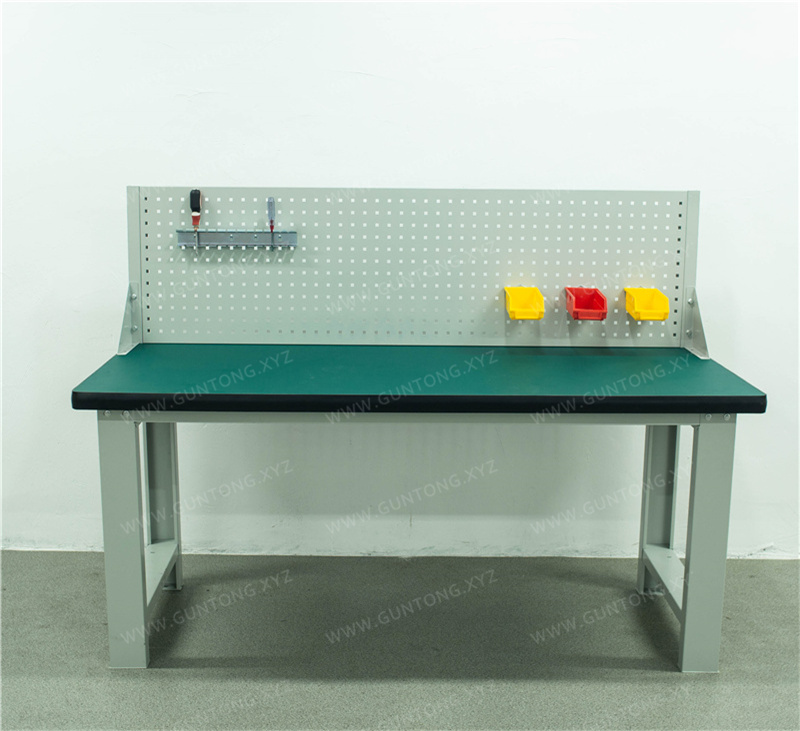
For stationary storage, the division of labor between drawer cabinets and shelf cabinets dictates long-term usability. Drawer units excel at organizing small hardware, calibration tools, and electronic components, leveraging the 80 kg per-drawer limit for balanced weight distribution. Open shelf or pegboard storage cabinets handle bulkier items, with adjustable shelves rated at 100 kg per tier. Mixing these formats according to item size and retrieval frequency creates a predictable 6S environment where every tool has a designated zone.
Customization Workflow and Acceptance Criteria
Non-standard workstation projects require precise input to avoid costly rework. The design phase begins with submitting your workshop layout, maximum expected point loads, and specific usage scenarios. Our engineering team translates these parameters into a three-dimensional configuration sheet, detailing frame gauge, desktop composition, pegboard placement, and accessory mounting points. Typical custom fabrication runs between seven and ten working days, depending on complexity, while standard inventory items ship within two to three days. All manufactured units carry a three-year warranty covering structural and mechanical components.
Acceptance criteria should be verified before final payment. Confirm that welded joints are fully penetrated and ground smooth, verify that drawer slides extend without binding, and test caster brakes under loaded conditions. For stainless steel variants, inspect surface finish consistency and confirm whether 201-grade cladding meets your corrosion resistance requirements. Document all deviations against the approved drawing to maintain traceability.
Conclusion and Next Steps
Evaluating cost and value in double pegboard stainless steel workbenches requires matching material specifications, structural ratings, and storage configurations to actual shop floor demands. Over-specifying leads to unnecessary capital outlay, while under-specifying accelerates replacement cycles. By defining your mobility needs, load thresholds, and 6S visual management goals upfront, you can select a workstation system that delivers measurable productivity gains.
To initiate a project-specific evaluation, share your current station layout and anticipated tool inventory. Our technical team will provide a tailored configuration proposal, including dimensional validation and load verification, aligned with your operational budget and timeline.