
Drawer Load Capacity and Shelf Ratings Across Workstation Product Lines: A Technical Specification Guide
Who Needs to Understand Drawer and Shelf Load Ratings
Procurement managers, workshop planners, and maintenance supervisors in manufacturing, electronics assembly, automotive parts, hardware mold, and warehousing environments regularly face a common question: can this drawer or shelf actually support the tools and parts we plan to store?
Misreading load ratings is one of the most frequent causes of premature drawer rail failure, shelf deflection, and workstation instability. The risk increases when buyers assume that a single "total load capacity" number applies uniformly to every drawer, shelf, or accessory across a product line.
This guide clarifies how drawer load capacity and shelf ratings work across Guang'ErMei Precision Components' workstation product lines, what signals to watch for, and how to match specifications to actual workshop conditions.
How Load Ratings Are Structured Across Product Lines
Tool Cabinets with Drawers
In heavy-duty tool cabinet configurations, drawer load capacity is specified per drawer, not as a shared pool. For example, certain 4-drawer tool cabinet models specify an 80 kg per-drawer rating. This means each drawer can independently support up to 80 kg when the load is evenly distributed across the drawer interior.
Key signals to verify:
- Per-drawer vs. total rating: Confirm whether the stated capacity applies to each drawer individually or to the entire cabinet.
- Load distribution: Concentrated loads (e.g., a single heavy vise placed in one corner) create higher stress than evenly distributed loads of the same total weight.
- Rail and guide type: Drawer rail specification directly determines usable load capacity. Heavier loads require reinforced rail systems.
Tool Carts with Drawers and Pegboards
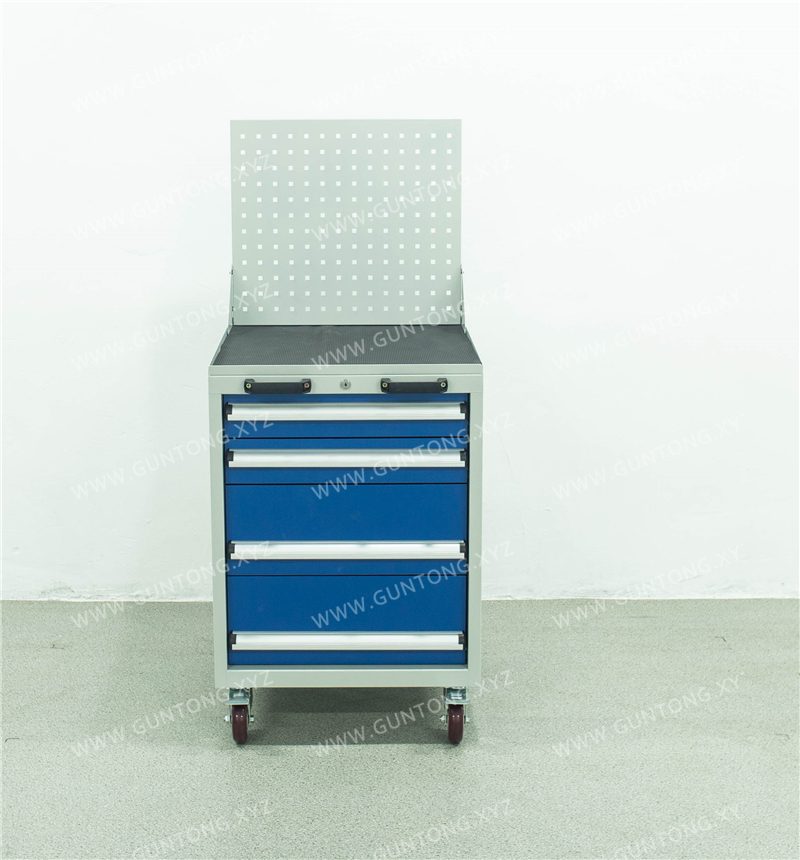
Tool carts combine mobility with storage. A typical 4-drawer 1-door tool cart with pegboard configuration may specify 80 kg per drawer. However, the mobility factor introduces additional constraints:
- Dynamic vs. static load: A drawer rated for 80 kg at rest may experience higher effective stress when the cart is in motion, especially over uneven floors or during braking.
- Caster load rating: The total weight of the cart plus all loaded drawers and stored items must remain within the combined caster capacity. Overloading casters leads to wheel deformation and unstable transit.
- Brake engagement: When the cart is stationary and drawers are fully extended, the center of gravity shifts. Brake quality and frame rigidity become critical safety factors.
Pegboard Storage Cabinets
For pegboard storage cabinets with adjustable shelves, shelf load ratings are typically specified per shelf. A standard inner half-pegboard storage cabinet may specify 100 kg per shelf with three adjustable shelves. The cabinet body is constructed from cold-rolled steel.
Important boundaries:
- Shelf span and support: Load capacity assumes proper shelf seating on support pins or brackets. Partially seated shelves reduce effective capacity.
- Upper vs. lower shelves: Upper shelves storing heavy items raise the center of gravity and increase tipping risk, especially in taller cabinet formats.
- Pegboard load: The pegboard section has its own load limits per hook or accessory. These are separate from shelf ratings and must be verified independently.
Steel Plate Workbenches with Drawer Configurations
Composite workbenches integrating drawer modules, such as the single back panel single door 4-drawer steel plate workbench, combine desktop load capacity with drawer storage ratings. The desktop structure features a raw steel plate composite over high-density fiberboard, and the C-type cold-rolled steel frame is rated for a total load capacity of 1000 kg. Drawer modules within this configuration follow the same per-drawer rating principles described above.
The critical distinction: desktop load capacity and drawer load capacity are independent specifications. A 1000 kg desktop rating does not increase drawer capacity, and fully loaded drawers do not reduce desktop capacity—provided the frame structure is intact.
Evaluation Criteria for Matching Ratings to Your Application
Use the following checklist when reviewing product specifications:
- Identify the heaviest single item you plan to store in any drawer or on any shelf. Compare it against the per-unit rating, not the total rating.
- Estimate typical load distribution. If items are concentrated rather than spread evenly, apply a safety margin below the rated capacity.
- Account for dynamic conditions if the equipment will be moved. Tool carts require caster and brake verification in addition to drawer ratings.
- Verify shelf seating and adjustment points. Adjustable shelves must be fully seated on all support points to achieve rated capacity.
- Separate accessory loads from structural loads. Pegboard hooks, bin rails, and lighting mounts carry their own limits.
Common Risks and Misapplication Patterns
Risk 1: Assuming total capacity equals per-drawer capacity.
A cabinet advertised with a total capacity across multiple drawers does not mean each drawer holds an equal share in all configurations. Verify the per-drawer specification directly.
Risk 2: Ignoring dynamic loading on mobile equipment.
Tool carts loaded to their static drawer limit may exceed safe transit conditions. Reduce mobile load when frequent movement is expected.
Risk 3: Overloading upper shelves in tall cabinets.
Storing dense metal parts on the top shelf of a tall cabinet creates tipping hazard. Reserve upper shelves for lighter items and place heavy loads on lower shelves.
Risk 4: Confusing desktop and drawer ratings on composite workbenches.
The single back panel single door 4-drawer steel plate workbench offers a robust 1000 kg frame rating, but drawer modules must still be loaded within their individual specifications.
Practical Examples by Application Scenario
Electronics assembly workstation: Light components, soldering tools, and small test instruments. Per-drawer loads are typically low. Standard drawer ratings provide ample margin. Focus selection on drawer count, divider options, and ESD compatibility rather than maximum load.
Automotive parts maintenance bay: Heavy wrenches, socket sets, and metal components. Per-drawer loads may be significant. Verify per-drawer ratings and confirm rail type. For mobile service, select tool carts with reinforced casters and reduce transit load.
Hardware mold workshop: Dense mold components, measuring instruments, and maintenance tools. Use heavy-duty tool cabinets with verified per-drawer ratings. Store heavy mold inserts on lower shelves of pegboard storage cabinets to maintain stability.
Warehousing and logistics: High-turnover tool and consumable storage. Pegboard storage cabinets with per-shelf ratings suit bulk consumables. Ensure shelf adjustment points match actual item heights to avoid wasted vertical space.
Boundaries and What Specifications Do Not Cover
Load ratings assume normal indoor workshop conditions. They do not account for:
- Corrosive or high-temperature environments that may degrade steel or rail lubricants
- Impact loads from dropping heavy items into drawers
- Modification of frame structure or removal of structural braces after delivery
- Use of non-OEM replacement drawers, shelves, or rails
When operating conditions deviate from standard workshop environments, consult Guang'ErMei's technical team to confirm whether standard ratings apply or whether material and structural upgrades are needed.
Next Steps for Procurement and Workshop Planning
- Document your actual load profile: List the heaviest items per drawer and per shelf, with weights and dimensions.
- Match against per-unit ratings: Use the evaluation criteria above to identify suitable product configurations.
- Request specification sheets: Ask for per-drawer and per-shelf ratings in writing before placing orders, especially for non-standard configurations.
- Plan for installation and inspection: Proper installation ensures load ratings are achievable. Verify shelf seating, drawer alignment, and caster function after delivery.
For detailed specifications on tool cabinets, tool carts, pegboard storage cabinets, and composite workbenches, or to discuss custom configurations for your workshop layout, contact Guang'ErMei Precision Components' technical team with your load requirements and site conditions.