
Workbench Stretcher, Shelf, and Double-Layer Structure Functions: A Buyer's Configuration Guide
When a Flat Workbench Isn't Enough
A standard single-tier workbench works fine for light assembly. But the moment operators need to store heavy dies below, keep ESD-sensitive components separated, or organize turnover bins within arm's reach, the under-frame structure becomes the real decision point. Buyers in electronics assembly, automotive parts manufacturing, and hardware mold workshops frequently ask: what do stretchers, shelves, and double-layer structures actually do, and when are they worth specifying?
This guide breaks down the functional role of each under-bench component, maps them to real workshop scenarios, and provides a selection checklist before you request a quote.
What Each Structure Actually Does
Stretcher (Lower Cross-Brace)
A stretcher is a horizontal bar welded or bolted between the workbench legs near the floor. Its primary function is structural rigidity, not storage.
- Prevents leg splay under heavy or off-center loads. On a 1500 mm or 1800 mm bench carrying 300–1000 kg, lateral forces during clamping or pressing can shift the frame without a stretcher.
- Provides a mounting surface for optional foot cups, casters, or leveling feet.
- Acts as a toe-kick barrier, keeping operators from accidentally sliding parts or tools under the bench.
A stretcher alone does not add usable storage. If your only need is stability on a heavy-duty fitter workbench, a stretcher is the minimum under-frame specification.
Shelf (Mid-Level or Lower Shelf)
A shelf is a flat panel—typically steel plate or high-density fiberboard—mounted between the legs at knee or shin height. Its function is accessible under-bench storage.
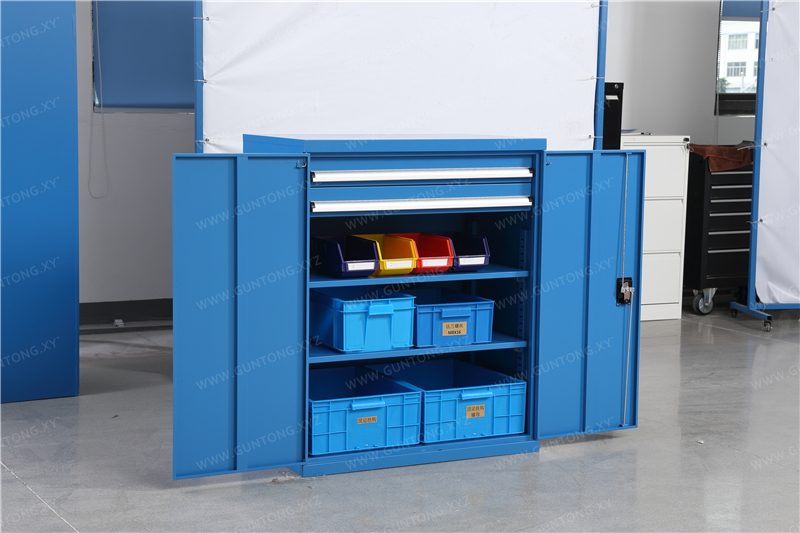
- Holds bins, tote boxes, and raw material within the operator's reach zone without requiring a separate rack.
- Supports 6S visual management: labeled shelf zones make it easy to audit workstation organization.
- Load capacity varies: a 1.0 mm or 1.2 mm cold-rolled steel shelf typically supports 50–100 kg distributed load, adequate for small parts bins and tooling.
Shelves are common on anti-static workbenches in electronics assembly, where operators need grounded component trays stored directly below the ESD work surface.
Double-Layer Structure
A double-layer workbench adds a full second working surface or shelf above or below the primary desktop, effectively creating two operational tiers.
- Separates workflow stages: for example, the upper tier holds inspection equipment or monitors, while the lower tier is the active assembly surface.
- Doubles under-bench storage density when configured as a lower shelf plus stretcher combination.
- Accommodates multi-operator stations where one worker assembles on the main surface and another stages parts on the secondary layer.
Double-layer configurations are frequently specified for testing and repair stations in automotive electronics, where oscilloscopes and diagnostic tools occupy the upper tier while the bench top remains clear for hands-on work.
Selection Checklist: Which Configuration Fits Your Scenario?
| Workshop Scenario | Recommended Under-Frame | Why |
|---|---|---|
| Heavy fitter / mold repair (load > 500 kg) | Stretcher + heavy-duty lower shelf | Frame rigidity plus die storage below |
| Electronics ESD assembly line | Shelf (grounded steel) | Component bin storage within ESD-safe zone |
| Automotive parts inspection & testing | Double-layer structure | Instrument tier above, clear work surface below |
| General packaging / light assembly | Stretcher only | Stability without added cost or weight |
| 6S-managed production cell | Shelf with labeled dividers | Visual organization and audit compliance |
Key Decision Factors
- Total load requirement. Workbenches rated at 300 kg (light-duty) may only need a stretcher. Benches rated at 1000 kg (heavy-duty) should include a stretcher and, if storage is needed, a reinforced shelf with adequate bracket support.
- Operator workflow. If the operator frequently reaches below the desktop for parts or tooling, a shelf reduces motion waste. If instruments must remain visible and accessible but off the main work surface, a double-layer frame is justified.
- ESD requirements. In anti-static workbench configurations, any metal shelf must be bonded to the common ground point. Verify that the shelf mounting hardware maintains electrical continuity with the frame and the ESD wrist strap ground bus.
- Floor space constraints. A double-layer structure adds height (typically 500 mm above the main desktop) but no additional footprint. If overhead clearance is limited—such as under mezzanine floors or conveyor lines—confirm the total height before ordering.
Common Configuration Mistakes to Avoid
- Adding a shelf without checking leg capacity. A shelf loaded with 80 kg of tooling transfers that weight to the leg brackets. On a light-duty frame designed for 300 kg total, this can push the structure beyond its rating when combined with desktop loads.
- Specifying a double-layer frame for single-operator light work. The added material cost and visual clutter are not justified unless the second tier serves a defined purpose.
- Ignoring grounding continuity on ESD shelves. A shelf that is electrically isolated from the frame defeats the purpose of an anti-static workstation. Always specify bonded mounting hardware.
- Overlooking stretcher height. A stretcher mounted too high reduces leg clearance and creates a tripping hazard. Standard placement is 100–150 mm above the floor.
How Guang'ErMei Configures These Structures
Guang'ErMei Precision Components designs workbench under-frames as part of a complete workstation solution. Standard configurations include:
- C-type cold-rolled steel frames with integrated stretcher bars, supporting total loads up to 1000 kg on heavy-duty models.
- Adjustable steel shelves with 50–100 kg per-shelf capacity, compatible with labeled bin systems for 6S-managed environments.
- Double-layer frames available on anti-static workbenches and fitter workbenches, with customizable upper-tier heights to accommodate monitors, lighting, or testing instruments.
- ESD-bonded shelf hardware ensuring electrical continuity from shelf surface through the frame to the ground bus.
All configurations support non-standard customization in dimensions, load rating, and accessory integration—including drawer cabinets, pegboards, and power rail mounting—based on on-site workstation planning.
Next Steps
If you are planning a workstation layout or upgrading existing benches, start by documenting the load per station, the operator's reach-zone requirements, and any ESD or 6S compliance needs. Share these details with our engineering team for a configuration recommendation and dimensional drawing.
Service coverage includes manufacturing customers in Huizhou and Guangdong Province, supporting nationwide workstation equipment customization and project delivery.