
What Workpieces Are Heavy-Duty Steel Workbenches Suitable For? Selection and Configuration Essentials
Who Needs a Heavy-Duty Steel Workbench?
Manufacturing teams handling metal parts, automotive components, hardware molds, or heavy mechanical assemblies face a common challenge: standard workbenches deform, scratch, or fail under repeated impact and concentrated loads. A heavy-duty steel plate workbench addresses this by combining a robust steel surface with a reinforced frame, providing a stable platform for demanding workshop operations.
If your daily workflow involves hammering, pressing, heavy fitting, or supporting dense metal workpieces, understanding the practical boundaries and configuration options of a steel-top workbench is essential before making a procurement decision.
What Workpieces and Operations Suit a Steel Plate Top?
A steel plate workbench top is not a universal solution. It excels in specific scenarios where surface durability and load-bearing capacity are the primary concerns.
High-Impact and High-Load Metal Workpieces
The most common applications involve workpieces that are heavy, sharp, or subject to impact forces:
- Automotive and Machinery Parts:*
- Engine blocks, transmission housings, brake calipers, and large stamping dies. These components often weigh tens to hundreds of kilograms and require a surface that resists denting and deformation.
- Hardware Mold Components:*
- Mold bases, inserts, and die shoes. Fitting and polishing these parts generate significant downward force and lateral friction.
- Structural Steel and Fabrication:*
- Welded assemblies, heavy brackets, and machined plates that are moved across the bench surface repeatedly.
Operations That Demand a Steel Surface
Beyond the workpiece itself, the type of operation dictates the need for a steel top:
- Bench Fitting and Filing:*
- Manual scraping, filing, and fitting of metal parts generate metal shavings and require a hard, flat reference surface.
- Pressing and Hammering:*
- Operations involving arbor presses, hydraulic presses, or manual hammering transmit shock loads directly into the bench top.
- Heavy Assembly:*
- Assembling large gearboxes, pumps, or industrial valves where components are lowered onto the bench with significant force.
Core Construction: 5mm Steel Plate Composite Desktop
The performance of a heavy-duty workbench hinges on its desktop structure. Based on standard configurations from Guang'ErMei Precision Components, a typical heavy-duty steel plate workbench utilizes a composite design:
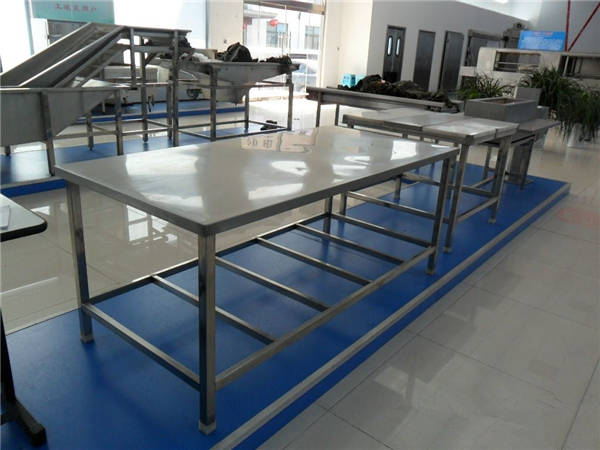
- Top Layer:*
- A 5mm raw steel plate provides the primary wear-resistant, impact-resistant working surface.
- Core Layer:*
- A 45mm high-density fiberboard core adds mass, dampens vibration, and provides structural rigidity without the extreme weight of a solid steel block.
- Total Thickness:*
- Approximately 50mm, often finished with black PVC edge banding for safety and durability.
- Load Capacity:*
- This composite structure, when paired with a reinforced frame, typically supports a total uniform load of up to 1000kg.
This construction balances durability with practical weight, making it suitable for most heavy industrial tasks while remaining movable with appropriate equipment.
Frame and Dimension Selection
The desktop must be supported by a frame engineered for the intended load. Key considerations include:
Frame Profile
Heavy-duty models typically employ a C-type cold-rolled steel frame. A common cross-section is 100mm x 50mm, providing the necessary torsional rigidity to prevent racking under asymmetric loads.
Standard Dimensions and Workspace Matching
Selecting the right length depends on the workpiece size and the number of operators:
| Length (mm) | Typical Application Scenario |
|---|---|
| 1500 x 750 x 800 | Single-operator fitting stations, small mold repair, maintenance bays with limited space. |
| 1800 x 750 x 800 | Standard heavy assembly stations, automotive component repair, general machining support. |
| 2100 x 750 x 800 | Large mold bases, long shaft assembly, multi-operator collaborative fitting tasks. |
Note: The 800mm height refers to the work surface; additional height may be added for back panels or overhead structures.
Configuration Options: Beyond the Basic Table
A bare steel table is rarely sufficient for an efficient 6S-compliant workshop. Buyers should evaluate necessary integrations:
- Tool Storage:*
- Integrating drawers (e.g., a 4-drawer tiered design) or a single-door cabinet below the bench keeps heavy tooling close to the point of use.
- Vertical Organization:*
- Adding a single or dual back panel (pegboard or louver panel) allows for hanging frequently used hand tools, reducing clutter on the steel surface.
- Vise Mounting:*
- If a bench vise is required, confirm that the 50mm composite top and underlying frame can handle the concentrated clamping forces and that appropriate mounting holes or brackets are specified.
Trade-Offs and Limitations
While steel plate workbenches are highly durable, they are not suitable for every environment:
- Surface Marring:*
- The raw steel surface will scratch and mark. It is not appropriate for precision optical work, delicate electronic assembly, or any task requiring a pristine, non-marring surface (where stainless steel or specialized composite tops are preferred).
- Corrosion Risk:*
- In environments with high humidity, chemical exposure, or frequent washdowns (such as food processing or certain chemical labs), a raw steel top will rust unless specifically treated or replaced with a stainless steel alternative.
- Weight:*
- The 50mm composite top and heavy frame make these benches difficult to relocate frequently. They are best suited for fixed-position workflow cells.
Next Steps for Procurement
To ensure the selected workbench meets your specific operational requirements:
- Audit Your Heaviest Workpiece: Determine the maximum point load and impact force your bench will encounter.
- Measure Your Workflow Cell: Confirm that standard lengths (1500, 1800, 2100mm) fit your allocated space and allow for operator movement.
- Define Accessory Needs: List required drawers, back panels, or vise mounts to include in the initial quotation.
- Request a Load-Bearing Confirmation: Ask the manufacturer to confirm the 1000kg total load capacity is valid for your specific configuration, especially if adding heavy accessories or modifying the frame.
Guang'ErMei Precision Components provides design, production, and installation services for heavy-duty steel workbenches tailored to electronics, automotive, hardware mold, and maintenance scenarios across Huizhou, Guangdong, and nationwide. Contact our team to discuss your specific workpiece requirements and workshop layout.