
What to Confirm When Customizing Beech Workbench Dimensions: A Buyer's Checklist
Who Needs to Confirm Beech Workbench Dimensions?
Manufacturing enterprises, hardware mold factories, maintenance and testing institutions, and vocational training centers frequently specify beech wood workbenches for tasks that require a solid, vibration-dampening, and aesthetically clean work surface. Unlike steel plate or anti-static composite tops, a beech finger-joint board desktop is chosen for bench fitting, precision inspection, light assembly, and instrument calibration.
However, purchasing a beech workbench is not simply a matter of selecting a wood top. The overall workstation performance depends on how the desktop dimensions, frame structure, load-bearing rating, and accessory configuration are matched to the actual workflow. Below is a practical checklist for procurement teams evaluating beech workbench options.
---
1. Desktop Thickness and Material Specification
The first dimension to confirm is the beech desktop thickness and construction method.
- Standard configuration: Beech finger-joint board at 50 mm thickness
- is a common heavy-duty specification used in workshop environments. This thickness provides sufficient rigidity for bench fitting tasks, including the use of bench vises and manual pressing operations.
- Surface treatment: Confirm whether the beech top is supplied raw, oiled, or sealed with a protective coating. Unsealed beech is susceptible to moisture absorption and staining from cutting fluids or solvents commonly used in automotive parts and hardware mold workshops.
- Edge banding: Unlike composite desktops that use PVC edge banding, solid beech tops typically have machined or chamfered edges. Verify the edge profile to ensure it meets your workshop's 6S management and safety requirements.
Key question for suppliers: Is the 50 mm beech top a single solid board or a finger-joint laminated panel? Finger-joint construction is standard for this thickness and provides good dimensional stability, but the joint pattern should be visually acceptable for your application.
---
2. Standard Length Options vs. Custom Dimensions
Beech workbenches are typically offered in three standard lengths that align with common workshop bay widths and operator reach zones:
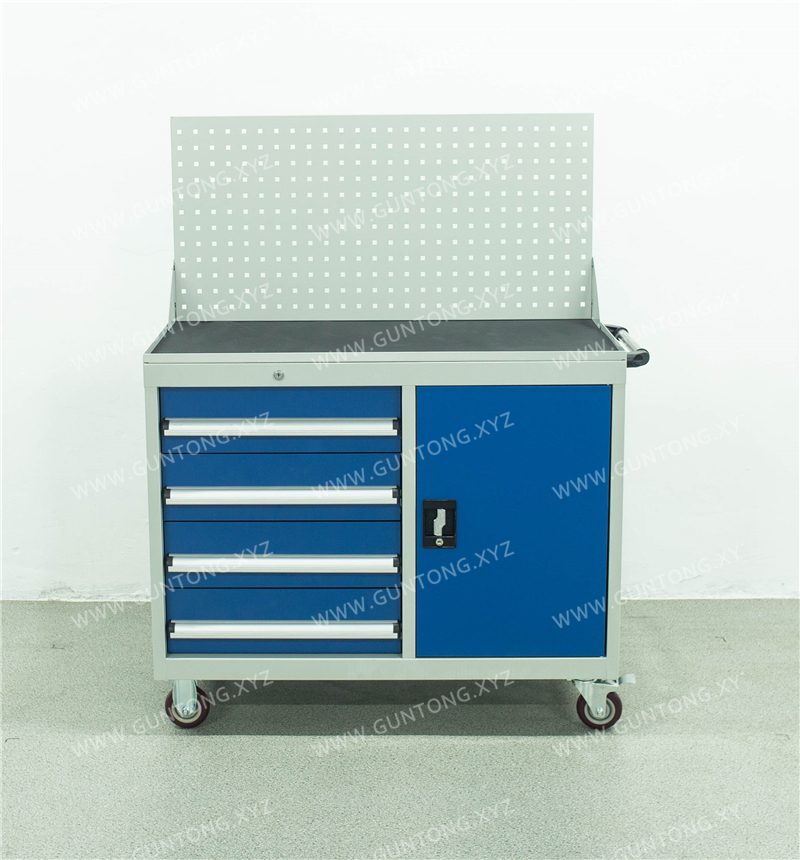
| Standard Length (mm) | Typical Use Case |
|---|---|
| 1500 × 750 × 800 | Single-operator bench fitting, instrument calibration, small-part inspection |
| 1800 × 750 × 800 | Two-operator light assembly, electronics testing with pegboard accessories |
| 2100 × 750 × 800 | Extended workstation for mold repair, multi-fixture layout, or dual-visor setup |
- Width (depth): 750 mm is the standard depth, providing adequate reach for most seated or standing tasks while allowing overhead pegboard or lighting accessories.
- Height: 800 mm is the standard working height. If your operators primarily work standing, confirm whether the frame supports height adjustment or whether a taller frame (e.g., 850–900 mm) is available.
When to request non-standard dimensions: If your workshop layout requires a workbench to fit between existing machinery, align with a specific lean pipe racking system, or accommodate an oversized mold or fixture, custom lengths and depths are available. Guang'ErMei Precision Components supports non-standard customization, but buyers should provide a dimensioned sketch or CAD file and confirm the following before production:
- Maximum unsupported span of the beech top (to prevent sagging under load)
- Whether additional cross-members or center legs are required for lengths exceeding 2100 mm
- Lead time implications for non-standard beech board cutting and finishing
---
3. Frame Load Capacity and Structural Compatibility
The beech desktop is only one part of the load-bearing system. The frame specification determines the total workstation capacity.
- Frame material: A common heavy-duty configuration uses 1.5 mm cold-rolled steel plate
- for the frame and legs, with a C-type structural profile.
- Total load capacity: Heavy-duty beech workbenches are typically rated for 1000 kg total load
- (including the desktop weight). This rating assumes evenly distributed static load. Point loads from heavy vises or press fixtures may require local reinforcement.
- Surface treatment: The steel frame is generally processed through pickling, phosphating, and powder electrostatic spraying with high-temperature baking at approximately 250°C. This finish provides corrosion resistance suitable for most indoor workshop environments, including those with moderate humidity or occasional oil mist exposure.
Risk to avoid: Do not assume that a 50 mm beech top automatically means a 1000 kg rated frame. Some suppliers pair thick wood tops with lighter-gauge frames to reduce cost. Always confirm the frame material thickness and the tested or rated load capacity as a complete system.
---
4. Accessory and Configuration Compatibility
A beech workbench rarely operates as a standalone table. Confirm which accessories are compatible with the frame and desktop:
- Pegboards (square-hole or louver types): Single or double pegboard panels can be mounted on the rear frame. Verify the mounting hole pattern and whether the beech top's rear edge allows flush pegboard installation.
- Drawers and tool cabinets: Under-bench drawer units (e.g., two-drawer, three-drawer, or four-drawer configurations) or floor-standing cabinets can be integrated. Confirm the drawer unit width matches the frame bay width.
- Shelves and cross-braces: Lower shelves or cross-brace bars improve storage and structural rigidity. For beech top workbenches used in precision tasks, a lower shelf is often preferred over a cross-brace to allow operator legroom.
- Bench vise mounting: If a bench vise will be installed, confirm the beech top's edge thickness and whether a steel reinforcement plate is needed under the vise mounting area to prevent wood compression over time.
---
5. Procurement Risks and Supplier Evaluation
When sourcing custom beech workbenches, buyers should be aware of several common procurement risks:
| Risk Area | What to Verify |
|---|---|
| Wood moisture content | Beech boards should be kiln-dried to a moisture content suitable for your local climate. High moisture content can cause warping after delivery. |
| Dimensional tolerance | Confirm the supplier's tolerance for length, width, and thickness. Non-standard cuts may have wider tolerances than standard panels. |
| Frame-to-top mounting | Verify how the beech top is secured to the steel frame. Bolt-through mounting with countersunk holes is preferred over surface brackets for heavy-duty use. |
| Delivery and installation | Beech top workbenches are heavy. Confirm whether the supplier provides on-site installation or whether the product ships flat-pack with assembly instructions. Guang'ErMei offers design, production, installation, and after-sales service as a full-chain process. |
| After-sales support | Confirm the supplier's policy on desktop replacement, frame repair, and accessory replenishment. A supplier with dual capabilities in standardized production and non-standard customization can more easily support future workstation modifications. |
---
Summary: Your Beech Workbench Dimension Checklist
Before placing an order, ensure you have confirmed the following with your supplier:
- Desktop: 50 mm beech finger-joint board, edge profile, and surface finish
- Dimensions: Standard (1500/1800/2100 × 750 × 800 mm) or custom, with structural implications documented
- Frame: 1.5 mm cold-rolled steel, C-type profile, 1000 kg rated capacity, powder-coated finish
- Accessories: Pegboard, drawer, shelf, and vise mounting compatibility
- Service scope: On-site planning, installation, and after-sales support availability
Guang'ErMei Precision Components provides beech workbench solutions combining standardized configurations with non-standard customization, supporting workshops in electronics, automotive parts, hardware molds, maintenance and testing, and vocational training environments across Huizhou, Guangdong Province, and nationwide.