
How to Verify Heavy-Duty Workbench Load Capacity: A Practical Guide for Workshop Buyers
Manufacturing buyers often see a single load rating—such as 1000 kg—on a workbench datasheet and assume the decision is straightforward. In practice, verifying heavy-duty workbench load capacity involves understanding how that number was derived, what structural elements support it, and whether your actual use case matches the test conditions. Misinterpreting these figures can lead to premature frame deformation, desktop failure, or safety incidents on the shop floor.
This guide breaks down the verification process into actionable steps, using real product configurations from Guang'ErMei Precision Components as reference points.
Step 1: Distinguish Static Load from Working Load
The first question to ask any manufacturer is whether the published figure represents a static uniform load or a dynamic working load.
- Static uniform load means weight is evenly distributed across the entire desktop surface with no movement or impact.
- Dynamic working load accounts for real workshop conditions: tools being placed down forcefully, parts being slid across the surface, and operators leaning on the bench.
For heavy-duty applications, Guang'ErMei classifies workbenches into tiers: light-duty models support up to 300 kg, while heavy-duty and custom configurations are rated for 1000 kg and above. These classifications align with industry conventions, but the verification lies in the structural details behind the number.
Step 2: Inspect the Frame Material and Cross-Section
The frame is the primary load-bearing element. Two specifications matter most:
Material grade and thickness. Cold-rolled steel is the standard for heavy-duty frames. Guang'ErMei's heavy-duty workbenches use C-type cold-rolled steel profiles, which provide higher torsional rigidity than simple rectangular tubing of the same weight.
Cross-section dimensions. For example, a 40×40×1.2 mm square tube frame is rated for approximately 300 kg in lighter configurations. When the application demands 1000 kg, the frame must be upgraded—either through thicker gauge steel, larger cross-sections, or reinforced cross-bracing. Always request the specific frame profile drawing rather than relying on a generic "heavy-duty" label.
Step 3: Verify the Desktop Composite Structure
The desktop is not just a surface—it contributes significantly to overall load distribution. A thin steel sheet placed on a weak substrate will deflect under concentrated loads, even if the frame is adequate.
Guang'ErMei's Single Back Panel 4-Drawer Steel Plate Workbench uses a composite desktop structure:
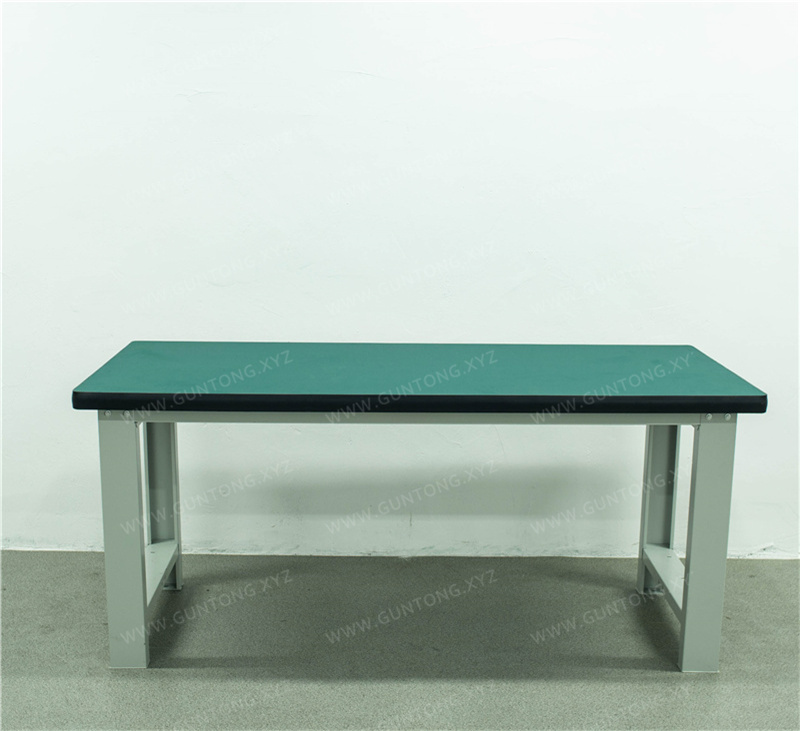
- 5 mm raw steel plate as the top wearing surface
- 45 mm high-density fiberboard as the structural core
- Black PVC edge banding for impact protection
This three-layer construction distributes point loads across a wider area of the frame, reducing the risk of localized failure. When verifying capacity, ask the manufacturer for the total desktop thickness and the material of each layer. A 50 mm composite desktop with a steel top layer behaves very differently from a 25 mm particle board surface with a thin laminate.
Step 4: Evaluate Load Distribution in Your Actual Scenario
A 1000 kg rating assumes uniform distribution. In real workshops, loads are rarely uniform:
- Concentrated loads: A single 200 kg mold placed in the center of the bench creates higher bending stress than 200 kg of small parts spread across the surface.
- Offset loads: Heavy equipment positioned near one end can cause frame racking if the cross-bracing is insufficient.
- Impact loads: Dropping a 50 kg component onto the surface generates momentary forces significantly higher than the static weight.
Before finalizing a specification, map your heaviest individual items and their typical placement. If concentrated loads exceed 30–40% of the total rated capacity, request a reinforced frame design or a thicker desktop core.
Step 5: Check the Connection Points and Adjustability
Load capacity is only as reliable as the weakest joint. Key areas to inspect:
- Bolted vs. welded joints. Fully welded frames generally offer higher rigidity, but bolted frames allow for on-site assembly and relocation. If bolted, verify the bolt grade and torque specifications.
- Adjustable feet. Heavy-duty workbenches often include adjustable foot cups to compensate for uneven floors. Ensure the foot cups are rated for the total bench load plus a safety margin.
- Accessory mounting. If you plan to add pegboards, overhead shelves, or drawer units, confirm that the additional load is included in the structural calculation. Guang'ErMei workbenches support flexible configuration of hanging cabinets, single or double cabinets, pegboards, and lighting panels—all of which add to the total load on the frame.
Step 6: Request Documentation and Test Evidence
Reputable manufacturers should be able to provide:
- A structural calculation sheet or finite element analysis (FEA) report for the specific configuration you are ordering.
- Material certificates for the steel profiles and desktop components.
- Load test photographs or videos showing the bench under rated conditions.
If a supplier cannot provide these documents, treat the published load rating with caution. Guang'ErMei supports custom load-bearing design as part of its on-site workstation planning service, meaning the structural specification is matched to your actual application rather than pulled from a generic catalog.
Common Specification Traps to Avoid
| Trap | What to Check |
|---|---|
| "Up to 1000 kg" without conditions | Ask whether this is uniform static load or includes impact |
| Desktop thickness listed without material breakdown | Request layer-by-layer specification |
| Frame described as "heavy-duty steel" without gauge | Demand exact cross-section dimensions and wall thickness |
| Load rating for base frame only | Confirm whether accessories and drawers are included |
| No mention of safety factor | Industry practice is 1.5× to 2× safety margin on rated load |
When to Choose Custom Over Standard
Standard heavy-duty workbenches cover most general manufacturing, maintenance, and assembly tasks. However, custom load-bearing design becomes necessary when:
- Individual concentrated loads exceed 500 kg.
- The bench must support vibrating equipment or repeated impact.
- The workspace requires non-standard dimensions that alter the structural span.
- Integration with automated storage systems or conveyor lines imposes additional dynamic forces.
Guang'ErMei provides both standardized production and non-standard customization, with on-site workstation planning that accounts for load-bearing requirements, 6S management adaptation, and full-process after-sales support.
Next Steps for Buyers
- Document your load profile. List the heaviest items, their dimensions, and typical placement on the bench.
- Request frame and desktop specifications. Compare composite structures, not just headline thickness.
- Ask for structural documentation. Calculation sheets or test reports should match your exact configuration.
- Plan for accessories. Include the weight of drawers, pegboards, and overhead components in your total load calculation.
- Engage early with the manufacturer. On-site planning services can identify load distribution issues before equipment is installed.