
Evaluating Tool Cabinet Drawer Load Capacity Specifications: A Technical Decision Memo
Evaluating Tool Cabinet Drawer Load Capacity Specifications: A Technical Decision Memo
Objective: Defining Load Requirements for Workshop Tool Storage
Manufacturing enterprises, automotive parts manufacturers, and maintenance testing institutions rely on precise tool storage to maintain 6S management and operational efficiency. When procuring workshop workstation equipment, buyers often focus on the overall dimensions of a tool cabinet or workbench while overlooking the critical engineering behind the drawers. The primary objective of this memo is to analyze tool cabinet drawer load capacity specifications, explaining the structural principles, operating logic, and applicable boundaries to prevent equipment failure and optimize facility layouts.
Evidence: Structural Features Dictating Drawer Load Limits
When evaluating tool cabinet drawer load capacity specifications, buyers must look beyond the stated maximum weight. The actual performance and safety margins depend on several integrated structural features:
Rail System and Extension Rate
The sliding mechanism is the primary determinant of a drawer's dynamic load capacity. Standard single-rail systems typically support up to 80 kg per drawer and allow an 85% opening extension. This configuration is engineered for standard hand tools, measuring instruments, and small hardware components. The 85% extension limit is a deliberate design boundary; it keeps the center of gravity within the cabinet footprint, preventing tipping hazards when the drawer is fully loaded and extended.
Drawer Panel Thickness and Bottom Reinforcement
The load-bearing capacity is directly tied to the steel plate thickness of the drawer panels and the bottom reinforcement ribs. Under an 80 kg load, unreinforced thin steel will sag, causing the drawer to bind against the cabinet frame. Heavy-duty drawers utilize thicker cold-rolled steel and stamped bottom profiles to maintain structural rigidity and ensure smooth operation over thousands of cycles.
Overall Frame Integration
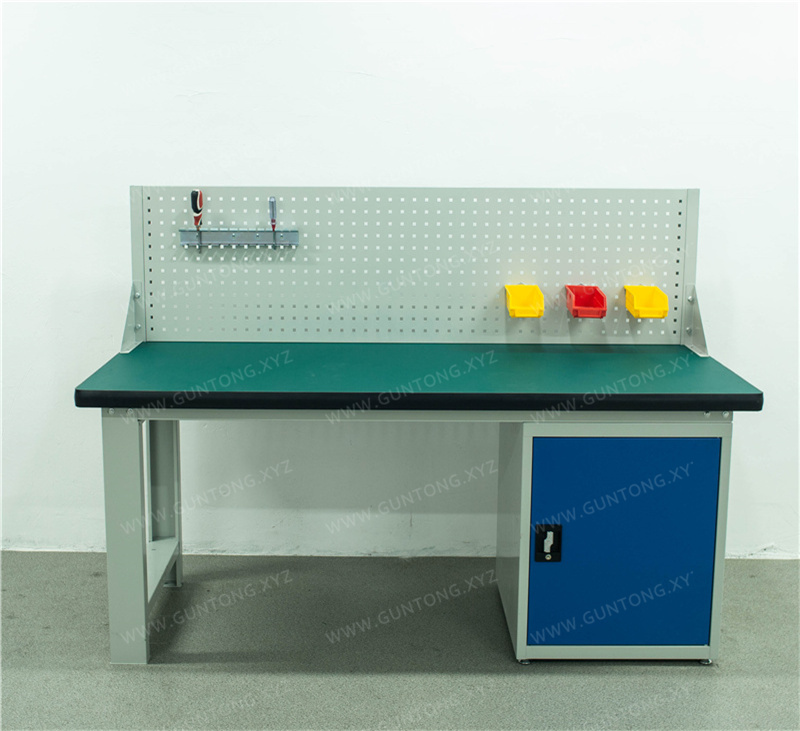
A drawer's capacity is only as reliable as the cabinet or workbench frame supporting it. For example, a 4-drawer steel plate workbench utilizes a C-type cold-rolled steel frame to ensure a 1000 kg total load capacity. This robust foundation is essential; if the main frame deflects under the combined weight of the composite desktop and fully loaded drawers, the drawer rails will misalign, leading to mechanical failure.
Alternatives: Configuring Drawer Layouts for Different Tool Profiles
Facilities must choose between varying drawer heights, rail types, and mobility configurations based on specific operational scenarios:
Tiered Drawer Configurations
A common and highly efficient setup is the 4-drawer tiered design, which combines different drawer heights (e.g., 100 mm and 200 mm) within a single unit. This allows for the organized, categorized storage of both small precision tools in the shallow top drawers and larger power tools or bulky hardware in the deeper bottom drawers, maximizing vertical space utilization.
Stationary Cabinets vs. Mobile Tool Carts
For mobile applications, a 4-drawer 1-door tool cart with a pegboard offers the same 80 kg per drawer capacity but requires heavy-duty casters and a reinforced base to maintain stability during transit. Conversely, stationary pegboard storage cabinets prioritize shelf load capacity alongside drawer storage, serving as comprehensive 6S management storage cabinets for fixed workstations.
Automated Storage Context
If integrating tool storage with automated systems, the structural parameters shift significantly. For instance, tote-based automated storage and retrieval systems (Miniload) are designed with entirely different tolerances, typically handling 50–100 kg per tote with rack heights reaching up to 12 meters. These systems require precision-engineered tote dimensions and rigid rack structures that differ fundamentally from manual tool cabinet drawers.
Applicable Boundaries and Risk Management
Understanding the operational boundaries of drawer load specifications is critical for risk management in industrial environments:
- Dynamic vs. Static Loads: The 80 kg specification generally refers to a uniformly distributed static load. Concentrating heavy items (such as dense metal molds or large calibration weights) in the center of the drawer can cause localized deformation. Heavy, concentrated loads require specialized double-rail systems with higher weight ratings.
- Extension Limits and Tipping Risks: Forcing a single-rail drawer beyond its designed 85% extension under maximum load can derail the sliding mechanism and compromise the cabinet's center of gravity. Facilities must enforce loading protocols that place the heaviest tools in the bottom drawers to maintain stability.
- Environmental Factors: In environments with high dust, metal shavings, or moisture (such as hardware mold factories), the rail systems require protective covers or regular maintenance to prevent debris accumulation, which can increase friction and reduce the effective load capacity.
Recommendation: Selecting the Right Configuration
For standard manufacturing, electronics assembly, and maintenance workshops, specify tool cabinets and workbenches with an 80 kg per drawer capacity utilizing single-rail systems with an 85% extension. Ensure the overall frame supports at least a 1000 kg total load capacity to guarantee long-term structural integrity.
For tools exceeding this weight or requiring 100% full extension for deep-reach retrieval, upgrade to double-rail heavy-duty drawers. Always align the drawer height configuration with your specific tool inventory to maximize spatial efficiency. By strictly adhering to these tool cabinet drawer load capacity specifications, facilities can achieve durable, safe, and highly organized workshop environments.