
Storage Cabinet vs Tool Cabinet: A Practical Comparison for Workshop Buyers
Storage Cabinet vs Tool Cabinet: A Practical Comparison for Workshop Buyers
A common failure in workshop equipment procurement is selecting a storage cabinet when a tool cabinet is needed—or vice versa. The result is predictable: tools become buried under bulk materials, retrieval times increase, and 5S/6S management breaks down within weeks. This misalignment happens because the terms "storage cabinet" and "tool cabinet" are often used interchangeably by suppliers, even though they serve fundamentally different operational purposes.
This article provides a direct, specification-level comparison to help manufacturing buyers, maintenance supervisors, and warehouse planners choose the correct cabinet type for their specific workstation scenarios.
The Core Distinction: What Each Cabinet Is Designed to Hold
The fundamental difference lies in the nature of the stored items and the retrieval frequency.
- Storage cabinets are engineered for bulk materials, consumables, packaged components, and heavier static loads. They prioritize shelf load-bearing capacity and volume efficiency.
- Tool cabinets are engineered for hand tools, measuring instruments, cutting tools, and small precision parts. They prioritize organized segregation, visual management, and rapid individual item retrieval.
Choosing the wrong type forces workers to adapt their workflow to the furniture, rather than the furniture supporting the workflow.
Structural and Configuration Differences
Load-Bearing Design
Storage cabinets typically feature reinforced shelf structures designed for uniform distributed loads. For example, Guang'ErMei's Pegboard Storage Cabinet (Inner Half-Pegboard Type) uses 1.0 mm or 1.2 mm cold-rolled steel construction with adjustable shelves rated at 100 kg per shelf. This makes it suitable for storing metal fittings, packaged fasteners, or maintenance consumables.
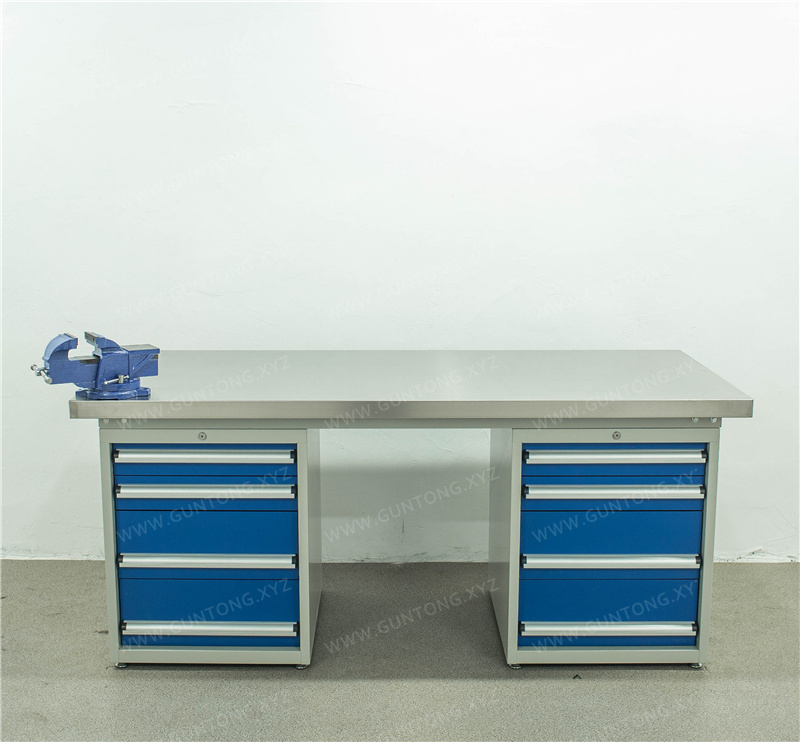
Tool cabinets, by contrast, distribute load across multiple drawers with individual weight ratings. Drawer configurations are tiered—commonly 100 mm and 200 mm heights—to accommodate different tool sizes while keeping the center of gravity low for stability. Drawer load ratings are typically specified per drawer rather than as a total unit capacity.
Internal Configuration
| Feature | Storage Cabinet | Tool Cabinet |
|---|---|---|
| Primary interior | Adjustable flat shelves | Multiple drawers with dividers |
| Door configuration | Full doors, sometimes with inner pegboard | May include pegboard panels for hanging tools |
| Item segregation | By shelf level or bin placement | By drawer, with adjustable partitions |
| Visual management | Limited unless combined with pegboard | High—drawer labels, shadow boards, pegboard integration |
| Retrieval pattern | Batch retrieval of materials | Individual tool retrieval, high frequency |
Pegboard Integration
Both cabinet types can incorporate pegboard panels, but the application differs. In a storage cabinet, an inner half-pegboard layout on the cabinet door provides supplementary hanging space for lightweight items while the shelves handle the primary load. In a tool cabinet or tool cart, a full pegboard serves as the primary visual management surface for frequently used hand tools.
Application Scenarios: Where Each Cabinet Performs Best
Storage Cabinet Ideal Scenarios
- Warehousing and logistics: Storing packaged spare parts, PPE supplies, and maintenance consumables near the point of use.
- Automotive parts manufacturing: Holding turnover components, gaskets, and seal kits organized by assembly station.
- Hardware mold factories: Keeping mold accessories, ejector pins, and cooling fittings segregated by mold series.
Tool Cabinet Ideal Scenarios
- Electronics assembly workstations: Organizing precision screwdrivers, tweezers, soldering tips, and ESD-safe tools.
- Maintenance and testing institutions: Segregating calibration tools, multimeters, and diagnostic probes by test type.
- Vocational college training centers: Teaching tool discipline and 5S practices through clearly assigned drawer layouts.
Selection Decision Framework
Before issuing a purchase order, workshop planners should answer three diagnostic questions:
1. What is the primary retrieval pattern?
If workers retrieve individual items more than 20 times per shift, a tool cabinet with drawer segregation is the correct choice. If materials are retrieved in batches or kits, a storage cabinet with adjustable shelves is more efficient.
2. What is the maximum weight per stored item category?
Items exceeding 15–20 kg per category generally require shelf-based storage cabinets. Lighter, numerous items benefit from drawer-based tool cabinets.
3. Is visual management a compliance requirement?
If the facility operates under 6S audit protocols or customer quality standards requiring shadow boards or labeled tool locations, a tool cabinet with integrated pegboard or a dedicated tool cart is necessary.
Common Procurement Mistakes and How to Avoid Them
Mistake 1: Buying storage cabinets for tool-heavy workstations.
Workers end up stacking tools on shelves, leading to damage, loss, and extended search times. Corrective action: Audit the workstation's tool list and retrieval frequency before specifying cabinet type.
Mistake 2: Over-specifying load capacity.
Ordering 100 kg shelf-rated cabinets for items weighing under 10 kg wastes budget and floor space. Corrective action: Match load specifications to actual stored item weights, not theoretical maximums.
Mistake 3: Ignoring workstation footprint constraints.
A 1000 × 500 × 1800 mm storage cabinet requires different clearance than a mobile tool cart. Corrective action: Map the workstation layout including operator movement paths before finalizing dimensions.
Integration with Broader Workshop Systems
Neither cabinet type operates in isolation. In well-planned workshops, storage cabinets are positioned at the perimeter or in staging areas, while tool cabinets and tool carts are placed directly at the workstation. For facilities implementing automated storage and retrieval systems—such as tote-based Miniload solutions with 50–100 kg per tote capacity and rack heights up to 12 meters—manual cabinets serve as the last-meter interface between automated inventory and the operator's hands.
Next Steps for Workshop Planners
If your facility is evaluating cabinet procurement or upgrading existing workstation equipment, start with a workstation-level audit of stored items, retrieval patterns, and load requirements. Guang'ErMei Precision Components provides on-site workstation planning, load-bearing design consultation, and 6S adaptation services across manufacturing facilities in Huizhou, Guangdong Province, and nationwide. Contact the engineering team with your workstation dimensions and tool inventory list to receive a configuration recommendation tailored to your operational requirements.