
Steel Plate vs Composite Workbenches: A Practical Comparison for Workshop Buyers
Who Needs to Make This Choice
Workshop planners, production managers, and maintenance supervisors in electronics, automotive parts, hardware mold, and testing environments frequently face a core specification question: should the workstation use a solid steel plate desktop or a composite desktop? The answer affects daily durability, tool placement, load handling, and long-term maintenance costs.
Both options are widely used in Huizhou and Guangdong manufacturing facilities, but they solve different problems. Misalignment between desktop type and actual task leads to premature surface damage, unstable tool mounting, or unnecessary capital spend.
Core Material Structures Compared
Steel Plate Workbench Desktop
A typical steel plate workbench uses a raw steel plate as the primary working surface. In heavy-duty configurations, this involves a 5mm raw steel plate bonded over a 45mm high-density fiberboard core, with black PVC edge banding machine-pressed around the perimeter. The total desktop thickness reaches approximately 50mm.
This structure delivers high impact resistance, tolerance to sharp tool contact, and stability under concentrated loads. The steel surface handles bench vises, heavy part placement, and repeated hammering or filing without delamination.
Composite Workbench Desktop
Composite workbenches use layered materials such as high-density fiberboard, anti-static laminates, or polymer-coated panels. These desktops prioritize surface flatness, electrostatic dissipation, and lighter overall weight. They are common in electronics assembly, precision testing, and clean packaging stations where surface scratching or static discharge is the primary concern.
Composite desktops generally do not tolerate heavy impact or direct vise mounting without reinforcement plates.
Load Capacity and Frame Considerations
Desktop material alone does not determine workstation performance. The frame structure must match the load profile.
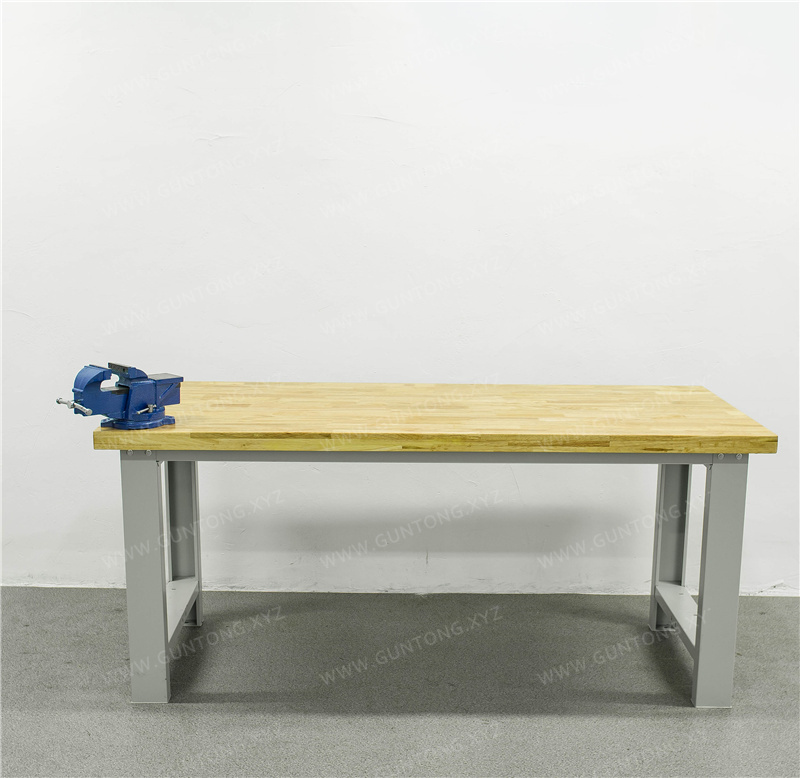
Heavy-duty steel plate workbenches typically pair with a C-type cold-rolled steel frame (100×50mm cross-section), supporting a total workstation load of up to 1000kg. This configuration suits mold repair, automotive part inspection, and hardware fitting tasks where multiple heavy components rest on the surface simultaneously.
Composite workbenches often use lighter frames optimized for 300–500kg total loads, which is sufficient for assembly, soldering, and instrument calibration but inadequate for heavy fitting or press work.
Key verification step: Always confirm the load rating for the complete workstation (desktop + frame + any drawer or cabinet modules), not just the desktop material in isolation.
Configuration Signals: Which Type Fits Your Station
| Decision Signal | Steel Plate Workbench | Composite Workbench |
|---|---|---|
| Primary task involves hammering, filing, or vise work | Strong match | Poor match |
| Station handles heavy metal parts (>50kg per piece) | Strong match | Limited match |
| Electrostatic-sensitive components are present | Requires grounding add-ons | Natural fit with ESD laminate |
| Surface must resist oil, coolant, or spark exposure | Strong match | Depends on laminate grade |
| Task is light assembly, testing, or packaging | Over-specified | Good match |
| Vise or heavy fixture mounting required | Direct mounting on steel plate | Requires reinforcement plate |
Common Dimensions and Space Planning
Both steel plate and composite workbenches share standard length options to fit typical workshop bay widths:
- 1500 × 750 × 800 mm — Compact stations, single-operator tasks
- 1800 × 750 × 800 mm — Standard fitting and assembly stations
- 2100 × 750 × 800 mm — Multi-operator or large-part inspection benches
The 800mm working height is standard for standing tasks. When overhead tool storage is needed, a 500mm pegboard or hanging panel can be added above the desktop, bringing total height to approximately 1300mm.
Storage and Accessory Integration
Workbench selection should account for tool storage at the same station. Common integrations include:
- Drawer modules (2-drawer, 3-drawer, or 4-drawer configurations) mounted under the desktop for categorized tool storage
- Single-door cabinets for bulkier items or consumables
- Square-hole pegboards for hanging hand tools, enabling visual 6S management
- Shelf layers or cross-braces for parts bins or secondary material placement
A steel plate workbench with a 4-drawer module and pegboard is a typical configuration for fitter and mold maintenance stations. A composite workbench with a single shelf layer and ESD wrist strap port is more typical for electronics testing.
Risk Boundaries and Common Specification Errors
- Specifying steel plate for ESD-sensitive stations without grounding planning. The steel surface is conductive; proper grounding paths must be designed into the workstation layout.
- Mounting a bench vise on a composite desktop without a reinforcement plate. This causes localized crushing of the fiberboard core.
- Assuming all "heavy-duty" labels mean the same load rating. Verify the complete system rating — some suppliers rate only the frame, others rate the desktop separately.
- Ignoring the 85% drawer-open clearance. When planning workstation spacing, account for drawer extension and operator movement zones.
Next Steps for Procurement Teams
- List the top 3–5 tasks performed at each workstation and note the heaviest single item placed on the surface.
- Determine whether electrostatic control is required at the station level or only for specific components.
- Confirm available floor space including drawer and door swing clearance.
- Request configuration drawings that show desktop material, frame specification, drawer load rating, and accessory mounting points as a complete package.
Guang'ErMei Precision Components provides both steel plate and composite workbench configurations with full customization of dimensions, drawer layouts, pegboard integration, and frame specifications. On-site workstation planning and load-bearing design support is available for manufacturing facilities across Guangdong and nationwide.