
Is It Safe to Buy Stainless Steel Workbenches Without 304 Grade Specified? Selection & Configuration Guide
Procurement teams often face two opposing failures when buying stainless steel workbenches: overspending by blindly mandating 304-grade stainless steel for standard assembly lines, or experiencing premature rusting and compliance failures by accidentally using 201-grade steel in food processing or highly corrosive environments. This happens because buyers often treat "stainless steel" as a single monolithic material rather than evaluating the specific grade against the workshop's actual environmental and budget constraints.
If a supplier quotation does not explicitly specify 304 grade, it typically defaults to 201 grade. Is it safe to proceed? For the vast majority of general manufacturing, electronics, and hardware mold workshops, the answer is yes—provided you configure the specifications correctly.
When Non-304 (201 Grade) Stainless Steel is the Right Choice
In industrial workstation equipment, 304 stainless steel is strictly necessary for food-grade processing, medical device manufacturing, or environments with extreme chemical exposure. However, for electronics manufacturing, automotive parts assembly, and standard maintenance testing, 201 stainless steel offers an optimal balance of durability and cost-efficiency.
A properly configured 201 stainless steel workbench provides excellent resistance to everyday wear, mild acids, and alkalis. It is highly suitable for scenarios with strict dustproof and anti-corrosion requirements, such as cleanroom-adjacent assembly or precision hardware packaging, without inflating the project budget unnecessarily.
Corrective Actions: How to Specify and Configure Your Workbench
To safely purchase a non-304 stainless steel workbench, you must shift your focus from simply demanding a material grade to verifying the structural configuration and surface treatment. Here is how to ensure you receive a heavy-duty, reliable product:
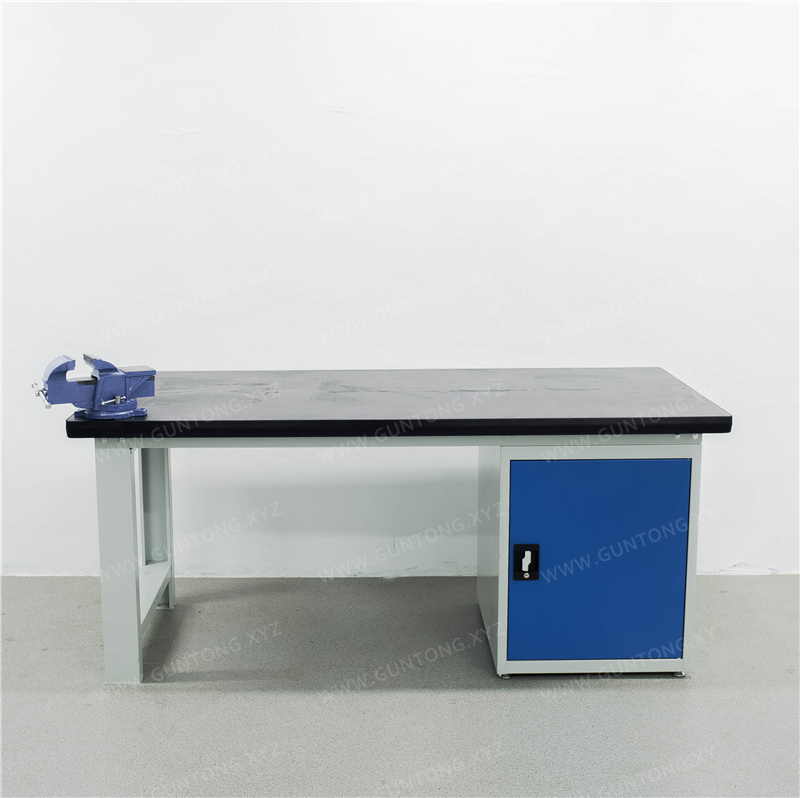
1. Verify the Desktop Composite Structure
A bare sheet of 201 stainless steel will dent under heavy loads. The industry standard for high-load capacity is a composite structure. For instance, a robust configuration utilizes a 1.0mm thick 201 stainless steel surface layered over a 49mm high-density composite board, resulting in a total desktop thickness of 50mm. Furthermore, the stainless steel should wrap five sides of the board (top and all four edges) to prevent moisture ingress and edge peeling, ensuring long-term structural integrity and providing the necessary acid and alkali resistance.
2. Confirm Frame Load Capacity and Surface Treatment
The workbench frame dictates the overall load-bearing capability. Ensure the understructure is built from high-quality 1.5mm cold-rolled steel rather than thin, lightweight tubing. A properly welded frame made from 1.5mm steel can support up to 1000kg. To prevent the frame itself from rusting, it must undergo a rigorous surface treatment process, specifically acid washing, phosphating, and high-temperature powder electrostatic spraying.
3. Standardize Dimensions or Define Custom Tolerances
To streamline procurement and future workshop reconfigurations, align your order with standard dimensional footprints. Common standard sizes include 1500×750×800mm, 1800×750×800mm, and 2100×750×800mm. If your facility requires non-standard dimensions for specific automated storage and retrieval system integrations or lean pipe workflows, ensure the manufacturer has dual capabilities in both standardized production and non-standard customization.
Key Configuration Parameters to Verify
Before finalizing a purchase order for a 201-grade stainless steel workbench, cross-check the following parameters with your supplier:
- Desktop Material:*
- 1.0mm 201 Stainless Steel (wrapping 5 sides).
- Core Board:*
- 49mm High-Density Fiberboard (Total thickness 50mm).
- Frame Material:*
- 1.5mm Cold-Rolled Steel.
- Load Capacity:*
- Up to 1000kg (static load).
- Surface Treatment:*
- Acid washing, phosphating, and electrostatic powder coating.
- Accessories:*
- Compatibility with add-ons like pegboards, tool drawers, or anti-static wrist strap grounding points if used in electronics manufacturing.
Conclusion and Next Steps
Buying a stainless steel workbench without a 304-grade specification is entirely safe and financially prudent for general industrial applications, as long as the default 201-grade material is engineered with the correct composite thickness and frame support. By focusing on structural specifications rather than just the steel grade, manufacturing enterprises can optimize their workstation budgets while maintaining strict 6S management and operational efficiency.
If you are planning a workshop upgrade or need to verify whether 201 or 304 grade is required for your specific operational environment, consult with a manufacturer that offers comprehensive on-site workstation planning.