
Square Hole Pegboard vs Louvered Panel: Which Tool Storage Backboard Fits Your Workshop?
Who Needs to Make This Choice?
Manufacturing buyers, workshop planners, and facility managers in electronics assembly, automotive parts production, hardware mold factories, and maintenance testing labs frequently face a specific decision when configuring workbenches and tool cabinets: should the backboard use a square hole pegboard or a louvered panel? Both serve tool organization and visual management, but they solve different operational problems. Selecting the wrong type leads to wasted accessories, poor retrieval efficiency, or non-compliance with 6S audit standards.
This comparison focuses on verifiable product parameters and real deployment constraints, not generic marketing claims.
Core Differences at a Glance
| Decision Factor | Square Hole Pegboard | Louvered Panel |
|---|---|---|
| Primary Function | Hanging tools via hooks, brackets, and custom fixtures | Holding bins, small parts boxes, and categorized containers |
| Hole Pattern | Uniform square holes (commonly 10×10 mm or 15×15 mm grid) | Horizontal louvers with open-front channels |
| Accessory Type | Hooks, tool holders, spring clips, custom brackets | Stackable bins, tilt-front boxes, divider panels |
| Visual Management | High — tools visible at a glance, shadow boards possible | Medium — bins obscure contents unless labeled |
| Load per Point | Moderate (depends on hook and steel gauge) | Higher per shelf channel (bin weight distributed) |
| Reconfiguration Speed | Fast — hooks reposition without tools | Moderate — bins slide in/out, but layout changes require relabeling |
| 6S / Lean Compatibility | Excellent for shadow boards and outline marking | Good for categorized part storage and kanban signals |
Step-by-Step Selection Path
Step 1: Audit Your Tool and Part Inventory
Before choosing a backboard type, classify what will be stored:
- Hand tools, wrenches, pliers, torque drivers, measurement instruments
- → These are best hung. A square hole pegboard allows individual hook placement matching each tool's shape and weight.
- Small fasteners, electronic components, consumables, categorized sub-assemblies
- → These require containment. A louvered panel with stackable bins prevents loss and supports batch retrieval.
Checkpoint: If more than 70% of stored items are individual hand tools, default to a square hole pegboard. If more than 70% are small parts in bins, default to a louvered panel.
Step 2: Evaluate Retrieval Frequency and Workflow
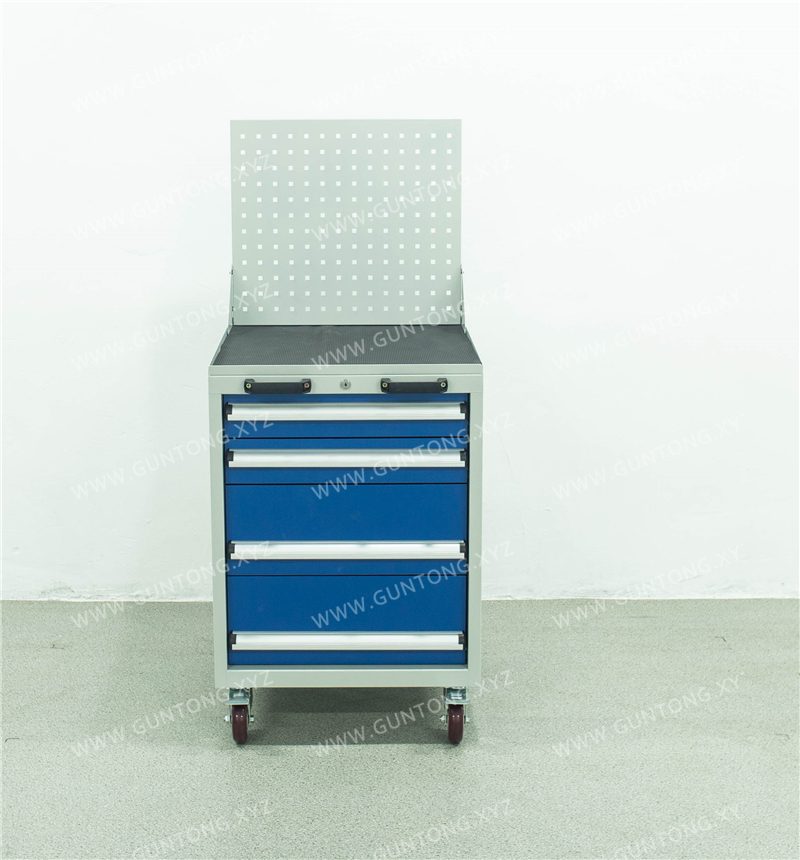
In high-mix, low-volume environments such as hardware mold maintenance or automotive parts prototyping, operators retrieve and return tools dozens of times per shift. A square hole pegboard mounted on a Single Back Panel Single Door 4-Drawer Steel Plate Workbench enables one-motion grab-and-return cycles. The 500 mm standard square-hole pegboard section on this model supports flexible hook expansion and visual management outlines.
In contrast, assembly lines running batch production with kitted components benefit from louvered panels where pre-sorted bins align with bill-of-material sequences.
Exception: Some workshops require both. In these cases, a hybrid configuration — pegboard on the upper back panel and louvered bins on a lower shelf rail — is achievable through custom workstation design.
Step 3: Confirm Load-Bearing and Material Requirements
Square hole pegboards are typically fabricated from 1.0 mm or 1.2 mm cold-rolled steel, matching the cabinet body specifications found in Guang'ErMei's Pegboard Storage Cabinet (Inner Half-Pegboard Type). This cabinet provides 100 kg load capacity per shelf and integrates a dual pegboard layout on the cabinet door for improved retrieval efficiency in heavy-duty material storage scenarios.
Louvered panels, when formed from the same gauge steel, distribute bin loads across the channel length rather than concentrating stress at individual hook points. For bins loaded with metal fasteners or dense electronic components, louvered channels reduce deformation risk.
Risk Boundary: Do not assume all pegboards share identical hole spacing. Hook accessories are not universally interchangeable between manufacturers. Confirm hole dimensions (e.g., 10×10 mm vs. 15×15 mm) and pitch before bulk-ordering accessories.
Step 4: Align with 6S and Audit Standards
Many manufacturing enterprises in Guangdong and nationwide enforce 6S workplace management. Square hole pegboards support shadow board techniques — painting tool outlines behind each hook — which makes missing tools immediately visible during audits. This is particularly valued in maintenance and testing institutions and vocational college training centers where accountability and training discipline are priorities.
Louvered panels support 6S through color-coded bins and labeled kanban cards, but the visual gap-detection is less immediate than a shadow board.
Next Action: Request a sample pegboard panel with your specified hole pattern to verify hook compatibility and outline marking feasibility before committing to a full workstation rollout.
Application Scenarios by Industry
| Industry | Recommended Backboard | Reasoning |
|---|---|---|
| Electronics assembly | Square hole pegboard (primary) + louvered bins (secondary) | Precision tools hung; small SMD reels in bins |
| Automotive parts manufacturing | Square hole pegboard | Heavy hand tools, torque wrenches, gauges require secure hanging |
| Hardware mold factories | Square hole pegboard | Large, irregular tools benefit from custom hook layouts |
| Warehousing and logistics | Louvered panel | Small parts sorting, pick-and-pack bin organization |
| Vocational training centers | Square hole pegboard | Shadow boards enforce tool accountability and training standards |
Common Configuration Mistakes to Avoid
- Ordering hooks before confirming hole pitch. Mismatched accessories cause project delays and wasted spend.
- Overloading a single pegboard point. Concentrated loads on thin-gauge hooks can deform the board. Distribute heavy tools across multiple hook points or use reinforced brackets.
- Ignoring depth clearance. Pegboard-mounted tools extend outward from the board surface. Ensure aisle clearance and adjacent workstation spacing accommodate the protrusion.
- Skipping the hybrid option. Many workshops force a binary choice when a dual-zone backboard (pegboard upper, louvered lower) better serves mixed workflows.
---
Implementation Checklist
- [ ] Inventory classified by tool type vs. part type
- [ ] Hole pitch and gauge confirmed with supplier
- [ ] Hook or bin accessories sampled and tested
- [ ] 6S visual management method selected (shadow board or kanban labels)
- [ ] Load distribution plan reviewed for heavy items
- [ ] Aisle and clearance dimensions verified
- [ ] On-site workstation layout reviewed with supplier engineering team
---
Conclusion
The choice between a square hole pegboard and a louvered panel is not about which is universally better — it is about matching the backboard to your dominant storage object, retrieval pattern, and compliance framework. Square hole pegboards excel in tool-heavy, high-retrieval, shadow-board-driven environments. Louvered panels serve part-heavy, bin-based, batch-kitting workflows. For mixed scenarios, custom hybrid configurations are available through workstation manufacturers offering both standardized production and non-standard customization.
Guang'ErMei Precision Components supports on-site workstation planning, load-bearing design, and 6S adaptation for manufacturing enterprises across Huizhou, Guangdong Province, and nationwide. Whether you need a single workbench reconfiguration or a full workshop rollout, the next step is to share your tool inventory list and floor plan for a tailored backboard recommendation.