
Specifications to Confirm for Custom Tool Carts: Selection and Configuration Guide
When procuring a custom tool cart for manufacturing, maintenance, or training environments, confirming the right specifications upfront prevents costly rework and ensures long-term usability. Below are the essential parameters to define based on real-world application scenarios.
1. Load Capacity per Drawer and Overall Structure
The most critical specification is the load-bearing capability. For heavy-duty applications in automotive parts or hardware mold factories, each drawer should support at least 80 kg using stamped heavy-duty rails that allow 85% extension. The overall frame, typically constructed from 1.0 mm or 1.2 mm cold-rolled steel, must maintain structural integrity under repeated mobile use.
Judgment basis: If tools include heavy wrenches, torque multipliers, or metal dies, specify heavy-duty rails. For lighter electronics assembly tools, standard rails may suffice.
2. Drawer Configuration and Dimensions
Drawer height options typically include 100 mm, 150 mm, and 200 mm modules. A common efficient configuration is two 100 mm drawers paired with two 200 mm drawers, accommodating both small precision tools and larger equipment.
Condition boundary: Confirm whether drawer heights are fixed or adjustable. Modular designs allow reconfiguration as tool inventories change over time.
3. Mobility and Wheel Specifications
Standard configuration includes four 4-inch casters: two fixed and two swivel with brakes. This setup provides stable positioning during use and easy relocation across workshop floors.
Execution suggestion: For uneven factory floors or frequent movement between workstations, specify larger diameter wheels or all-swivel configurations with individual locking mechanisms.
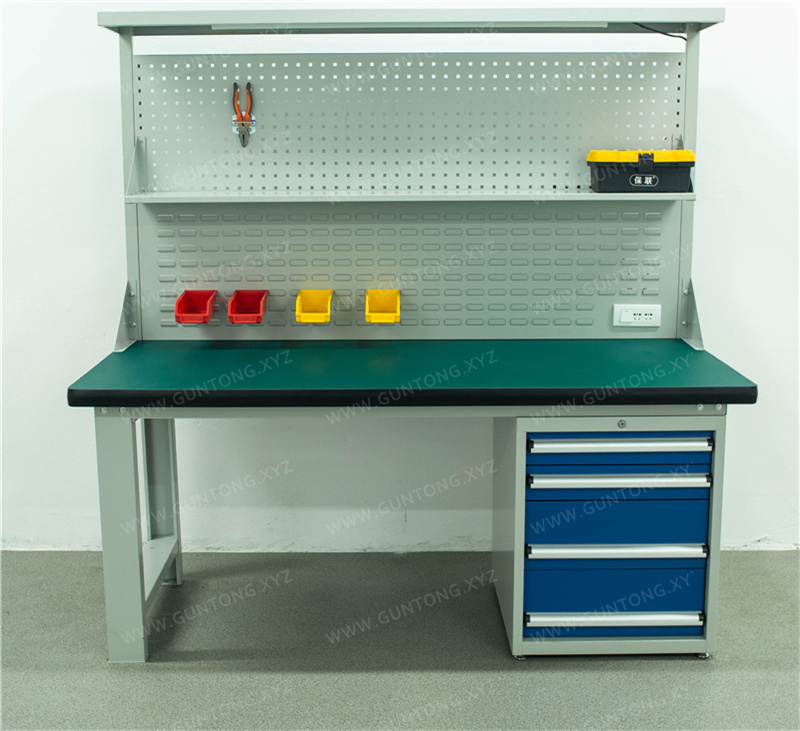
4. Pegboard Integration for Visual Management
A 500 mm square-hole pegboard mounted on the cart enables immediate tool visibility and supports 6S workplace organization. The pegboard can be positioned as a back panel or integrated into cabinet doors for space efficiency.
Real scenario: In maintenance and testing institutions, technicians frequently need immediate access to specific tools. Pegboard mounting reduces drawer opening time and prevents tool loss.
5. Material and Surface Treatment
Cabinet bodies and drawers should use minimum 1.0 mm cold-rolled steel for durability. Surface treatment options include powder coating in standard gray-white or blue, with custom colors available for corporate branding or departmental color-coding.
Boundary condition: Anti-static requirements in electronics manufacturing may necessitate specialized surface treatments beyond standard powder coating.
6. Overall Dimensions and Space Planning
A typical mobile tool cart footprint is approximately 1000 mm (W) × 500 mm (D) × 850 mm (H), including pegboard height. Confirm aisle widths and workstation clearances before ordering to ensure the cart fits operational workflows.
Execution suggestion: Measure the narrowest passage the cart must traverse and add 100 mm clearance on each side for comfortable maneuvering.
7. Customization Lead Time and Production Capacity
Standard configurations may be available within 2-3 working days. Non-standard customizations typically require 7-10 working days depending on complexity. Confirm production capacity if ordering multiple units for facility-wide deployment.
8. After-Sales Support and Warranty
Verify warranty terms—industry standard covers three years for structural components and drawer mechanisms. Confirm availability of replacement parts such as casters, rails, and drawer dividers for long-term maintenance.
---
By systematically confirming these eight specification categories, procurement teams can ensure custom tool carts meet actual workshop requirements rather than generic catalog descriptions. The key is matching load capacity, mobility needs, and storage configuration to specific industry applications.