
Single vs. Double Pegboard Workbenches: A Practical Selection Guide for Workshop Planners
Who This Decision Matters To
Workshop planners, production line managers, and procurement teams in electronics manufacturing, automotive parts fabrication, hardware mold factories, and maintenance/testing facilities regularly face a specific configuration question: should a workbench carry a single pegboard or a double pegboard? The answer is rarely about cost alone. It involves operator ergonomics, tool retrieval speed, visual management requirements, and the physical constraints of the workstation layout.
Guang'ErMei Precision Components designs and manufactures both single and double pegboard workbenches as part of its workstation equipment range, supporting standardized and non-standard customization for facilities across Huizhou, Guangdong Province, and nationwide.
Core Differences at a Glance
| Evaluation Factor | Single Pegboard Workbench | Double Pegboard Workbench |
|---|---|---|
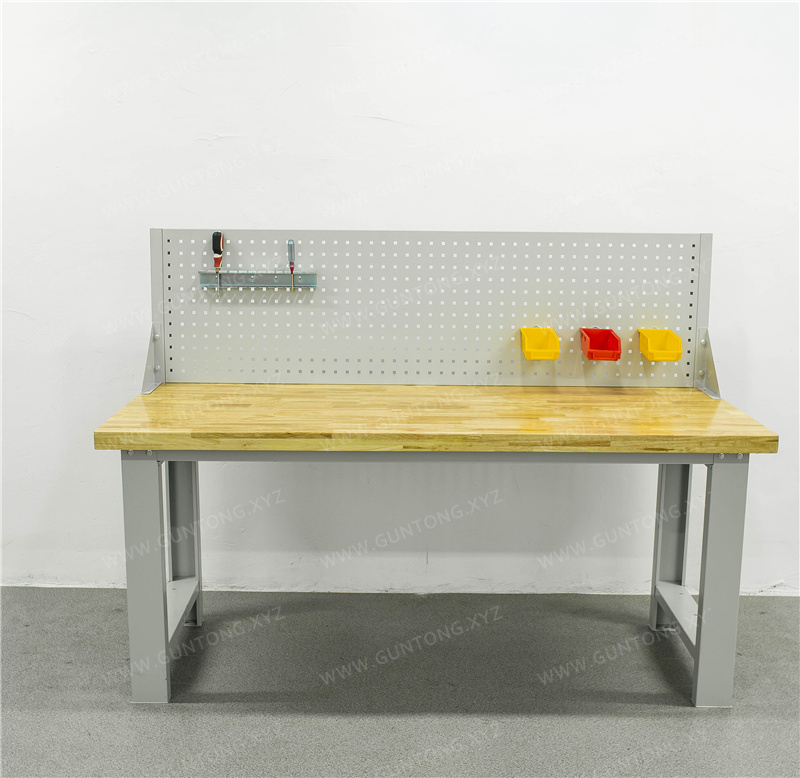
| Typical Configuration | One rear-mounted panel, usually 500 mm above desktop | Two panels—rear plus upper or side-mounted—expanding hanging surface |
| Tool Hanging Capacity | Moderate; suits task-specific tool sets | High; supports multi-task or shared-station tool inventories |
| Operator Sightline | Clear forward view; minimal visual obstruction | Upper panel may reduce overhead sightline; requires height planning |
| Footprint Impact | No additional depth or width required | May require taller frame or wider stance for stability |
| Best-Fit Scenarios | Dedicated assembly, single-operator inspection, ESD-sensitive electronics work | Multi-operator maintenance bays, fitter stations, training centers |
| Load Consideration | Lower moment load on frame | Higher moment load; frame must be rated for cantilevered weight |
Signals That Point to a Single Pegboard
A single pegboard configuration is typically sufficient when the workstation serves a focused, repeatable task. Consider these practical indicators:
Task-specific tool sets. If an operator uses fewer than 20 hand tools per shift—common in electronics assembly or precision inspection—a single rear panel with standard square-hole pegboard provides adequate hanging space. Tools remain within arm's reach without requiring the operator to scan multiple surfaces.
ESD-controlled environments. In anti-static workstations used for electronics assembly or testing, the workbench frame is typically constructed from 40×40×1.2 mm square steel tubing with a load rating of up to 300 kg for light-duty configurations. Adding a second pegboard increases the frame's cantilevered load and may require structural reinforcement that complicates grounding continuity. A single panel keeps the ESD path simpler to validate.
Limited overhead clearance. Facilities with low ceiling heights, overhead conveyor systems, or lighting rigs mounted close to the workstation may not accommodate a double pegboard's additional height. Standard workbench dimensions—such as 1500×750×800 mm or 1800×750×800 mm—leave limited vertical margin when a second panel extends 500 mm or more above the desktop.
6S visual management simplicity. When a workstation follows 6S methodology, a single pegboard with shadow boards or labeled hook positions makes it easier to audit tool placement at shift change. Fewer surfaces mean fewer places for tools to be misplaced.
Signals That Point to a Double Pegboard
A double pegboard configuration earns its additional complexity in specific operational contexts:
Multi-task or shared stations. In maintenance and repair bays where technicians rotate through different equipment types—automotive components, hardware molds, or industrial machinery—the tool inventory per station can exceed 40 items. A second pegboard, typically mounted as an upper tier or on a side wing, separates heavy wrenches and pliers from precision instruments, reducing retrieval time and cross-contamination risk.
Training and vocational education centers. School practical training workshops often configure workbenches for multiple curricula. A double pegboard allows instructors to dedicate one panel to the current lesson's tool set while the second panel holds reference tools or upcoming project materials. This separation supports structured learning without requiring full tool cabinet reconfiguration between classes.
Fitter and heavy-duty bench operations. Fitter workbenches rated for 1000 kg total load capacity—heavy-duty configurations per Guang'ErMei's product classification—have the structural margin to support dual pegboards without frame compromise. The cold-rolled steel frame and composite desktop (such as a 5 mm raw steel plate over high-density fiberboard) provide the rigidity needed when both panels are fully loaded with hanging tools.
Evaluation Criteria for Your Decision
Before specifying either configuration, workshop planners should assess the following:
1. Tool count and turnover frequency. Count the distinct tools an operator accesses per shift. Below 20 tools with low turnover, a single pegboard is usually optimal. Above 30 tools with frequent changeover, a double pegboard reduces search time.
2. Operator height and reach envelope. The upper edge of a double pegboard's second panel should not exceed the operator's comfortable reach height—typically 1800–1900 mm from the floor for standing work. If the workbench is configured for seated operation, the second panel may need to be side-mounted rather than stacked.
3. Frame load rating and moment calculation. Each loaded pegboard exerts a cantilevered moment on the workbench frame. A single panel loaded with 15 kg of tools at 500 mm above the desktop generates approximately 75 Nm of moment. A second panel at 900 mm with similar loading doubles the moment demand. Verify that the frame specification—such as C-type cold-rolled steel or 40×40×1.2 mm square tubing—is rated for the combined load.
4. Integration with existing storage. If the workstation already includes under-bench drawer cabinets (such as a 4-drawer configuration with 80 kg per-drawer capacity) or a separate tool cart, the pegboard's role may be limited to frequently used tools only—favoring a single panel.
5. Future reconfiguration needs. Facilities planning for lean pipe integration or automated storage and retrieval system (AS/RS) accessories should consider whether a double pegboard's additional hardware will complicate future workstation redesigns. Single-panel setups are generally faster to reconfigure.
Risks and Boundaries to Watch
Overloading the upper panel. A double pegboard's upper tier is often treated as overflow space, leading to unplanned weight accumulation. Specify a maximum load per panel and communicate it to operators. Guang'ErMei's pegboard panels, constructed from cold-rolled steel with square-hole patterns, are designed for distributed tool loads—but concentrated heavy items (large torque wrenches, power tools) should be stored in drawers or on lower shelves.
ESD continuity compromise. When adding a second pegboard to an anti-static workbench, ensure that the panel's mounting hardware maintains electrical continuity with the grounded frame. Insulated fasteners or powder-coated contact surfaces can break the grounding path. Request verification testing from the manufacturer after installation.
Sightline obstruction in inspection tasks. For quality inspection or testing stations where operators need an unobstructed view of the workpiece or monitoring equipment, a double pegboard's upper panel can create blind spots. In these cases, a single pegboard with a lower profile—or a side-mounted panel—is preferable.
Vibration transmission. In environments with nearby stamping presses or heavy machining, a double pegboard's additional surface area can amplify vibration transmission to hanging tools, potentially causing tool chatter or premature wear on precision instruments. Damping mounts or isolation pads between the pegboard and frame may be necessary.
Practical Configuration Examples
Electronics assembly line (single pegboard). A 1500×750×800 mm anti-static workbench with a single rear pegboard, 4-drawer under-bench cabinet, and ESD mat desktop. The pegboard holds soldering irons, tweezers, and wire cutters—12 tools total. The drawers store component reels and consumables. This configuration supports one operator per station with clear sightlines to the assembly board.
Automotive parts maintenance bay (double pegboard). A 2100×750×800+500 mm heavy-duty fitter workbench with a composite steel plate desktop rated for 1000 kg. The rear pegboard holds standard hand tools; the upper pegboard holds specialty pullers, gauges, and diagnostic probes. A separate 4-drawer tool cart with pegboard sits adjacent for overflow. This configuration supports two technicians working simultaneously on different vehicle subsystems.
Vocational training workshop (double pegboard). An 1800×750×800 mm workbench with dual pegboards configured for curriculum rotation. One panel is labeled for the current module's tools; the second panel holds upcoming project materials. Under-bench storage includes a single-door cabinet for shared measuring instruments. This setup supports 6S training and visual management education.
Next Steps for Workshop Planners
If you are evaluating pegboard configurations for a new workstation rollout or facility upgrade, start by documenting the tool inventory per station and the operator's primary task type. Use this data to determine whether a single or double pegboard delivers measurable retrieval-time improvement without introducing structural or ergonomic risk.
Guang'ErMei Precision Components provides on-site workstation planning, load-bearing design, and 6S adaptation consulting for manufacturing facilities. Our product range includes single and double pegboard workbenches, tool cabinets, tool carts, mold racks, and lean pipe systems—all supporting standardized production and non-standard customization.
Contact our engineering team to discuss your specific workstation requirements, request dimensional drawings, or schedule an on-site assessment for your facility in Huizhou, Guangdong Province, or nationwide.