
Single Tier vs Double Tier Stainless Steel Workbenches: A Practical Selection Guide
Single Tier vs Double Tier Stainless Steel Workbenches: A Practical Selection Guide
The Core Buyer Question: Open Ergonomics or Vertical Storage?
When outfitting a cleanroom, electronics assembly line, or testing laboratory, procurement managers often face a specific spatial dilemma: should we specify a single-tier stainless steel workbench for unrestricted legroom, or a double-tier model to maximize vertical tool and material storage? The answer is rarely about which design is universally better, but rather which configuration aligns with your specific operational constraints, cleanliness requirements, and workflow dynamics.
Comparing Options by Operational Constraints
1. Spatial Footprint and Ergonomics
Single-Tier Workbenches:
A single-tier design provides an open under-desk area. This is critical for operators who need to sit on adjustable stools, require extensive legroom, or use under-bench pedal controls. It also facilitates easier floor cleaning, a strict requirement in dust-proof and anti-corrosion environments.
Double-Tier Workbenches:
Double-tier models incorporate a secondary shelf either above the desktop or below it. While an under-desk shelf reduces legroom and forces a standing or high-stool working posture, an upper-tier shelf utilizes vertical airspace. This keeps frequently used components within arm's reach but may obstruct overhead lighting or interfere with suspended cleanroom airflow systems.
2. Load Capacity and Structural Integrity
The choice of tiering impacts the load distribution and required frame strength.
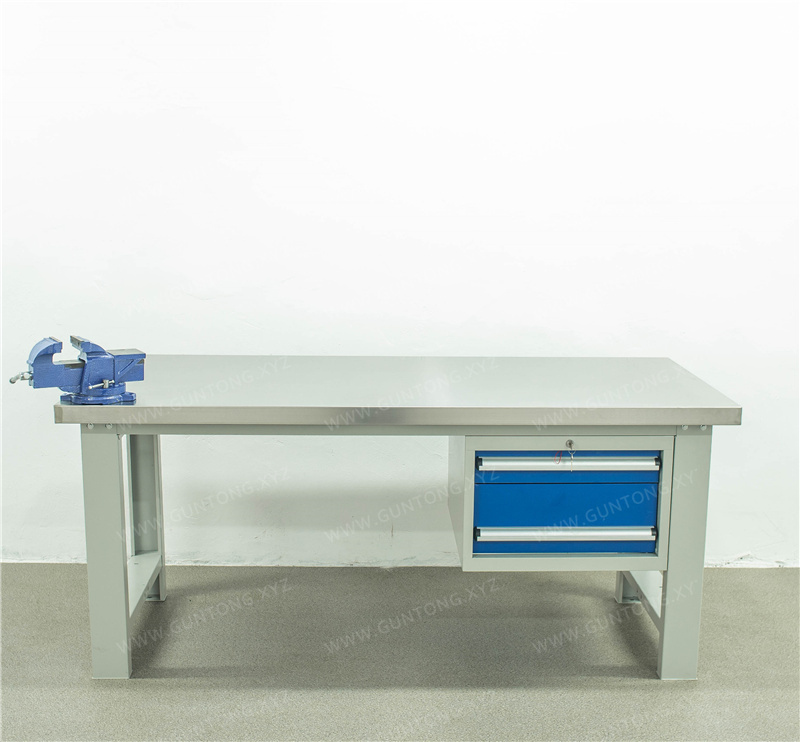
- For heavy-duty applications requiring up to 1000 kg load capacity, the frame typically utilizes 1.5mm high-quality cold-rolled steel with acid washing, phosphating, and powder electrostatic spraying. A single-tier design with this robust frame ensures maximum stability without the vibration transfer that might occur on a heavily loaded upper tier.
- For medium-duty tasks with a 500 kg load capacity, frames constructed with 3.0mm square tubes are sufficient. Double-tier configurations in this category are ideal for holding lightweight electronic components or testing instruments on the secondary shelf.
3. Surface Material and Cleanliness Requirements
Regardless of the tier configuration, the desktop material dictates the workbench's suitability for sensitive environments. High-quality stainless steel workbenches feature a total desktop thickness of 50mm, constructed by wrapping 1mm 201 stainless steel around a 49mm high-density board covering all 5 sides. This composite structure delivers high strength, aesthetic appeal, and excellent acid and alkali resistance, making it strictly suitable for scenarios with high dust-proof and anti-corrosion requirements, such as medical device manufacturing or chemical testing labs.
Trade-Offs and Decision Matrix
| Constraint / Requirement | Single-Tier Stainless Steel Workbench | Double-Tier Stainless Steel Workbench |
|---|---|---|
| Operator Posture | Ideal for seated tasks; full legroom. | Best for standing tasks or high-stool seating. |
| Tool & Material Access | Requires separate tool cabinets or carts. | Keeps immediate consumables within arm's reach. |
| Floor Cleaning & 6S | Unobstructed floor access; excellent for cleanrooms. | Under-desk shelves may trap dust; requires strict 6S management. |
| Overhead Clearance | No vertical obstruction; safe for suspended equipment. | Upper tiers may interfere with lighting or airflow. |
Implementation Boundaries and Customization
When procuring these workbenches, buyers must balance standard lead times with custom requirements.
- Standard Dimensions: Manufacturers typically keep standard sizes ready for rapid deployment, commonly 1500x750x800 mm, 1800x750x800 mm, and 2100x750x800 mm.
- Non-Standard Customization: For specialized assembly lines or vocational college training centers, non-standard dimensions and specific tier heights can be customized. With 18 years of industry experience in workshop equipment, manufacturers like Huizhou Guang'ErMei Precision Components support tailored designs, integrating anti-static features, specific drawer configurations, or lean pipe structures to match exact workflow needs.
Conclusion
Choosing between a single-tier and double-tier stainless steel workbench requires evaluating your operators' ergonomic needs against your immediate storage requirements. If your priority is unrestricted movement, seated ergonomics, and stringent cleanroom floor hygiene, the single-tier model is the optimal choice. If your workflow demands high-density, immediate-access storage for small parts and operators primarily stand, a double-tier configuration will improve efficiency.
Next Steps
Evaluate your current workstation layouts and identify whether under-desk space or vertical storage is the primary bottleneck. For tailored advice on integrating stainless steel workbenches with tool cabinets and automated storage systems, consult with our engineering team to optimize your workshop's 6S management and operational flow.