
How to choose selection criteria, single pegbo: selection, rollout and support checklist
Single Pegboard 3-Drawer Composite Workbench: A Practical Guide to Selection Criteria
Understanding the Technical Parameters Before You Buy
Selecting a single pegboard 3-drawer composite workbench is not merely about choosing standard dimensions. It requires evaluating how desktop composition, frame geometry, and storage architecture interact under operational loads. For maintenance workshops, electronics assembly lines, and automotive parts testing stations, the right configuration directly impacts 6S compliance, retrieval efficiency, and long-term structural stability.
Desktop Composition and Load Distribution
The term composite desktop refers to a layered surface designed to balance durability, vibration damping, and tool protection. In practice, this typically combines a structural base layer with a functional top layer such as high-density fiberboard or anti-static laminate. The composite structure prevents metal-on-metal noise, reduces surface wear, and distributes point loads more evenly across the supporting frame. When evaluating load capacity, distinguish between total bench rating and per-drawer limits. While heavy-duty workshop benches often support substantial static loads, individual drawers operate under different stress vectors. Industry benchmarks for comparable storage modules indicate single-drawer capacities around 80 kg, though exact ratings depend on slide rail grade and internal bracing. Always match your heaviest tools or test fixtures to the bottom drawer, where the center of gravity remains lowest.
Pegboard Integration and 6S Adaptation
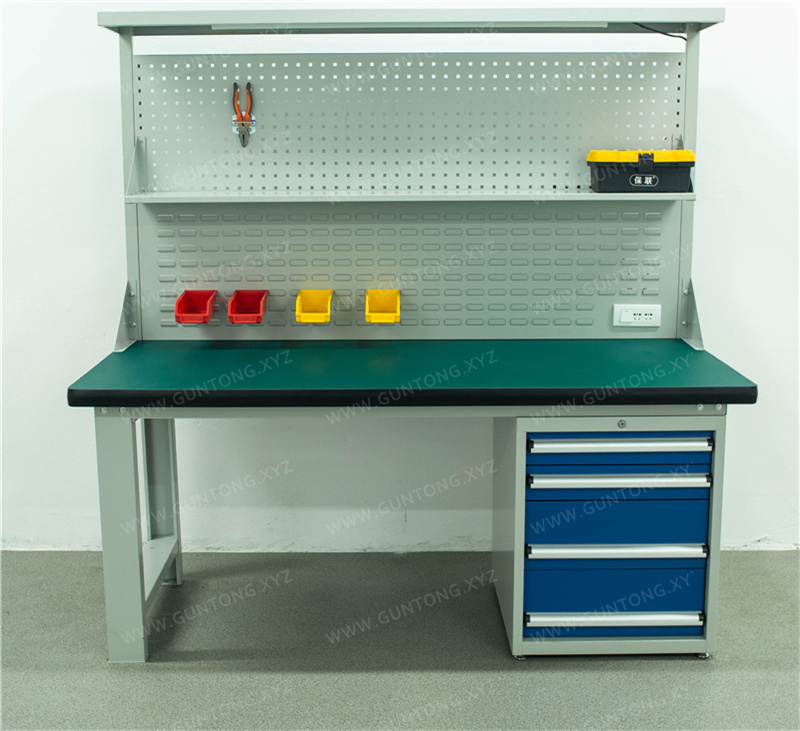
A single-side pegboard layout prioritizes vertical visibility and quick access without consuming additional floor space. The square-hole grid system allows modular hooks, bins, and torque wrench holders to be repositioned as workflow changes. However, pegboard effectiveness depends on mounting depth and backing reinforcement. If your operation requires frequent reconfiguration, verify that the pegboard is backed by solid sheet metal rather than thin perforated panels, which can sag under repeated hardware adjustments.
Internal organization varies significantly across models. As noted in manufacturer specifications, exact shelf counts, pegboard positioning, and drawer configurations differ by unit type. This means selection should start with a physical inventory of your tools, not just external measurements. A 3-drawer unit works best when paired with a dedicated pegboard zone for frequently used hand tools, while heavier or bulkier items remain in the lower compartments.
Frame Geometry and Installation Boundaries
The frame dictates mobility, leg clearance, and overall rigidity. Cold-rolled steel frames with reinforced corner welds provide superior resistance to lateral sway during assembly or testing tasks. For fixed installations, bolt-down feet or leveling pads ensure alignment with existing floor markings. If mobility is required, verify caster wheel specifications including load rating, brake type, and floor compatibility before finalizing the order.
Delivery and installation follow a clear boundary: manufacturers typically supply standardized components within defined dimensional tolerances, while site-specific adaptations such as custom cutouts, integrated power/data conduits, or specialized surface coatings require engineering review. Floor flatness, ambient humidity, and intended duty cycle should be communicated during the quoting phase to avoid post-delivery modifications.
Decision Checklist for Procurement Teams
- Confirm total static load versus dynamic operational load requirements.
- Verify desktop material matches your ESD, chemical, or heat exposure needs.
- Map your tool inventory to drawer heights and pegboard zones.
- Request load-test certificates or structural diagrams for critical applications.
- Align delivery timelines with site preparation milestones.
Next Steps
Guang'ErMei Precision Components supports both standardized configurations and non-standard customizations for workshop workbenches. Our engineering team reviews floor plans, load matrices, and 6S layouts to recommend optimal desk dimensions, frame types, and storage integrations. To initiate a precise quotation or request a technical specification sheet for a single pegboard 3-drawer composite workbench, contact our project consultation line or submit your operational requirements through the official inquiry form. All custom dimensions, material grades, and load ratings are finalized upon engineering approval and contract signing.
Specifications indicate that single-drawer load limits typically cap at 80 kg, with full-extension slides permitting approximately 85% drawer opening. While standardized footprints exist, exact rail grades and weight ratings vary significantly across models. Similar to modular storage systems where structural components feature free assembly and adjustable spacing, always cross-reference specific dimensional and load data against your operational requirements before finalizing procurement.