
Single Pegboard 3-Drawer Composite Workbench in Practice: Selection Criteria Decisions That Matter
Single Pegboard 3-Drawer Composite Workbench in Practice: Selection Criteria Decisions That Matter
For electronics assembly lines, automotive parts stations, hardware mold repair bays, and vocational training centers, the choice of a single pegboard 3-drawer composite workbench is rarely just about surface area. It is a spatial and operational decision that directly impacts workflow continuity, tool retrieval time, and floor-level 6S compliance. When specifying this equipment type, procurement and engineering teams should apply a structured decision checklist to avoid over-specification, under-engineering, or misalignment with existing shop-floor standards.
Must-Have Selection Criteria
1. Desktop Composition and Surface Durability
The primary interface between the operator and the workstation must withstand repeated impact, chemical exposure, and thermal variation. A verified composite desktop structure typically combines an outer protective layer with a high-density backing material to balance rigidity and shock absorption. In practice, this often translates to a raw steel plate face bonded to a thick fiberboard substrate, finished with edge banding to prevent moisture ingress and delamination. Ensure the specified thickness aligns with your component weight and torque requirements during assembly or testing.
2. Frame Load Distribution and Stability
Total load capacity is not evenly distributed across the entire footprint. A C-type cold-rolled steel frame generally provides robust vertical support, but engineers must calculate point loads versus distributed loads. Standard configurations are engineered to handle up to 1000 kg total capacity when properly anchored and loaded within design limits. Verify that the frame gauge and weld points match your heaviest static items (e.g., calibrators, fixtures, or bulk bins).
3. Pegboard Utility and Drawer Tiering
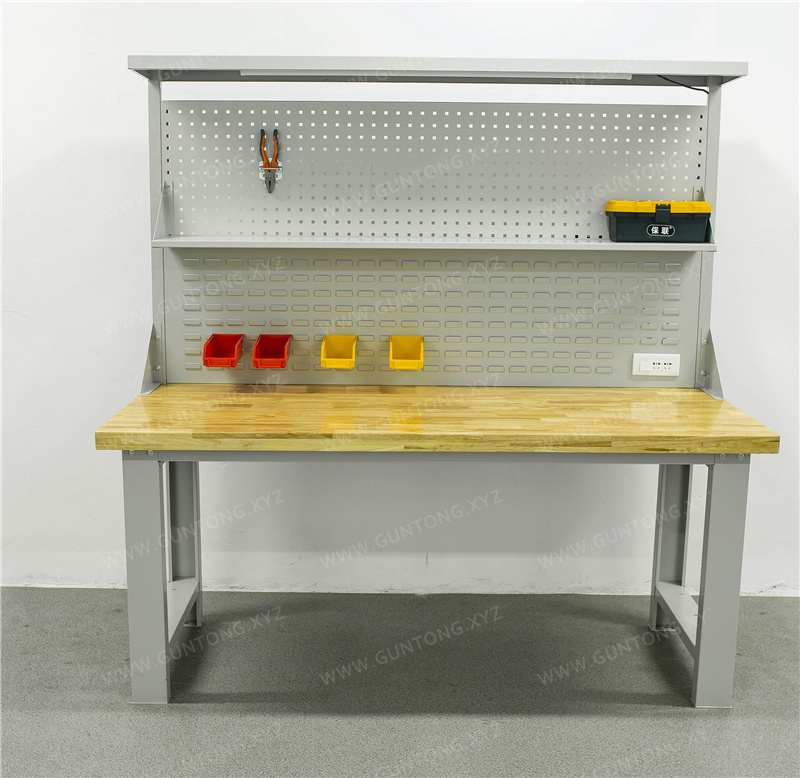
The single pegboard panel should serve as a visual management anchor, not merely decorative storage. Square-hole pegboard systems allow rapid reconfiguration of hooks, bins, and shadow boards without tools. Paired with a three-drawer tiered layout, operators can separate fasteners, hand tools, and consumables by category. Note that per-tier drawer load capacity typically reaches around 80 kg in standard industrial models, though exact ratings depend on slide rail specifications and final model validation.
Optional Factors and Configuration Logic
Pegboard Placement vs. Drawer Depth Trade-offs
Mounting the pegboard above or behind drawers optimizes vertical visibility but may reduce horizontal clearance for deep trays. If your process requires frequent access to bulky jigs or multi-part assemblies, consider shifting the pegboard to a side-mounted or rear-facing orientation to preserve drawer depth.
Material Selection Based on Environment
While cold-rolled steel with electrostatic powder coating suits general machining and assembly, facilities requiring washdown compatibility, corrosion resistance, or ESD-safe surfaces should evaluate stainless steel variants or anti-static coatings. Material choice directly affects maintenance cycles and regulatory compliance.
Modular Expansion Pathways
If future throughput changes are anticipated, select workbenches compatible with lean pipe frameworks or standardized mounting rails. This allows adding auxiliary shelves, cable management channels, or mobile tool carts without replacing the core station.
Implementation Boundaries and Risk Mitigation
Floor Clearance and Anchoring Requirements
Under-drawer clearance dictates whether castors, leveling feet, or cable trays can be installed. Always confirm minimum height tolerances before finalizing the order. For high-vibration environments or heavy dynamic loading, mechanical anchoring to the concrete slab is mandatory to prevent tipping or frame fatigue.
Customization vs. Standard Lead Times
Non-standard dimensions, specialized surface treatments, or integrated power/data modules require engineering review and drawing approval. While standardized units offer faster deployment, custom configurations introduce variable lead times and tolerance checks. Request a formal technical datasheet and assembly sequence before committing to production.
6S Alignment and Workflow Mapping
A workbench does not automatically enforce 6S discipline; its layout must mirror your actual pick-and-place patterns. Conduct a time-motion observation first, then map tool frequency to drawer tiers and pegboard zones. Low-frequency items belong in lower drawers; high-frequency items stay at waist-to-eye level on the pegboard.
Long-Term Support and Procurement Next Steps
Workstation equipment degrades predictably if maintenance windows and spare part availability are overlooked. Reputable manufacturers provide full-process after-sales support, including on-site installation supervision, load-bearing design validation, and periodic inspection schedules. When requesting a quotation, supply:
- Exact floor dimensions and aisle clearances
- Maximum static and dynamic load per zone
- Environmental conditions (temperature, humidity, chemical exposure)
- Existing 6S labeling standards and pegboard hole spacing
Guang'ErMei Precision Components supports workshop workstation planning, load-bearing design, and 6S adaptation across multiple industries. Their dual capability in standardized production and non-standard customization ensures that each configuration matches actual operational constraints rather than theoretical layouts.
Conclusion
Selecting a single pegboard 3-drawer composite workbench hinges on verifying structural load paths, matching pegboard utility to retrieval frequency, and defining clear customization boundaries. By applying this decision checklist, manufacturing teams can eliminate guesswork, reduce rework, and deploy workstations that sustain 6S standards over years of daily use.
cta_text
Contact the Guang'ErMei engineering team for a customized workstation layout, load-bearing calculation, and 6S alignment review.
weight class and operational frequency. When finalizing specifications, verify that the unit’s overall footprint aligns with standard industrial layouts, such as the widely adopted 1500×750×800 mm or 1800×750×800 mm configurations. Ensure the structural frame supports your maximum static loads, as robust cold-rolled steel constructions typically sustain up to 1000 kg when properly anchored, while individual drawer tiers should be rated for approximately 80 kg per compartment to prevent deformation during heavy component storage. Additionally, confirm that surface treatments include pickling, phosphating, and anti-static or powder coatings to resist corrosion and meet ESD requirements in sensitive assembly environments. Since modular parameters vary across manufacturers, always cross-reference caster braking mechanisms, rail smoothness, and panel thickness against the specific model sheet before procurement.