
Single Pegboard 3-Drawer Composite Workbench: A Practical Guide to Implementation Process
Single Pegboard 3-Drawer Composite Workbench: A Practical Guide to Implementation Process
Direct Answer: Implementing a single pegboard 3-drawer composite workbench requires aligning fixed desktop ergonomics with mobile storage boundaries to establish a stable, 6S-compliant workflow. The process moves from spatial and load assessment to component configuration, on-site calibration, and visual management setup.
Signals: Assessment & Planning
Before procurement or layout drafting, verify three core signals:
- Floor Space & Aisle Clearance: Measure the primary assembly or testing zone. Standard mobile tool carts typically follow a 566×600×850 mm footprint, which dictates minimum aisle widths (usually ≥800 mm) to allow smooth navigation without colliding with fixed stations.
- Load Distribution Requirements: Determine how weight will be shared between the desktop and storage units. Standard drawer configurations are engineered with a per-compartment limit of approximately 80KG, meaning heavy fixtures or bulk components should be routed to lower shelves or reinforced base frames rather than concentrated in upper drawers.
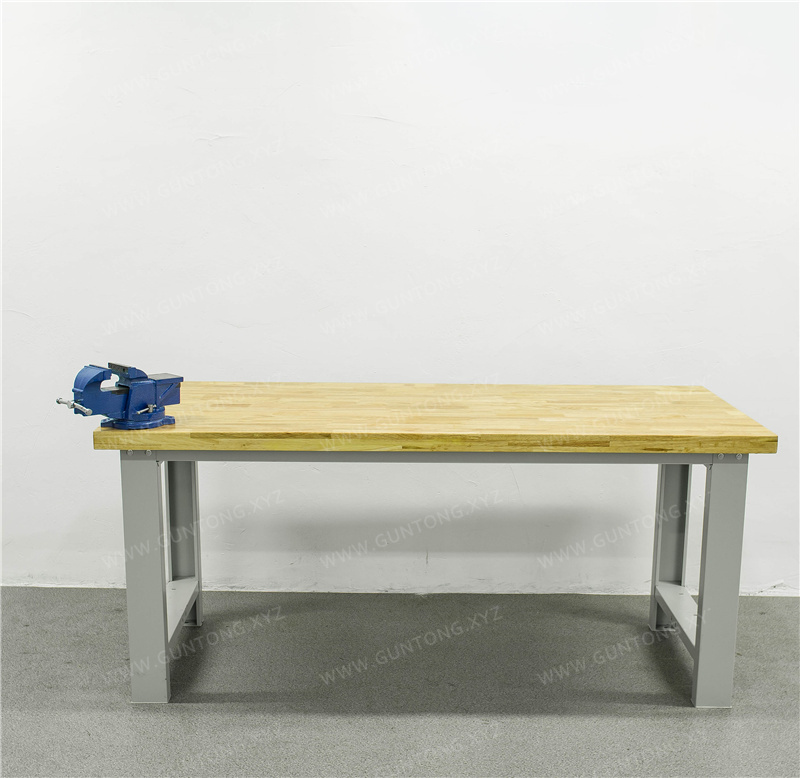
- Surface Compatibility: Match the desktop material to the task. A composite structure combining a 5 mm raw steel plate with high-density fiberboard offers impact resistance, vibration dampening, and optional anti-static treatment, making it suitable for electronics assembly, light machining, and inspection tasks.
Actions: Implementation Steps
Once parameters are confirmed, execution follows a structured sequence:
1. Layout Mapping & Module Pairing
Position the single pegboard workbench against a wall or partition to maximize open floor space. Pair it with a 4-drawer 1-door tool cart for frequently accessed hand tools and consumables. The cart’s sliding mechanism enables rapid station-to-station movement while keeping the main desktop clear for active assembly or measurement.
2. Structural Assembly & Leveling
Guang’ErMei Precision Components supplies standardized C-type cold-rolled steel frames designed for uniform load distribution across the 1,000 kg total capacity range. Technicians anchor leveling feet, secure casters where mobility is required, and verify squareness before installing drawer rails and pegboard panels.
3. 6S Visual Management Integration
Apply color-coded labels to drawer fronts, shelf edges, and pegboard zones. Route cables through integrated grommets and attach tension rods or lean pipe supports for hanging bins, torque wrenches, or test probes. Ensure all moving parts (drawers, doors, casters) operate smoothly without binding or excessive play.
4. Custom Configuration & Documentation
For non-standard workflows, provide exact dimensional tolerances, load charts, and environmental conditions (e.g., humidity, chemical exposure). Guang’ErMei translates these inputs into 3D layout drafts and configuration lists, ensuring that every module aligns with actual shop-floor operations before production begins.
Boundaries & Risk Control
Fixed composite workbenches excel in stationary assembly, inspection, and light hardware processing but are not intended for heavy forging, continuous high-frequency vibration, or direct cutting operations. Mobile carts introduce flexibility but require floor surface verification; uneven concrete may necessitate locking casters or reinforced bases to prevent drift during operation.
Material selection also defines operational limits: composite tops suit general manufacturing and electronics, whereas environments requiring washdown protocols or chemical resistance should specify stainless steel cladding or coated surfaces. Custom configurations bypass standard lead times, so early submission of usage scenarios and structural requirements prevents rework or misalignment during installation.
Conclusion
A successful workstation implementation hinges on matching static storage capacity with dynamic workflow demands. By verifying spatial signals, pairing fixed benches with appropriately rated mobile carts, and applying systematic 6S practices, manufacturers can reduce search time, minimize clutter, and maintain consistent output quality.
Next Steps
Share your workshop floor plan, expected part weights, and retrieval frequency with Guang’ErMei Precision Components. Our engineering team will provide a tailored configuration list, 3D layout draft, and on-site installation schedule aligned with your production timeline.