
Single vs. Double vs. No Pegboard Workbenches: A Facility Planner’s Selection Guide
Selecting the appropriate workbench configuration is a critical decision for manufacturing facility planners and workshop managers. The choice between a single pegboard, double pegboard, or no pegboard workbench directly influences operator ergonomics, tool retrieval speed, and overall floor space utilization. This guide evaluates these three configurations across the adoption lifecycle to help you align your workstation equipment with specific production requirements.
Before Adoption: Assessing Workflow and Spatial Constraints
The initial selection phase requires a thorough analysis of the tasks performed at the workstation, the physical dimensions of the workpieces, and the available vertical clearance.
No Pegboard Workbenches: Maximizing Vertical Clearance
Workbenches without pegboards are engineered for environments where overhead space must remain entirely unobstructed.
- Ideal Scenarios: Heavy-duty assembly of large components, maintenance tasks requiring overhead hoists or mobile cranes, and operations where large testing equipment is mounted directly above the desktop.
- Operational Impact: Operators rely entirely on under-bench storage or adjacent tool cabinets. This setup prioritizes unrestricted vertical movement over immediate tool visibility.
Single Pegboard Workbenches: The Ergonomic Standard
A single back panel setup is the most widely deployed configuration in general manufacturing and electronics assembly.
- Ideal Scenarios: Standard assembly lines, hardware mold maintenance, and vocational training centers where a moderate variety of hand tools and pneumatic devices are used.
- Operational Impact: It provides an optimal balance between tool visibility and open workspace. Guang'ErMei's design capabilities cover heavy-duty, single pegboard, two-drawer, and vise configurations to meet diverse operational needs, ensuring that the most frequently used tools are within the operator's primary reach zone without causing visual clutter.
Double Pegboard Workbenches: High-Density Tool Management
Double pegboard setups (often featuring a primary back panel and an upper tier or dual-sided panels) maximize vertical storage density.
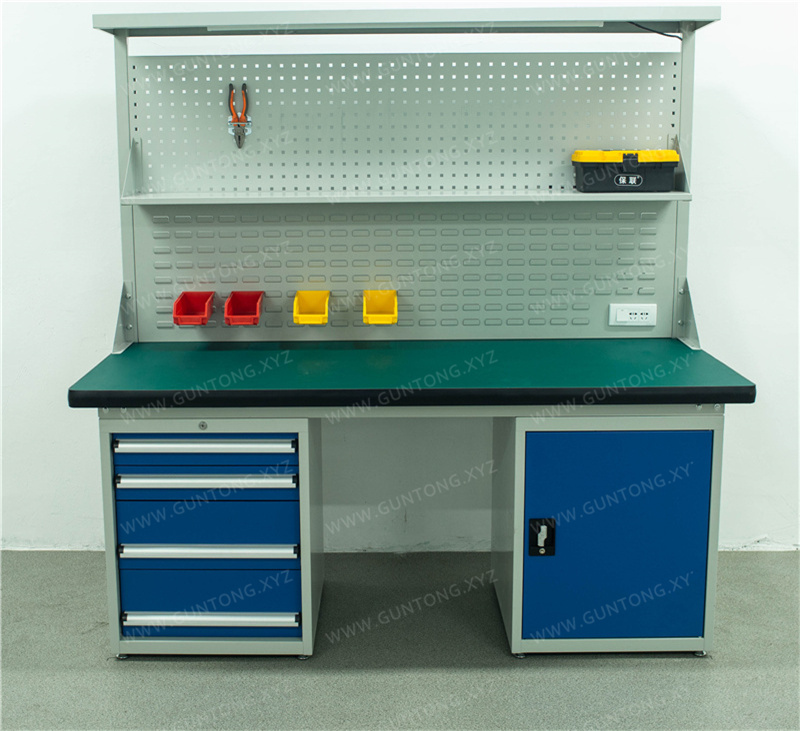
- Ideal Scenarios: High-mix, low-volume production, complex electronics repair, and comprehensive testing stations requiring dozens of specialized instruments.
- Operational Impact: While offering superior tool capacity, double pegboards require careful planning regarding facility lighting and ceiling height to prevent shadowing on the work surface and to maintain a safe, uncramped environment.
During Adoption: Configuration and Equipment Integration
Once the configuration type is selected, the focus shifts to integrating the pegboard with the workbench structure and supplementary storage to ensure structural integrity and workflow continuity.
Structural Load and Material Selection
The addition of a pegboard alters the center of gravity and load distribution of the workbench. For single pegboard steel plate workbenches, the frame must support both the desktop load and the dynamic weight of tools hung on the panel. Utilizing C-type cold-rolled steel frames ensures stability, particularly when the desktop is subjected to heavy impacts.
Integrating Under-Bench Storage
Pegboards handle visual management and quick-access tools, but bulkier or heavier items require secure drawer storage. When pairing workbenches with heavy-duty tool cabinets, drawers can open approximately 85% and support a load capacity of up to 80 kg per drawer. This combination ensures that heavy power tools are stored safely at a lower center of gravity, while lightweight, high-frequency tools remain on the pegboard.
Standardization and Customization
Facility planners can reference an extensive catalog featuring 394 product detail pages to identify the precise workstation components required. Whether selecting standard square-hole pegboards for universal hook compatibility or specifying custom dimensions for automated production lines, matching the pegboard hole type with standardized hanging accessories is essential for a seamless installation.
After Adoption: 6S Management and Continuous Optimization
Post-installation, the pegboard configuration becomes the visual anchor for the facility's 6S management (Sort, Set in order, Shine, Standardize, Sustain, Safety) protocols.
Visual Management and Shadow Boards
Single and double pegboards facilitate the implementation of shadow boards. By outlining tool shapes directly on the pegboard, supervisors can instantly identify missing tools, reducing search time and preventing foreign object debris (FOD) in sensitive manufacturing environments like automotive parts production.
Workflow Adjustments
As production requirements evolve, the modular nature of pegboard systems allows for rapid reconfiguration. Hooks, shelves, and tool holders can be repositioned without modifying the workbench structure. Regular audits should be conducted to ensure that the tools placed on the upper tiers of double pegboards remain ergonomically accessible to all operators, adjusting layouts to prevent excessive stretching or strain.
By systematically evaluating spatial constraints, integrating robust storage solutions, and enforcing visual management standards, manufacturers can deploy workbench configurations that sustainably enhance productivity and workplace safety.