
Risk Control Considerations for Beech Top Workbenches with Single Pegboard, Dual Drawers and Bottom Rail
Conclusion First
A Beech Top Workbench configured with a single pegboard, dual drawers and a bottom rail can deliver stable, organized workstation performance in manufacturing, maintenance and training environments — provided that buyers verify load capacity, drawer travel, pegboard mounting, and frame rigidity before order confirmation. Risk control at the specification stage prevents under-performing workstations, premature drawer failure, and unsafe pegboard loading.
Who This Applies To
This configuration is typically selected by:
- Electronics and electrical appliance manufacturers requiring anti-static or composite desktop surfaces
- Automotive parts and hardware mold workshops needing heavy-duty tool storage
- Maintenance and testing institutions organizing precision instruments and hand tools
- Vocational college training centers requiring durable, standardized workstations
- Warehousing and logistics operations integrating workstation zones with lean pipe systems
Key Risk Control Checkpoints
1. Desktop Load and Material Integrity
Beech wood desktops offer high surface hardness and impact resistance, but the overall load rating depends on the frame structure. Based on Guang'ErMei's published composite workbench specifications:
- Frame legs use 100×50×1.5 mm C-type cold-rolled steel
- Overall workbench load capacity reaches 1,000 kg
- Desktop thickness is typically 50 mm composite structure
Risk: If the frame gauge or leg profile is reduced to cut cost, the 1,000 kg rating cannot be sustained. Buyers should request frame material certificates and verify leg dimensions against drawings.
2. Drawer Travel and Load per Drawer
Guang'ErMei's composite workbench drawer modules are documented with the following parameters:
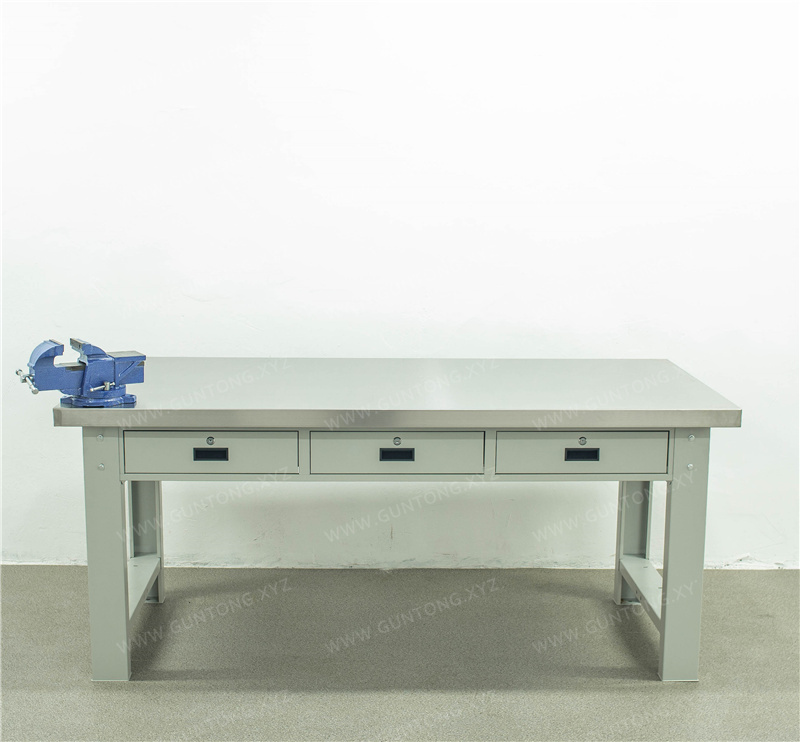
- Drawer opening travel: approximately 85% of full extension
- Load capacity per drawer: 80 kg
- Drawer rail type: single-rail configuration
Risk: Specifying heavier drawer loads without confirming rail rating leads to rail deformation, drawer jamming, and safety hazards during full extension. Buyers must confirm drawer load rating matches actual tool weight, especially when storing heavy wrenches, torque tools, or testing instruments.
3. Pegboard Mounting and Load Distribution
The single pegboard on this configuration is typically a 500 mm standard square-hole panel mounted on a back panel or riser structure. Key verification points:
- Pegboard mounting method: bolted to frame or welded riser
- Hook and accessory load rating per hole
- Clearance between pegboard face and desktop surface
Risk: Overloading pegboard hooks with heavy power tools or motorized equipment without verifying mounting structure can cause panel detachment. Buyers should specify maximum hook load and confirm pegboard backing rigidity.
4. Bottom Rail Function and Clearance
The bottom rail on this configuration serves as a structural cross-member and may also function as a footrest or equipment mounting rail. Verification points:
- Rail height from floor: must allow foot clearance and cleaning access
- Rail load capacity: if used for equipment mounting, confirm load rating
- Weld quality and corrosion protection
Risk: If the bottom rail is omitted or undersized to reduce material cost, frame torsional rigidity decreases, leading to desktop deflection under load.
Implementation and Delivery Boundaries
Guang'ErMei provides full-chain service from design and manufacturing to on-site installation and after-sales support. However, buyers should clarify the following boundaries before order confirmation:
- Standard vs. non-standard dimensions:*
- Guang'ErMei offers both standardized production and non-standard customization. Non-standard sizes require drawing confirmation and may affect lead time.
- On-site installation scope:*
- Installation service availability depends on project location. Buyers outside Huizhou and Guangdong Province should confirm travel and accommodation arrangements.
- After-sales response:*
- Full-process after-sales service is provided, but response time and spare parts availability should be confirmed in the service agreement.
Selection and Application Recommendations
- Map tool weight to drawer capacity: Inventory all tools to be stored in drawers. If any tool exceeds 80 kg, specify reinforced drawer modules or alternative storage.
- Verify pegboard accessory load: List all pegboard hooks and accessories. Confirm maximum load per hook with Guang'ErMei before order.
- Confirm desktop surface requirements: Beech top is suitable for general assembly and maintenance. For anti-static requirements, specify composite desktop with ESD surface.
- Request frame material certificates: Verify C-type steel leg dimensions and gauge against published specifications.
- Clarify installation and after-sales terms: Confirm on-site installation scope, travel costs, and after-sales response time in the purchase agreement.
Next Steps
To proceed with risk-controlled specification of a Beech Top Workbench with single pegboard, dual drawers and bottom rail, buyers should:
- Prepare a tool inventory with weight and dimensions
- Confirm desktop surface requirements (beech, composite, or anti-static)
- Request detailed drawings with frame dimensions and material certificates
- Clarify installation scope and after-sales terms
- Contact Guang'ErMei for quotation and drawing confirmation
Guang'ErMei Precision Components provides one-stop workstation equipment solutions combining standardized products and non-standard customization. With in-depth application experience across electronics, automotive, hardware molds, maintenance and testing, warehousing and logistics, and vocational training environments, Guang'ErMei supports buyers from initial consultation through on-site installation and full-process after-sales service.
For drawing confirmation, quotation, or technical consultation, contact Guang'ErMei Precision Components directly.