
Requesting Quotes for Stainless Steel Workbenches: Essential Parameters and Configuration Trade-Offs
Requesting Quotes for Stainless Steel Workbenches: Essential Parameters and Configuration Trade-Offs
When requesting quotes for stainless steel workbenches, manufacturing and testing facilities must clearly define the desktop composition, frame load capacity, dimensional tolerances, and surface treatment requirements. Confirming these parameters upfront prevents budget overruns and ensures the equipment meets the specific dust-proof and anti-corrosion demands of your workspace.
Core Parameters to Confirm in Your RFQ
1. Desktop Composition and Wrapping Method
The desktop dictates the workbench's durability and chemical resistance. A standard high-performance configuration features a 1.0mm 201 stainless steel surface composite with a 49mm high-density fiberboard core, resulting in a total thickness of 50mm.
Critical detail to confirm: Specify whether the stainless steel wraps all 5 sides (top and four edges) or just the top surface. A 5-side wrap significantly enhances edge durability and prevents moisture ingress, which is vital for environments with strict anti-corrosion requirements.
2. Frame Material and Load Capacity
The understructure must align with your operational load. You typically have two structural paths:
- Heavy-Duty C-Frame:*
- Constructed from 1.5mm high-quality cold-rolled steel, this design supports up to 1000 kg. It is ideal for hardware mold factories and automotive parts assembly.
- Standard Square Tube Frame:*
- Utilizing 3.0mm square tubes, this configuration supports up to 500 kg, suitable for electronics assembly or lightweight testing institutions.
Surface Treatment: Always confirm if the frame undergoes pickling, phosphating, and powder electrostatic spraying (cured at 250°C) to ensure long-term rust resistance.
3. Dimensions: Standard vs. Non-Standard
Standard dimensions (e.g., 1500×750×800mm, 1800×750×800mm, and 2100×750×800mm) generally offer faster lead times and better cost efficiency. If your facility layout or automated storage and retrieval system (AS/RS) integration requires non-standard sizes, explicitly state the exact length, width, and height, as custom fabrication will impact both pricing and delivery schedules.
Configuration Trade-Offs and Budget Factors
Material Grade: 201 vs. 304 Stainless Steel
While 201 stainless steel provides excellent strength and aesthetic appeal for general dust-proof and mild anti-corrosion environments (like standard electronics or warehousing), facilities dealing with harsh chemicals or food-grade processing must upgrade to 304 stainless steel. This upgrade increases material costs but is non-negotiable for strict hygiene or high-corrosion scenarios.
Load Capacity vs. Structural Cost
Over-specifying load capacity wastes budget. If your maximum distributed load is 400 kg, opting for the 1000 kg C-type cold-rolled steel frame is unnecessary. Match the frame specification strictly to your verified maximum load to optimize procurement costs.
Integrated Storage vs. Standalone Units
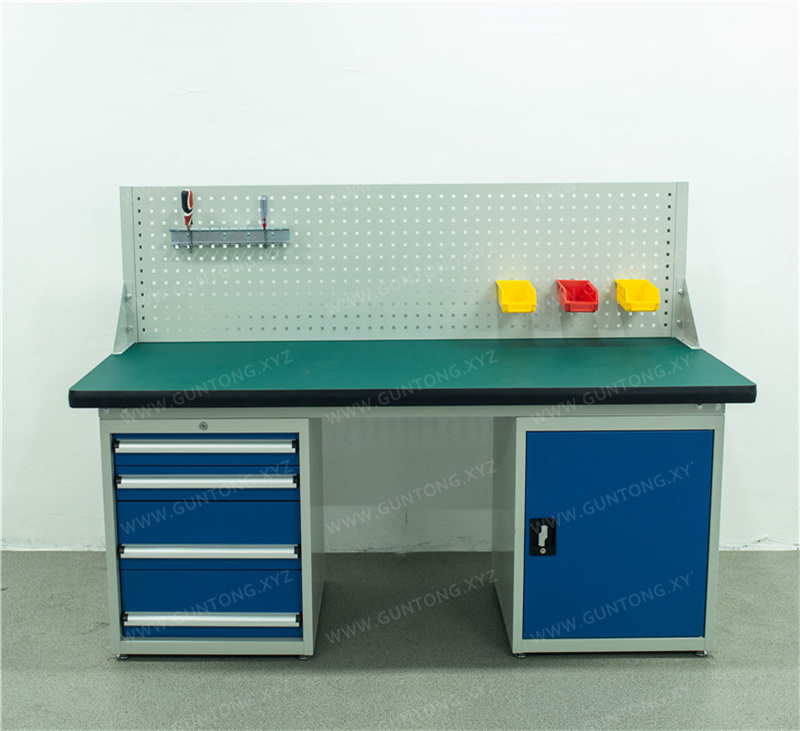
Decide whether your stainless steel workbench needs integrated drawers and pegboards, or if it will operate alongside standalone tool cabinets and carts. Adding under-bench drawers increases the quote complexity and cost but improves 6S management and operator efficiency at the workstation.
Application Boundaries and Risk Mitigation
Stainless steel workbenches excel in environments requiring high cleanliness, dust-proofing, and moderate anti-corrosion properties. However, buyers should note:
- Heavy Impact Risks:*
- While the 50mm composite desktop is robust, direct heavy impact from dropped metal molds can dent the stainless steel surface. For heavy fitter workbenches, a thicker raw steel plate composite might be more appropriate.
- Ground Leveling:*
- For workbenches exceeding 1800mm in length, ensure the quote includes adjustable leveling feet to compensate for uneven workshop floors, maintaining stability during precision tasks.
Frequently Asked Questions
What is the most cost-effective desktop thickness for a stainless steel workbench?
A 50mm total thickness (1.0mm stainless steel + 49mm high-density board) is the industry standard for balancing cost and durability.
Condition/Boundary: If your application involves heavy pounding or extreme point loads, this composite structure may deform.
Actionable Advice: For heavy-duty fitter tasks, request a 5mm raw steel plate composite desktop instead of stainless steel.
Can standard stainless steel workbenches be integrated with automated systems?
Yes, standard sizes like 1500×750×800mm can be aligned with conveyor lines or AS/RS stations.
Condition/Boundary: The standard height of 800mm may not match specific automated transfer heights.
Actionable Advice: When requesting a quote, specify the exact mating height required for your automated equipment to customize the leg dimensions.
Next Steps for Procurement
To receive an accurate and comprehensive quote from a manufacturer like Huizhou Guang'ErMei Precision Components, prepare a brief detailing your required dimensions, target load capacity, and specific environmental conditions. Leveraging a supplier with 18 years of industry experience ensures you receive practical advice on non-standard customization and full-chain service from design to on-site installation.