
Parameters Needed for Composite Workbench Quotes: A Buyer's Configuration Checklist
Parameters Needed for Composite Workbench Quotes: A Buyer's Configuration Checklist
When a procurement manager for an electronics assembly plant requests a quote for "standard 1.5-meter workbenches," they often receive vastly different pricing and specifications from suppliers. This discrepancy rarely stems from arbitrary markups; rather, it results from missing critical configuration details. A composite workbench is not a single, uniform product. It is a highly configurable system where material thickness, load-bearing engineering, and modular accessories dictate both performance and cost.
To secure an accurate, comparable, and operationally viable quote, buyers must provide a comprehensive set of parameters. Below is a diagnostic checklist to help manufacturing, maintenance, and warehousing teams specify their exact requirements.
Diagnosing the Quoting Gap
Suppliers cannot provide precise pricing without understanding the physical stresses and workflow demands of your specific environment. A workbench used for lightweight electronic testing requires entirely different structural engineering than one used for heavy-duty hardware mold assembly. By defining the following parameters, you eliminate guesswork and ensure the quoted equipment meets your 6S management and operational safety standards.
The Essential Parameter Checklist for Composite Workbenches
1. Desktop Composition and Surface Treatment
The "composite" nature of a workbench primarily refers to its desktop structure, which directly impacts durability, anti-static properties, and cost. When requesting a quote, specify the required surface material and core structure:
- Heavy-Duty Composite:*
- For high-impact environments like hardware mold factories, specify a composite structure such as a 5mm raw steel plate layered over high-density fiberboard (e.g., 45mm thickness) with PVC edge banding. This provides exceptional impact resistance and longevity.
- Anti-Static Requirements:*
- For electronics and electrical appliance manufacturers, standard steel or wood is insufficient. You must specify if the desktop requires an anti-static mat grounded via a specific connection point to dissipate static electricity to the earth, or if a specialized anti-static laminate is required.
- Stainless Steel Options:*
- For environments requiring high corrosion resistance or strict hygiene, specify a stainless steel top, noting whether it needs an additional anti-static layer.
2. Load-Bearing Capacity and Frame Specifications
Workbenches are generally categorized by their load-bearing capabilities, which dictate the steel gauge and frame design. Clearly state your maximum expected static and dynamic loads:
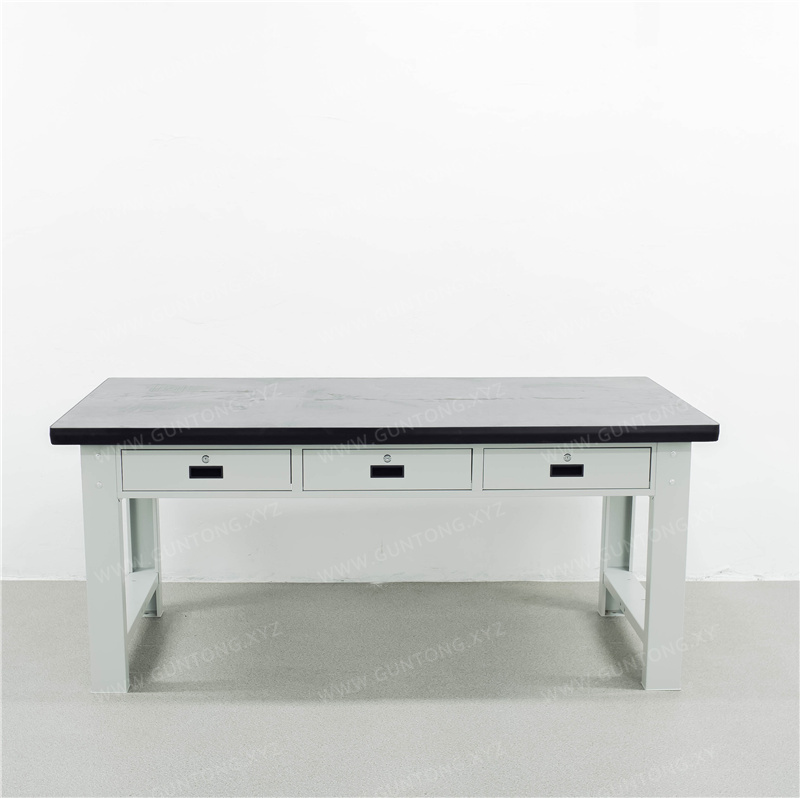
- Light-Duty (up to 300 kg):*
- Suitable for precision assembly, testing, and packaging. Frames typically utilize standard square steel tubes (e.g., 40x40x1.2mm).
- Medium to Heavy-Duty (up to 1000 kg):*
- Required for automotive parts manufacturing, heavy machinery maintenance, and mold fitting. These require robust frames, such as C-type cold-rolled steel, and reinforced cross-beams to prevent deflection under heavy loads.
3. Dimensions and Ergonomic Adjustability
While custom footprints are available, aligning your request with standard manufacturing dimensions can optimize lead times and budget. Specify your required Length × Width × Height. Common standard dimensions include:
- 1500 × 750 × 800 mm
- 1800 × 750 × 800 mm
- 2100 × 750 × 800 mm
Additionally, indicate if the workstation requires height-adjustable legs (via adjustable foot cups) to accommodate different operator heights or uneven factory floors.
4. Modular Accessories and Power Integration
A bare workbench rarely meets the demands of a modern, efficient workshop. To avoid hidden costs later, include your required modular configurations in the initial quote request:
- Storage:*
- Specify the number, height, and load capacity of drawers (e.g., 4-drawer tiered designs) or under-bench cabinets.
- Visual Management & Hanging:*
- Indicate if you need a back panel, overhead shelves, or a square-hole pegboard (e.g., 500mm height) for tool hanging and visual management.
- Electrical Integration:*
- Explicitly request pre-drilled power holes at the desk corners or integrated electrical boards for installing power sockets, lighting (lamp top boards), and pneumatic connections.
Budget Trade-Offs and Decision Factors
When evaluating the quotes returned based on these parameters, consider the following trade-offs:
- Material Thickness vs. Cost:*
- Upgrading from a 1.0mm to a 1.2mm cold-rolled steel cabinet body increases durability and drawer load capacity (e.g., up to 80 kg per drawer) but raises the initial investment.
- Standardization vs. Customization:*
- Utilizing standard dimensions (like 1500mm or 1800mm lengths) and standard modular accessories usually results in more competitive pricing and faster delivery compared to fully bespoke, non-standard dimensions.
- Integrated Storage vs. Separate Cabinets:*
- Integrating drawers directly into the workbench frame saves floor space and improves operator ergonomics, though it may cost more upfront than purchasing a basic table and a separate mobile tool cart.
Next Steps for Procurement
Compiling these parameters before approaching a manufacturer transforms the quoting process from a vague estimation into a precise engineering proposal. It ensures that the equipment you procure will safely support your operational loads, integrate seamlessly into your facility's power and layout, and deliver a long service life.
Guang'ErMei Precision Components specializes in translating these exact parameters into high-quality, standardized, and custom workstation solutions. From 5mm steel plate composite desktops to fully integrated anti-static testing stations, we provide comprehensive design, manufacturing, and installation services.