
Parameters and Drawings to Prepare Before Requesting a Custom Workbench Quote
Objective: Reduce Quote Turnaround and Specification Risk
Manufacturing buyers—especially in electronics assembly, automotive parts, and hardware mold workshops—often request custom workbench quotes with incomplete specifications. The result is multiple revision cycles, underestimated load requirements, or workbenches that fail 6S compliance audits after installation.
Before contacting a supplier like Guang'ErMei Precision Components, procurement teams should prepare a structured specification package. This memo defines what to include, what to verify, and where common purchasing risks emerge.
Alternatives: Standard vs. Non-Standard Workbench Procurement
Option A: Standard Catalog Workbenches
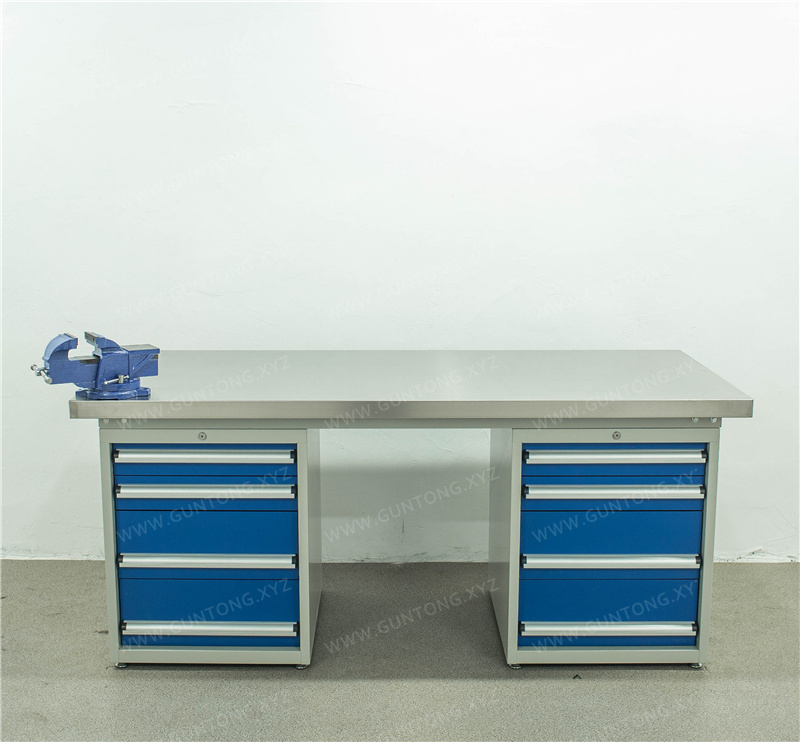
Standard models—such as composite-top workbenches with common dimensions of 1500×750×800 mm, 1800×750×800 mm, or 2100×750×800 mm—are available with shorter lead times. These typically feature:
- C-type cold-rolled steel frames (100×50×1.5 mm profile) with 1000 kg total load capacity
- 50 mm composite desktops (high-density fiberboard core with steel plate or laminate surface)
- Pre-configured drawer modules (e.g., horizontal 3-drawer or 4-drawer configurations with 80 kg per drawer capacity)
When to choose: Your workshop layout is fixed, load requirements fall within standard ranges, and no special tool management or ESD grounding is needed.
Option B: Non-Standard Custom Workbenches
Custom workbenches are necessary when:
- Load requirements exceed 1000 kg or involve concentrated point loads (e.g., mold assembly stations)
- Desktop materials must meet specific conditions—stainless steel for cleanrooms, anti-static surfaces for PCB assembly, or 5 mm raw steel plate for heavy fitter work
- Integrated storage (pegboards, tool cabinets, hanging rails) must match your existing 6S visual management system
- Workbench dimensions must fit constrained aisle widths or connect to automated storage and retrieval system (AS/RS) stations
When to choose: Your application involves unique ergonomic, environmental, or integration requirements that catalog products cannot satisfy.
Evidence: The 7 Parameters Suppliers Need for an Accurate Quote
Based on typical custom workbench projects delivered across Guangdong and nationwide, the following data package minimizes back-and-forth and ensures structural accuracy.
1. Overall Dimensions and Ergonomic Height
Provide length × width × height in millimeters. Standard working heights are 800 mm (seated) or 850 mm (standing), but specify whether you need adjustable legs or leveling feet for uneven workshop floors. If overhead tool racks or lighting gantries are required, include the total height including accessories.
2. Load Capacity Requirements
Distinguish between uniformly distributed load and concentrated point load. A composite-top workbench with C-type steel frame typically supports 1000 kg total. If your station involves pressing, riveting, or mold fitting, specify the maximum point load and its location on the desktop. Suppliers use this data to determine whether additional cross-bracing or heavier gauge steel is required.
3. Desktop Material and Thickness
Common options include:
| Desktop Type | Typical Construction | Application Scenario |
|---|---|---|
| Composite | 50 mm high-density fiberboard + surface laminate | General assembly, inspection |
| Steel plate composite | 5 mm raw steel plate + 45 mm fiberboard core | Heavy fitter work, mold repair |
| Stainless steel | SUS304 or SUS201 top with welded seams | Food-grade, cleanroom, humid environments |
| Anti-static | ESD laminate with grounding stud | Electronics assembly, PCB testing |
Specify thickness, edge banding preference (PVC, aluminum, or welded steel edge), and whether the surface must resist oils, solvents, or high temperatures.
4. Frame and Leg Structure
Confirm whether you need:
- C-type cold-rolled steel (standard for most 1000 kg class workbenches)
- Square tube frames (for heavier loads or cantilevered configurations)
- Floor-mounted or mobile (caster type, brake requirements, and floor load limits)
5. Storage and Tool Management Configuration
Detail the required accessories:
- Drawer count, height per drawer (e.g., 100 mm × 2 + 200 mm × 2), and load per drawer (commonly 80 kg)
- Pegboard type: square-hole or round-hole, standard 500 mm height or custom
- Hanging rails, tool balancers, or air supply integration
- Under-bench cabinets with single-door or double-door access
6. Electrical and Utility Integration
If the workstation requires power outlets, compressed air ports, Ethernet drops, or ESD grounding points, provide a utility layout drawing. Specify voltage, amperage, and connector types. This prevents costly on-site modifications after installation.
7. Quantity, Layout Drawing, and Site Conditions
A single workbench quote differs significantly from a 50-station production line layout. Provide:
- A scaled floor plan showing workbench placement, aisle widths, and material flow direction
- Floor condition (concrete, epoxy, anti-static flooring) and anchoring requirements
- Delivery access constraints (elevator dimensions, doorway widths, crane availability)
Supplier Evaluation Criteria
When comparing quotes from multiple workstation equipment manufacturers, evaluate beyond unit price:
| Evaluation Dimension | What to Verify |
|---|---|
| Design capability | Does the supplier provide CAD drawings and load calculation reports before production? |
| Material traceability | Are steel gauge, desktop composition, and coating specifications documented in the contract? |
| Non-standard experience | Has the supplier delivered custom configurations for your industry (automotive, electronics, mold, warehousing)? |
| Installation service | Is on-site assembly included? Does the supplier handle leveling, anchoring, and utility connection? |
| After-sales scope | What is the warranty period for structural components vs. drawer slides and casters? |
Guang'ErMei Precision Components supports both standardized production and non-standard customization, with on-site workstation planning, load-bearing design, and 6S adaptation services covering manufacturing customers in Huizhou, Guangdong Province, and nationwide.
Purchase Risks and Boundaries
- Under-specified load data is the most common cause of workbench failure. Always provide worst-case load scenarios, not average operating conditions.
- Drawer slide ratings are often quoted at static load. Confirm dynamic load capacity (drawer open/close cycles under load) if high-frequency tool retrieval is expected.
- ESD workbenches require verified grounding paths from desktop surface through frame to floor. A simple ESD mat placed on a standard workbench does not provide equivalent protection.
- Lead time for custom configurations is longer than catalog products. Confirm production scheduling before committing to project timelines.
Recommendation: Prepare Before You Inquire
Before submitting a custom workbench quote request, compile the 7-parameter specification package outlined above. Attach a scaled layout drawing if the project involves more than 5 workstations. This preparation typically reduces quote turnaround from weeks to days and prevents costly specification changes after production begins.
For complex projects involving integrated tool management, automated storage system interfaces, or multi-site rollout, request a preliminary on-site survey to validate dimensions and utility conditions before finalizing the purchase order.