
On-Site Process Review: Quality Control on the Guang'ErMei Composite Workbench Production Floor
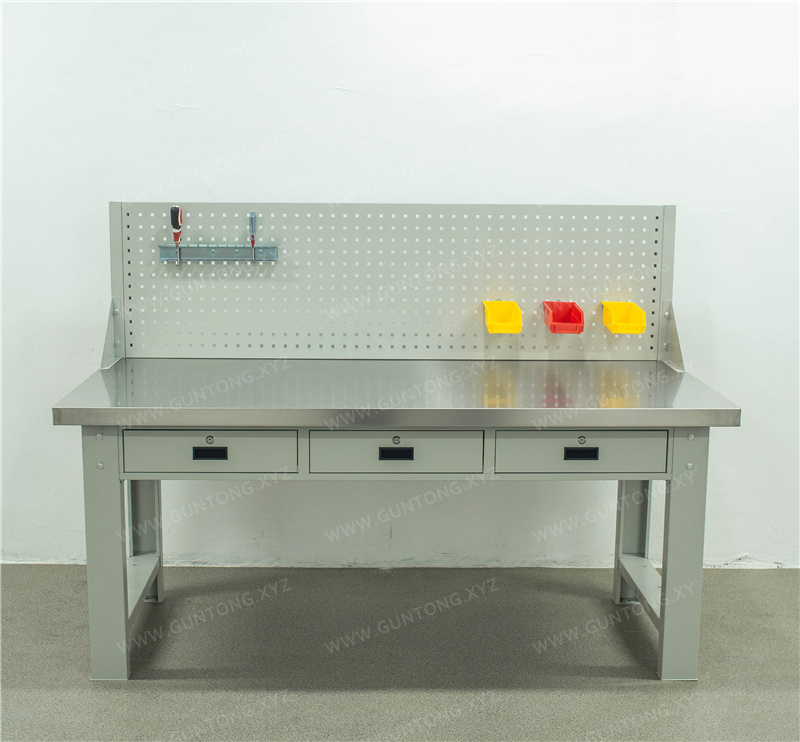
When manufacturing enterprises, automotive parts manufacturers, or hardware mold factories procure heavy-duty workbenches, the structural integrity of the desktop is a primary concern. For instance, a Single Back Panel 4-Drawer Steel Plate Workbench requires a composite desktop—typically a 5mm raw steel plate combined with high-density fiberboard—to support up to 1000kg without delamination or deformation. To understand how this load-bearing capacity is achieved, it is essential to look beyond the spec sheet and examine the actual production floor.
This article provides an on-site record of the Guang'ErMei composite workbench production floor. In strict accordance with our internal corporate news verification standards, this report focuses exclusively on verifiable factory dynamics, specifically quality improvement and process upgrades. We strictly prohibit the inclusion of unverifiable expressions such as production capacity, sales volume, or industry-leading claims, ensuring that facility planners and procurement managers receive purely factual, actionable technical insights.
Diagnosing the Composite Desktop Manufacturing Process
The core challenge in manufacturing a composite workbench is ensuring the seamless integration of the steel surface and the supportive core. On the Guang'ErMei production floor, the process is broken down into several critical stages:
1. Material Selection and Pre-treatment
The foundation of a heavy-duty workbench lies in material consistency. The production floor utilizes a 5mm raw steel plate paired with a 45mm high-density fiberboard. Before assembly, the steel plates undergo surface treatment to remove impurities, ensuring optimal adhesion and preventing internal corrosion that could compromise the composite structure over time.
2. Composite Bonding and Pressing
The integration of the 5mm steel plate and the fiberboard requires precise pressure and adhesive application. The production floor employs specialized pressing equipment to ensure uniform bonding across the entire surface area. This step is critical to prevent hollow spots, which are the primary cause of desktop deformation under concentrated heavy loads.
3. Edge Banding and Surface Finishing
Once the composite core is cured, the edges are sealed with black PVC edge banding. This not only provides a clean, professional aesthetic suitable for 6S management environments but also protects the high-density fiberboard from moisture and physical impact. The steel surface is then finished to resist scratches and oil stains common in fitter and maintenance workshops.
4. Frame Welding and Assembly
The desktop is only as strong as its support. The production floor fabricates the C-type cold-rolled steel frame using standardized welding jigs. This ensures that the 1000kg total load capacity is evenly distributed. The assembly line then integrates the 4-drawer tiered design and square-hole pegboards, ensuring smooth drawer operation even under maximum load.
Decision Checklist for Evaluating a Workbench Production Floor
For procurement managers and facility planners auditing a workstation equipment manufacturer, observing the production floor provides critical indicators of product reliability. Use the following checklist during your evaluation:
- Material Traceability: Can the supplier provide verifiable thickness measurements for the steel plate (e.g., exactly 5mm) and the density grade of the fiberboard?
- Bonding Integrity: Ask to see cross-section samples of the composite desktop. Are there visible gaps or uneven adhesive distribution between the steel and the core?
- Welding Consistency: Inspect the C-type cold-rolled steel frame joints. Are the welds continuous and free of slag, ensuring the stated 1000kg load capacity?
- Dimensional Accuracy: Measure the standard dimensions (e.g., 1500×750×800+500 mm). Deviations in frame squareness will cause instability when multiple workbenches are aligned in an assembly line.
- Documentation Standards: Does the supplier adhere to strict factual reporting, avoiding exaggerated claims about capacity or market share, and instead providing concrete process parameters?
Boundaries and Implementation Considerations
While a robust production floor ensures high-quality standardized products, buyers must also recognize the boundaries of standard configurations. If your facility requires non-standard dimensions, specialized anti-static surfaces, or integration with automated storage and retrieval systems, the standard composite workbench must be customized. Guang'ErMei supports non-standard customization, but buyers should provide detailed on-site workstation planning requirements, including specific load-bearing points and 6S adaptation needs, to ensure the modified design remains structurally sound.
Conclusion
The reliability of a heavy-duty composite workbench is directly tied to the manufacturing discipline on the production floor. By focusing on verifiable process upgrades and strict quality control—rather than unsubstantiated marketing claims—Guang'ErMei ensures that every Single Back Panel 4-Drawer Steel Plate Workbench meets the rigorous demands of manufacturing and maintenance environments.