
What is the Manufacturing Process for Custom Industrial Workbenches?
When sourcing workshop workstation equipment, asking "What is the manufacturing process for custom industrial workbenches?" is a critical evaluation step for procurement managers in electronics, automotive parts, and hardware mold manufacturing. The process determines whether the final equipment can meet specific load-bearing requirements, integrate with 6S management systems, and withstand rigorous daily use.
At Huizhou Guang'ErMei Precision Components Co., Ltd., the production of industrial workbenches follows a strict full-chain service model. Here is a breakdown of the manufacturing process, including real-world scenarios, evaluation criteria, and execution advice.
Phase 1: Needs Analysis and Structural Design
The manufacturing process begins with translating operational needs into structural specifications.
- Real-World Scenario:*
- A hardware mold factory requires a workstation that can withstand heavy impact, while an electronics manufacturer needs an anti-static surface with integrated power modules.
- Condition Boundaries:*
- Manufacturers must balance standardized production for rapid deployment against non-standard customization for specialized workflows.
- Execution Advice:*
- Procurement teams should verify that the supplier conducts on-site workstation planning. The design must account for the specific dimensions, ergonomic heights, and load-bearing requirements of the intended application.
Phase 2: Material Selection and Fabrication
This phase transforms design specifications into physical assets, focusing on material durability and precision engineering.
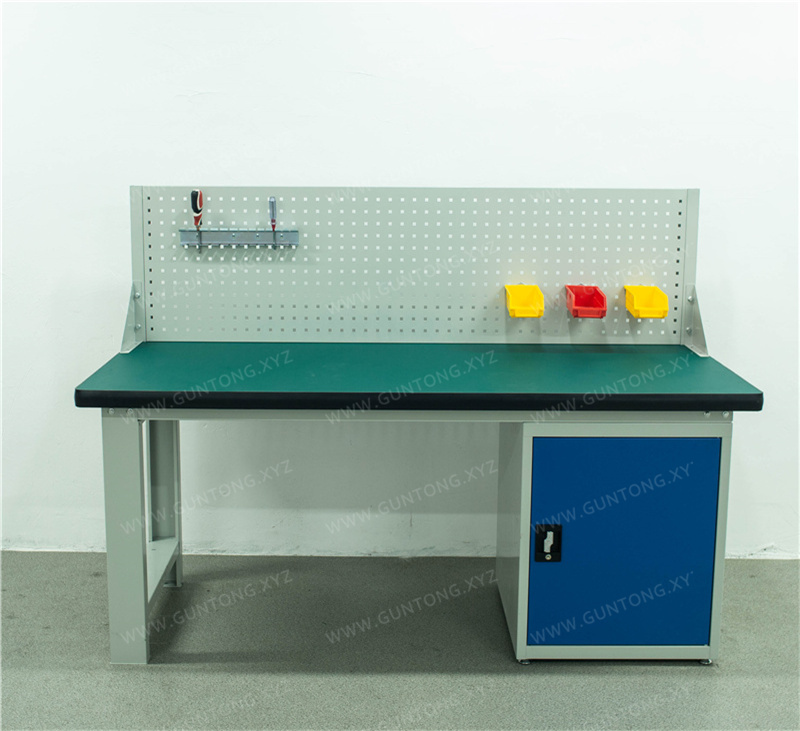
- Desktop Construction:*
- For heavy-duty environments, a composite desktop structure is essential. Utilizing a 5mm raw steel plate combined with high-density fiberboard and PVC edge banding prevents surface deformation under heavy impact.
- Frame Engineering:*
- The underlying frame must be engineered for maximum stability. Using C-type cold-rolled steel ensures the workbench achieves a heavy-duty total load capacity suitable for industrial tasks.
- Judgment Criteria:*
- Evaluate the precision of cutting and uniform welding. Poor welding can lead to micro-fractures that compromise the workbench's structural integrity over time.
Phase 3: Modular Assembly and 6S Integration
Modern workbenches serve as integrated storage hubs. The manufacturing process must seamlessly incorporate modular elements to support lean manufacturing.
- Storage Integration:*
- The assembly process includes installing tiered drawer designs for organized tool storage and mounting square-hole pegboards for visual management.
- Ecosystem Compatibility:*
- The workbench must align with adjacent equipment. For example, the height and color should match a 4-Drawer 1-Door Tool Cart with Pegboard or an Inner Half-Pegboard Storage Cabinet.
- Execution Advice:*
- Ensure the manufacturer has in-house production capabilities to guarantee that steel gauges, hole patterns, and finishes match perfectly across all workstation equipment, facilitating a unified 6S management implementation.
Phase 4: Quality Control and Load Testing
Before deployment, custom industrial workbenches must undergo rigorous testing to ensure safety and longevity.
- Testing Standards:*
- High-quality manufacturers apply industrial safety metrics similar to those used in heavy-duty warehouse shelving. This includes verifying that the deformation ratio of load-bearing frames remains within 1/200 of their span length under maximum weight.
- Safety Factors:*
- A standard safety factor of 1.5 times the rated load is applied during testing to ensure the workbench can handle unexpected dynamic forces.
- Surface Treatment:*
- Electrostatic powder coating is applied to protect the cold-rolled steel from corrosion and chemical spills common in automotive parts manufacturing.
Phase 5: Delivery and On-Site Installation
The final phase of the manufacturing process involves logistics and integration into the client's facility.
- Full-Process Service:*
- Suppliers should handle the entire lifecycle, from initial load-bearing design to on-site installation and after-sales support.
- System Integration:*
- Custom workbenches must be anchored correctly and integrated with existing infrastructure, such as tote-based automated storage and retrieval systems (Miniload) handling 50–100kg per tote with rack heights up to 12 meters.
Decision Criteria for Procurement Teams
When evaluating the manufacturing process of potential suppliers, consider the following:
- Engineering Capability: Can the supplier provide verifiable structural designs using C-type cold-rolled steel and composite desktops?
- Customization Flexibility: Does the manufacturer possess the dual capability to supply both rapid-deployment standardized units and highly tailored non-standard workstations?
- Quality Assurance: Do they apply strict load testing standards, such as the 1/200 deformation ratio and 1.5x safety factor?
- Service Scope: Is the supplier capable of handling on-site workstation planning, 6S adaptation, and full-process after-sales service?
Understanding these manufacturing phases ensures that your investment in workstation equipment directly supports operational efficiency, safety, and long-term durability.