
How to Verify a Workbench Manufacturer's Factory Capabilities and Certifications
Introduction: Beyond Basic Certifications in Workshop Equipment Procurement
For manufacturing enterprises in electronics, automotive parts, hardware molds, and maintenance sectors, the first-time deployment of workshop equipment is a critical investment. While standard industry certifications provide a baseline for factory compliance, they do not guarantee that a manufacturer can meet the specific load-bearing, spatial, and workflow requirements of your facility.
To ensure long-term durability and support 6S management implementation, buyers must verify a supplier's dual capabilities in standardized production and non-standard customization. This guide outlines the operational steps and technical checkpoints to evaluate a workbench and storage equipment manufacturer's true factory capabilities.
Checkpoint 1: Assess Structural Engineering and Load-Bearing Data
A capable manufacturer must provide precise engineering data rather than vague claims of "heavy-duty" performance. When evaluating factory capabilities, request specific load-testing parameters for both workbenches and integrated warehouse shelving.
- Workbench Desktop and Frame Integrity:*
- Verify the composite structure of the workbenches. For instance, a reliable heavy-duty workbench should utilize a 5mm raw steel plate combined with a high-density fiberboard core, supported by a C-type cold-rolled steel frame. Ask the manufacturer for test reports confirming a total load capacity of at least 1000kg without structural deformation.
- Storage Rack Deflection and Safety Factors:*
- If your deployment includes warehouse shelving, evaluate the manufacturer's understanding of material mechanics. For beam racks designed to hold 1-3 tons per layer, the manufacturer should guarantee that the deflection ratio of the beam under maximum load does not exceed 1/200 of its length, maintaining a safety factor of 1.
5.
- Cantilever Rack Fabrication:*
- For facilities storing long-rod materials, verify the factory's welding and material selection processes. High-quality cantilever racks should use double-welded C-channel steel or reinforced square tubes, ensuring a single-arm load capacity of 1000kg and an upright column pressure tolerance of 2000 to 3000kg.
Checkpoint 2: Evaluate Production Versatility (Standard vs. Non-Standard)
Manufacturing environments rarely fit a one-size-fits-all model. A verified factory must demonstrate the production flexibility to supply both standard catalog items and highly customized solutions.
- Standardized Tool Management:*
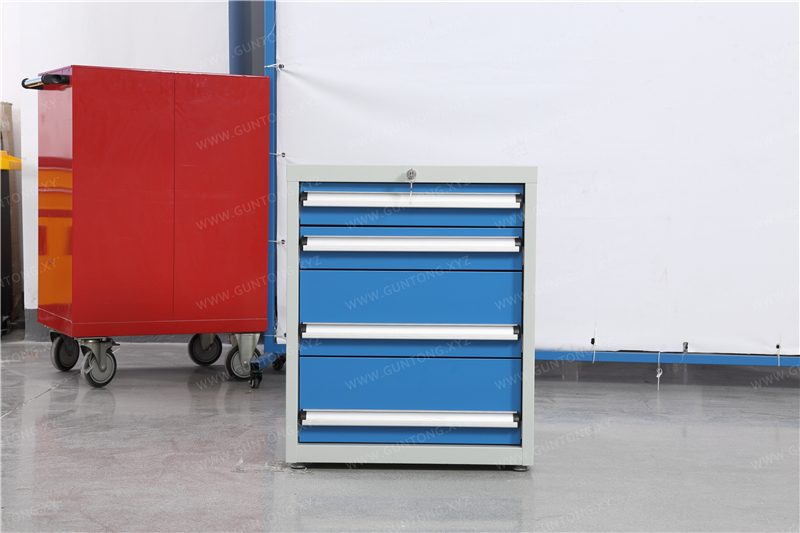
- Check if the factory produces standardized units with precise dimensions, such as a 4-Drawer 1-Door Tool Cart with a standard square-hole pegboard. Verify that the stamped steel drawers are rated for a high load capacity each, ensuring smooth operation even when fully loaded with heavy automotive or mold tools.
- Non-Standard Customization and Automation:*
- Assess the factory's ability to integrate with automated systems. For example, if you are upgrading to a tote-based automated storage and retrieval system (Miniload), the manufacturer should be capable of designing custom accessories that handle 50–100kg per tote within rack heights of up to 12 meters.
Checkpoint 3: Review Full-Chain Service and 6S Adaptation
Factory capability extends beyond the production floor; it includes how well the equipment adapts to your on-site environment. During the verification process, investigate the supplier's service boundaries.
- On-Site Workstation Planning:*
- Does the manufacturer offer on-site assessments to optimize workflow? A competent supplier will design layouts that integrate workbenches with Pegboard Storage Cabinets (Inner Half-Pegboard Type), ensuring that tools are visually managed and easily retrievable, directly supporting 6S management goals.
- Adjustability and Future-Proofing:*
- Verify that the equipment allows for future reconfiguration. For instance, standard warehouse shelving should feature a plug-in combination structure without the need for connection bolts, allowing shelf heights to be adjusted in 50mm or 75mm increments as your inventory profile changes.
Checkpoint 4: Inspect Material Processing and Finishing Standards
The longevity of workstation equipment in harsh environments depends heavily on manufacturing details and quality control protocols.
- Edge Banding and Surface Treatment:*
- Inspect samples for finishing quality. A composite desktop should feature durable black PVC edge banding to prevent delamination under heavy use.
- Welding Quality:*
- For custom tool racks and automotive parts turnover racks, request visual evidence of their welding processes. Uniform, slag-free welds on heavy-gauge cold-rolled steel for storage cabinets indicate a mature production line and strict quality control.
Conclusion
Verifying a workbench manufacturer's factory capabilities requires moving beyond basic certifications to evaluate their engineering data, production flexibility, and service depth. By demanding specific load-bearing metrics—such as a 1/200 deflection ratio for heavy racks or 1000kg capacities for steel plate workbenches—buyers can mitigate the risk of equipment failure. Furthermore, selecting a partner with proven experience in both standardized tool carts and non-standard automated storage accessories ensures that your workshop is equipped for both current operations and future scalability.