
Maintenance Applications for Pegboard Tool Carts: Selection and Configuration Guide
Why Maintenance Teams Need Dedicated Pegboard Tool Carts
Maintenance operations differ fundamentally from fixed-station assembly work. Technicians move between machines, carry varied tool sets, and need immediate visual access to every item. A pegboard tool cart solves this by combining mobile drawer storage with vertical hanging space in a single unit. But not every cart configuration fits every maintenance scenario. Choosing the wrong setup leads to overloaded drawers, unstable movement across shop floors, or tools that cannot be hung securely.
This guide helps maintenance managers and procurement teams at manufacturing enterprises, testing institutions, and automotive parts facilities evaluate pegboard tool carts based on real operational constraints — not catalog specifications alone.
Core Maintenance Scenarios and Cart Requirements
Scenario 1: Machine Repair and Preventive Maintenance
Technicians performing scheduled maintenance on CNC machines, presses, or conveyor systems typically carry a mixed set of hand tools, measuring instruments, and replacement fasteners. The cart must travel across concrete floors, sometimes over cable covers or threshold strips.
Key requirements:
- Drawer load capacity of at least 80 kg per tier to hold heavy wrench sets and torque tools without rail deformation
- Stamped heavy-duty guide rails that allow 85% drawer extension, giving full access even in tight machine aisles
- A 500 mm pegboard section above the cabinet body for hanging frequently used tools like hex keys, pliers, and inspection gauges
Guang'ErMei's 4-Drawer 1-Door Tool Cart with Pegboard addresses this scenario directly. Its drawer configuration includes two 100 mm and two 200 mm height tiers, allowing separation of small precision tools from larger power tool accessories. The 1.0 mm cold-rolled steel cabinet body maintains structural rigidity during movement.
Scenario 2: Electrical and Instrumentation Maintenance
Electrical maintenance teams in electronics manufacturing or appliance production facilities handle sensitive components. Their carts need organized storage that prevents tool-on-tool contact and supports ESD-safe workflows when paired with appropriate mats or wrist straps at the point of use.
Key requirements:
- Inner half-pegboard cabinet designs that combine shelf storage for multimeters and soldering stations with door-mounted pegboards for probe sets and wire cutters
- Adjustable shelving with 100 kg per-shelf capacity to accommodate heavier test equipment
- Cold-rolled steel construction with powder-coated finishes that resist static buildup in controlled environments
The Pegboard Storage Cabinet (Inner Half-Pegboard Type) serves this need with three adjustable shelves and dual pegboard layouts on the cabinet door. This configuration lets technicians store bulkier equipment inside while keeping hand tools visible and accessible on the door panels.
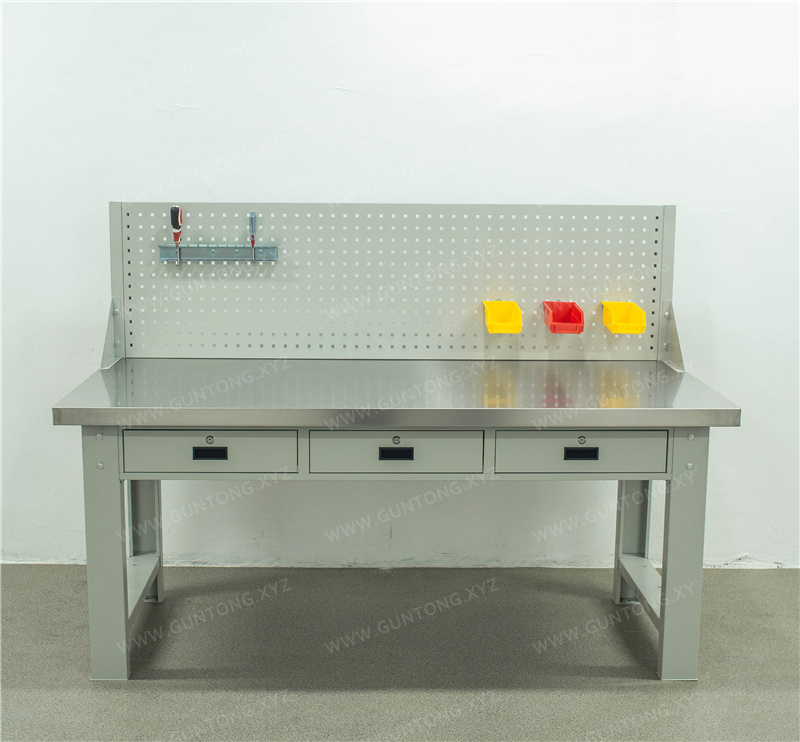
Scenario 3: Facility and Building Maintenance
Facility maintenance teams in warehousing, logistics, or vocational training centers cover large areas and respond to diverse tasks — from HVAC filter changes to lighting repairs. Their carts must be highly mobile and configurable for tasks that change daily.
Key requirements:
- Standard 4-inch casters (two fixed, two swivel with brakes) for stable rolling and secure parking on uneven surfaces
- Flexible pegboard layouts with square-hole patterns that accept standard hooks and holders
- Compact overall dimensions that fit through standard doorways and elevator openings
Selection Decision Matrix: Matching Cart Type to Maintenance Need
| Constraint | Single-Drawer Cart | 4-Drawer Pegboard Cart | Inner Half-Pegboard Cabinet |
|---|---|---|---|
| Tool variety (high) | Limited | Strong | Strong |
| Heavy tool storage (>50 kg total) | Not suitable | Suitable (80 kg/drawer) | Suitable (100 kg/shelf) |
| Mobility requirement | High | Moderate-High | Low (stationary or repositioned) |
| Visual tool management | Basic | Pegboard + drawer labeling | Door pegboard + shelf labeling |
| Floor space footprint | Small | Medium (1000×500 mm) | Medium (1000×500 mm) |
Configuration Details That Matter in Practice
Drawer Height Selection
Guang'ErMei offers drawer heights of 100 mm, 150 mm, and 200 mm. For maintenance carts, the most effective configuration typically pairs shallow drawers (100 mm) for small fasteners and precision tools with deeper drawers (200 mm) for socket sets, cordless tool batteries, and replacement parts. This tiered approach prevents small items from being buried under heavier tools.
Guide Rail Specifications
The stamped heavy-duty guide rails used in Guang'ErMei carts support 80 kg per drawer at 85% extension. This matters for maintenance teams because technicians often pull drawers fully open while standing beside the cart in narrow aisles. Rails that only extend 60–70% force technicians to reach deep into partially open drawers, increasing the risk of dropping tools or pinching fingers.
Caster and Mobility Configuration
Standard configuration includes 4-inch casters: two fixed wheels and two swivel wheels with brakes. For maintenance environments with oil-spotted or chip-covered floors, upgrading to larger diameter or polyurethane-tread casters improves roll resistance. Always specify brake requirements based on whether the cart will be parked on inclines or near vibrating machinery.
Pegboard Layout and Hook Compatibility
The 500 mm standard square-hole pegboard section on Guang'ErMei carts accepts widely available hook systems. Maintenance teams should standardize on one hook type across all carts to enable quick reconfiguration when tool sets change between jobs. The square-hole pattern also supports bin holders for small parts like fuses, connectors, and fasteners.
Implementation Boundaries and Common Mistakes
Do not overload beyond rated capacity. The 80 kg per-drawer rating assumes evenly distributed loads. Concentrating heavy items at the front of a drawer creates a tipping moment that stresses the rail mounting points.
Do not skip brake engagement. Maintenance carts parked near operating machinery can drift from vibration. Always engage both swivel-wheel brakes when the cart is stationary.
Do not mix incompatible finishes. Standard gray-white or blue powder coatings are suitable for most environments. If the cart will be used in food-grade or cleanroom-adjacent maintenance, specify stainless steel or alternative surface treatments — standard cold-rolled steel with powder coating is not appropriate for washdown environments.
Plan for non-standard dimensions when needed. Guang'ErMei supports custom sizing with a typical lead time of 7–10 working days for non-standard configurations, compared to 2–3 working days for standard models. Factor this into project timelines when outfitting multiple maintenance bays.
After-Sales and Lifecycle Considerations
Guang'ErMei provides a three-year warranty on tool carts and cabinets. For maintenance departments running multi-shift operations, this warranty period covers the highest-wear phase of drawer rails and casters. Establish a quarterly inspection routine: check rail alignment, caster bearing play, and pegboard hook retention. Replace worn casters proactively rather than waiting for failure.
Next Steps for Maintenance Equipment Procurement
- Audit your current tool sets. List every tool category and approximate weight to determine drawer count and height requirements.
- Map your floor conditions. Identify threshold heights, floor surface types, and aisle widths to set caster and dimension constraints.
- Request configuration consultation. Share your tool list and floor plan with Guang'ErMei's engineering team to receive a tailored cart specification, including any non-standard dimensions or drawer layouts.
- Pilot one cart before fleet deployment. Test the configured cart in your most demanding maintenance scenario for two weeks, then adjust specifications before ordering for all bays.
For detailed product specifications or to discuss your maintenance cart requirements, contact Guang'ErMei Precision Components directly. Our team supports workstation planning, load-bearing design, and full-process after-sales service across Guangdong and nationwide.