
Inside the Fabrication Floor: How Guang'ErMei Engineers Custom Stainless Steel Workbenches
When a facility planner in the electronics, medical device, or precision hardware sector specifies a new assembly line, the workstation material is rarely an afterthought. Environments requiring strict hygiene, corrosion resistance, or anti-static properties demand stainless steel. However, sourcing a stainless steel workbench is not as simple as swapping the material. A poorly fabricated unit will suffer from welding distortion, inadequate load distribution, and surface contamination.
To understand how these risks are mitigated, we open the doors to the Guang'ErMei stainless steel workbench fabrication floor, examining the practical engineering and quality controls that turn raw steel sheets into reliable industrial workstations.
Diagnosing Common Fabrication Failures in Stainless Steel Workbenches
Before detailing our manufacturing process, it is necessary to diagnose why some stainless steel workbenches fail in real-world applications. Facility managers often encounter three primary issues:
- Thermal Distortion: Stainless steel has a high coefficient of thermal expansion. Inexperienced welding leads to warped desktops and misaligned frames, making it impossible to integrate the bench into a seamless lean production line.
- Hidden Structural Weakness: Stainless steel is often used in thinner gauges to control costs. Without a properly engineered internal support frame, the desktop will sag under the weight of heavy testing equipment or mold components.
- Cross-Contamination: If stainless steel is cut or welded on the same tables used for carbon steel, iron particles embed into the surface, leading to localized rust spots that compromise cleanroom or food-grade standards.
Process Controls on the Guang'ErMei Fabrication Floor
Addressing these failure points requires strict process discipline. On the Guang'ErMei stainless steel workbench fabrication floor, our production strategy focuses on precision, structural integrity, and contamination prevention.
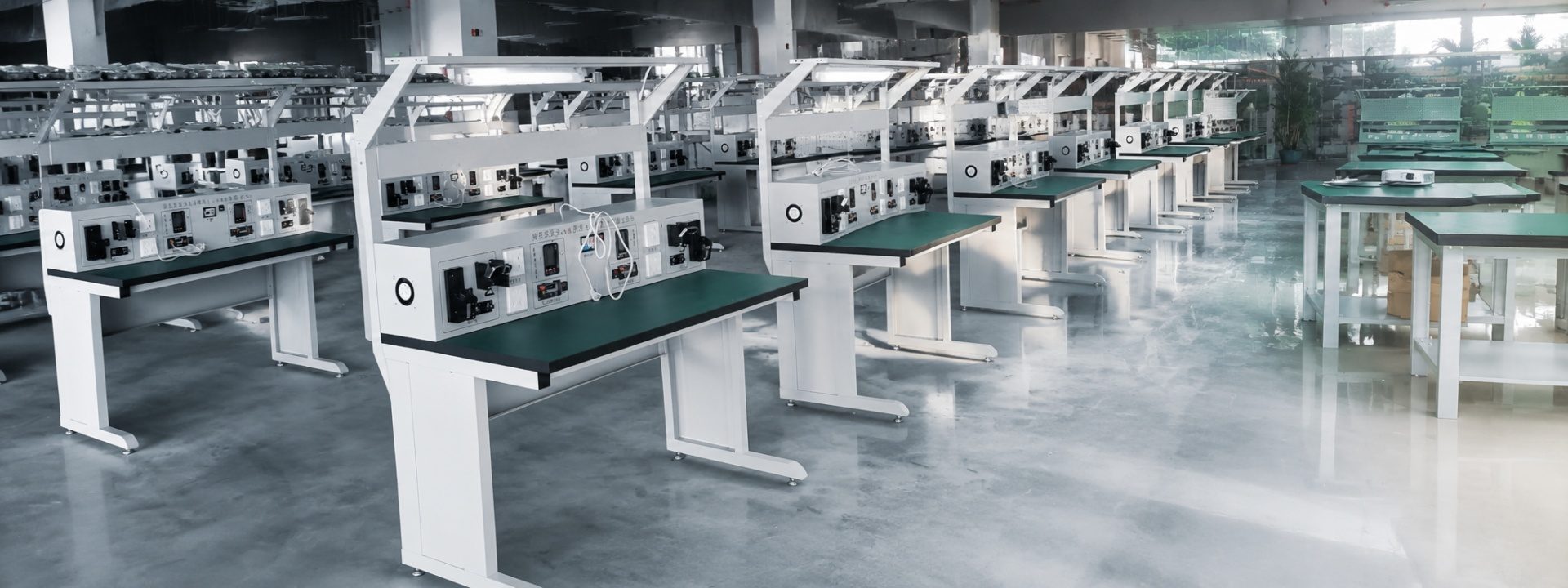
Dedicated Tooling and Thermal Management
To prevent thermal distortion, our welding stations utilize specialized jigs and fixtures that secure the stainless steel components during the joining process. By controlling the heat input and employing intermittent welding techniques where appropriate, we maintain the flatness of the desktop and the squareness of the frame. This ensures that the final product meets the strict dimensional tolerances required for automated storage and retrieval system accessories or precision assembly lines.
Engineered Load-Bearing Substructures
A stainless steel top is only as strong as the frame beneath it. Our engineering team designs C-type or reinforced square-tube cold-rolled steel substructures (often powder-coated for corrosion resistance) or fully stainless steel frames, depending on the load requirements. For heavy-duty applications, such as hardware mold maintenance, we integrate additional cross-bracing and gusset plates. This load-bearing design ensures that a 1000kg capacity requirement is met safely without over-engineering the visible stainless steel surfaces.
Strict 6S Adaptation and Contamination Control
The fabrication floor itself operates under strict 6S management principles. Stainless steel processing zones are physically separated from carbon steel cutting and welding areas. Abrasive tools used on stainless steel are color-coded and dedicated solely to that material. This operational discipline guarantees that the workbenches delivered to your facility are free from carbon steel contamination and ready for immediate deployment in sensitive environments.
Decision Checklist for Specifying Stainless Steel Workbenches
When planning your next workstation upgrade or facility expansion, use this checklist to evaluate your requirements and supplier capabilities:
- Material Grade Selection:*
- Determine if SUS304 is necessary for your environment (e.g., high moisture, chemical exposure, food/medical) or if SUS201 is sufficient for dry, general electronics assembly.
- Surface Finish Requirements:*
- Specify the required finish. A matte or brushed finish (e.g., #4 finish) is typically preferred for industrial workbenches to reduce glare and hide minor scratches, whereas a mirror finish is reserved for specific cleanroom applications.
- Load Capacity and Deflection Limits:*
- Clearly define the maximum static load and the acceptable deflection limit (e.g., no more than 2mm deflection under full load). Ensure the supplier provides a structural design that meets this metric.
- Integration and 6S Features:*
- Identify necessary accessories. Will the bench require a perforated pegboard for tool hanging, integrated LED lighting, ESD grounding points, or specific drawer configurations for 6S visual management?
- Edge and Corner Treatment:*
- Verify how edges are finished. Folded and hemmed edges prevent operator injury and improve the structural rigidity of the desktop.
Moving Forward with Your Workstation Project
Designing and manufacturing a stainless steel workbench that survives the rigors of daily industrial use requires more than just raw materials; it requires a controlled fabrication environment and practical engineering experience. By understanding the processes on the fabrication floor, facility planners can make more informed decisions that lead to longer-lasting, safer, and more efficient workstations.
If you are planning a facility upgrade or require non-standard customization for your production line, evaluating the supplier's manufacturing discipline is the critical first step.