
How to Reinforce Stainless Steel Workbenches for Bench Vises: Selection & Configuration Guide
How to Reinforce Stainless Steel Workbenches for Bench Vises: Selection & Configuration Guide
A common question from manufacturing and maintenance facilities is whether a standard stainless steel workbench can support a bench vise. While stainless steel workbenches are excellent for cleanrooms, food processing, and anti-corrosion environments, mounting a bench vise introduces concentrated clamping forces and impact vibrations that standard configurations are not inherently designed to absorb.
If your workflow requires both a corrosion-resistant surface and heavy-duty fitter operations, understanding how to properly reinforce the workstation is critical to preventing surface deformation and structural fatigue.
The Structural Challenge of Bench Vises on Stainless Steel Desks
To determine the necessary reinforcements, it is essential to understand the baseline construction of a standard stainless steel workbench. Typically, the desktop has a total thickness of 50mm, consisting of 1mm 201 stainless steel wrapping a 49mm high-density board. The overall frame material uses 1.5mm high-quality cold-rolled steel with a load capacity of 1000kg.
While a 1000kg uniform load capacity is sufficient for most assembly and packaging tasks, a bench vise generates highly localized stress. Tightening the vise or hammering a workpiece can dent the 1mm stainless steel skin, crush the high-density fiberboard core, or cause the C-type frame to deflect over time. Therefore, reinforcement must address both the desktop surface and the underlying support structure.
Reinforcement Options and Trade-Offs
When configuring a stainless steel workbench for bench vise applications, buyers generally evaluate three reinforcement strategies based on their specific operational constraints.
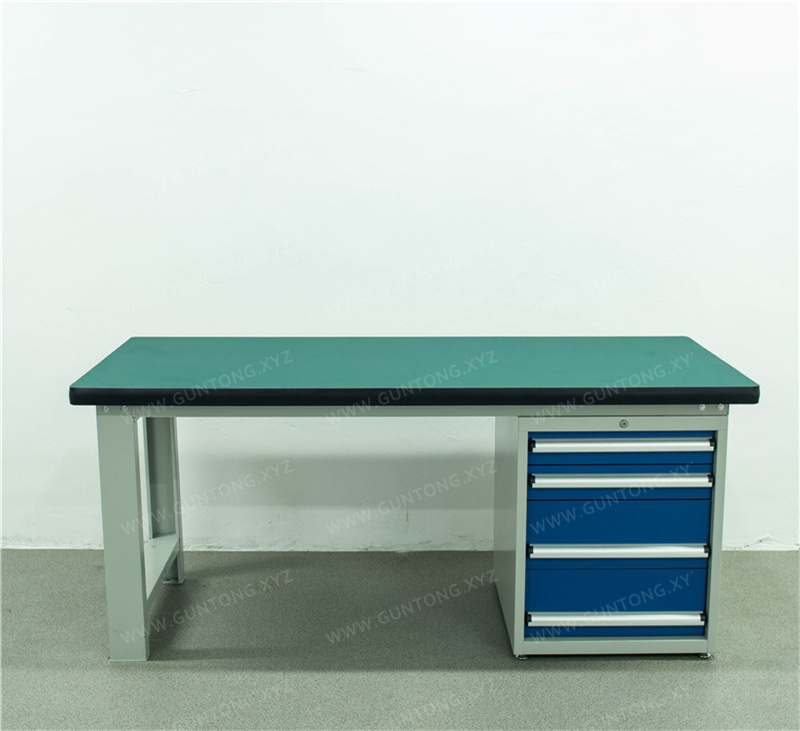
Option 1: Localized Surface Reinforcement
Approach: Embed or mount a thicker solid steel plate (e.g., 5mm to 10mm raw steel plate) exclusively in the area where the bench vise will be bolted.
Constraint: The facility strictly requires a stainless steel surface for overall hygiene or chemical resistance but needs a localized heavy-duty zone.
Trade-Off: This preserves the anti-corrosion properties of the main workspace while providing a rigid mounting base for the vise. However, it requires precise flush-mounting fabrication to ensure the steel plate does not create a tripping hazard or disrupt the flat working plane.
Option 2: Sub-Frame Structural Upgrades
Approach: Reinforce the underlying C-type cold-rolled steel frame by adding vertical support columns or thicker square tubes directly beneath the vise mounting point.
Constraint: The desktop material is sufficient for the clamping force, but the vibration from filing or hammering causes unacceptable desk shake.
Trade-Off: Adding direct vertical supports significantly improves stability and vibration dampening. The primary trade-off is the reduction of under-desk legroom and storage space, which may interfere with seated operations or the placement of under-bench tool cabinets.
Option 3: Transitioning to a Dedicated Fitter Workbench
Approach: Instead of modifying a stainless steel desk, deploy a dedicated heavy-duty fitter workbench featuring a 5mm raw steel plate composite desktop for the vise operations, keeping the stainless steel benches for lighter assembly tasks.
Constraint: The application involves intensive, continuous heavy machining rather than occasional light clamping.
Trade-Off: A 5mm raw steel plate composite desktop offers superior impact resistance and structural rigidity for bench vises. The trade-off is sacrificing the acid and alkali resistance of the stainless steel surface. For many hardware mold factories and automotive parts manufacturers, separating heavy fitter work from clean assembly work is the most practical operational choice.
Implementation Boundaries and Next Steps
Reinforcing a workbench is not merely about adding material; it requires calculating the dynamic load and ensuring the floor anchoring (if applicable) can handle the transferred vibration.
If your facility requires a customized stainless steel workbench with integrated bench vise reinforcements, it is crucial to communicate the exact vise model, maximum clamping force, and the nature of the mechanical operations (e.g., light filing vs. heavy hammering) to the manufacturer.
Guang'ErMei Precision Components provides dual capabilities in standardized production and non-standard customization. Our engineering team supports on-site workstation planning and load-bearing design to ensure your workbenches meet the rigorous demands of electronics, automotive, and hardware mold manufacturing.
Next Step: Evaluate whether your primary need is surface corrosion resistance or impact resistance. If you need to integrate a bench vise into a clean environment, contact our technical team to discuss localized steel plate reinforcement and frame upgrades tailored to your specific workshop layout.