
How to Clean Stainless Steel Workbenches Without Water Spots: A Practical Maintenance Guide for Workshops
Water spots on stainless steel workbenches are a frequent complaint in manufacturing environments where moisture, cleaning agents, or humidity are present. While stainless steel is chosen for its corrosion resistance and hygiene properties, improper cleaning routines can leave mineral deposits, streaks, or dull patches that compromise both appearance and surface integrity.
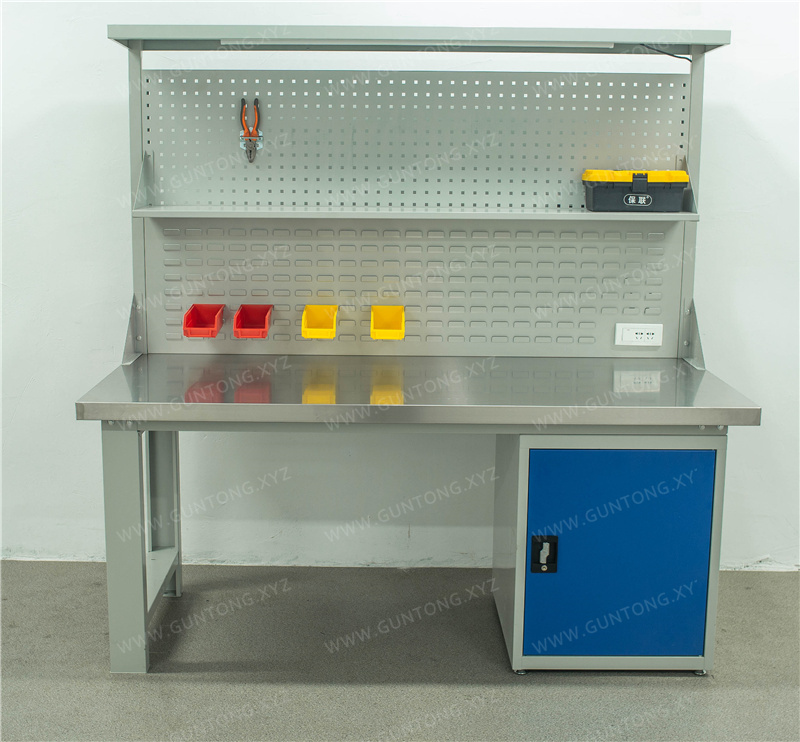
This guide addresses the root causes of water spotting, outlines safe cleaning methods, and explains how workstation construction—such as the 201 stainless steel surface bonded to high-density fiberboard used in Guang'ErMei's stainless steel workbenches—affects maintenance outcomes.
Why Water Spots Form on Stainless Steel Surfaces
Water spots are not a defect in the steel itself. They are mineral deposits left behind when tap water or cleaning solutions evaporate on the surface. The severity depends on three factors:
- Water hardness: Facilities in areas with high calcium or magnesium content in the water supply will see faster spot formation.
- Surface finish: Brushed or matte stainless finishes tend to hide spots better than mirror-polished surfaces, but they can trap residue in the grain if not wiped along the grain direction.
- Drying method: Air-drying is the primary cause of spotting. Any cleaning routine that does not include a manual dry step will leave deposits.
In workshop settings such as electronics assembly, hardware mold maintenance, or testing laboratories, workbenches are often wiped down at shift end with wet cloths and left to dry overnight. This is the most common scenario where spotting accumulates over time.
How to Clean Stainless Steel Workbenches Without Leaving Spots
The following procedure is suitable for standard 201 stainless steel workstation surfaces, including composite desktops where a 1.0 mm stainless steel sheet is bonded over a 49 mm high-density fiberboard core.
Step 1: Remove Loose Debris
Use a dry microfiber cloth or soft brush to clear metal shavings, dust, or particulate matter. Abrasive particles dragged across the surface during wet cleaning can cause micro-scratches that make future spotting more visible.
Step 2: Apply a Mild Cleaning Solution
Use warm water mixed with a small amount of neutral pH detergent. Avoid chlorine-based cleaners, bleach, or hydrochloric acid solutions, as these can damage the passive oxide layer on stainless steel and lead to pitting corrosion over time. For environments with strict chemical controls—such as electronics or food-grade workshops—verify that the cleaning agent is compatible with 201-grade stainless steel.
Step 3: Wipe Along the Grain
Stainless steel sheets used in workstation desktops typically have a directional brushed finish. Wiping parallel to the grain prevents residue from lodging in the surface texture and reduces streaking.
Step 4: Rinse and Dry Immediately
If a detergent was used, follow with a clean water wipe to remove soap film. Then dry the surface completely with a lint-free cloth. This single step eliminates the majority of water spot formation.
Step 5: Address Existing Spots
For spots that have already formed, a 50/50 solution of white vinegar and water applied with a soft cloth can dissolve mineral deposits. Rinse and dry immediately after. Do not allow vinegar to sit on the surface for extended periods.
How Workbench Construction Affects Cleaning and Maintenance
Not all stainless steel workbenches are built the same way, and construction details influence how well the surface holds up under repeated cleaning cycles.
| Construction Feature | Maintenance Impact |
|---|---|
| Solid stainless steel top | Heavier and more expensive; can be resurfaced if deeply scratched. Less common in standard workshop configurations. |
| Stainless steel cladding over composite core | Guang'ErMei's standard configuration uses a 1.0 mm 201 stainless steel sheet wrapped over a 49 mm high-density fiberboard core, with a total desktop thickness of 50 mm. This provides a durable, corrosion-resistant working surface at a practical cost. The wrapped-edge design (covering five faces) prevents moisture ingress at the edges, which is critical in wet-cleaning environments. |
| Frame and load-bearing structure | C-type cold-rolled steel frames with acid-wash, phosphating, and powder-coated finishes support loads up to 1,000 kg. The frame finish is separate from the stainless desktop and requires its own cleaning protocol—typically a dry or damp wipe without solvents. |
Standard dimensions for these workbenches are 1500×750×800 mm, 1800×750×800 mm, and 2100×750×800 mm, with non-standard sizes available through custom orders. Larger surfaces require more disciplined drying routines, as the time between wiping and drying increases with surface area.
Common Mistakes That Cause Permanent Damage
- Using steel wool or abrasive pads: These embed iron particles into the stainless surface, which then rust independently and appear as orange spots that are difficult to remove.
- Leaving acidic solutions on the surface: Vinegar, citric acid, or industrial descalers must be rinsed off promptly. Prolonged contact can etch the surface.
- Ignoring the edge wrap: On composite-core workbenches, the edge wrap is a critical moisture barrier. Aggressive scrubbing at the edges can compromise the seal over time.
- Using the same cloth for steel and stainless steel: Cross-contamination from carbon steel particles (e.g., from cleaning a carbon steel frame or nearby tooling) can cause rust spots on the stainless surface.
When to Consider Surface Replacement or Professional Refinishing
If a stainless steel desktop has accumulated deep scratches, pitting from chemical exposure, or persistent discoloration that does not respond to vinegar treatment, the surface may need professional assessment. For composite-core workbenches, the stainless cladding is bonded to the core and is not typically field-replaceable. In such cases, replacing the full desktop or the entire workstation unit is the standard approach.
Guang'ErMei supports both standardized product supply and non-standard customization for workshop workstation equipment, including stainless steel workbenches configured for specific environmental requirements such as anti-static, anti-corrosion, or cleanroom-adjacent applications.
Next Steps
If your facility is experiencing persistent water spot issues or needs to specify stainless steel workbenches for a new production line, testing lab, or training center, the surface grade, construction type, and cleaning protocol should all be evaluated together. Contact Guang'ErMei's engineering team to discuss your workstation requirements, including load capacity, dimensional specifications, and environmental conditions.