
How to Choose a Steel Workbench for Mold Repair: Configuration and Decision Guide
How to Choose a Steel Workbench for Mold Repair: Configuration and Decision Guide
Selecting the right workstation for mold repair requires prioritizing impact resistance, heavy load capacity, and modular tool organization. Unlike standard assembly lines, mold maintenance involves hammering, grinding, and handling heavy steel components. The direct conclusion for facility planners is to specify a workbench with a 50mm composite steel top and a heavy-duty C-type frame as the baseline, while balancing standard dimensions against custom layout needs to optimize budget and delivery.
Core Configuration: Desktop and Frame Specifications
The most critical decision when evaluating how to choose a steel workbench for mold repair is the desktop material and structural frame. Mold repair generates significant physical stress and occasional high temperatures.
- Composite Steel Desktop: A standard heavy-duty configuration features a 50mm thick composite desktop, constructed from a 5mm raw steel plate bonded to a 45mm high-density fiberboard, finished with black PVC edge banding. This specific combination ensures the surface is wear-resistant, high-temperature resistant, and capable of absorbing heavy impacts without deforming.
- Heavy-Duty Frame: To support the desktop and the molds being repaired, the underlying frame should utilize a C-type cold-rolled steel structure with a 100x50mm cross-section. This engineering standard ensures a total load capacity of up to 1000kg, providing the necessary rigidity for pressing, fitting, and repairing heavy mold components.
Sizing and Spatial Trade-offs
Workshop space and mold dimensions dictate the physical footprint of the workbench. Balancing standard sizes with customization is a key budget and decision trade-off.
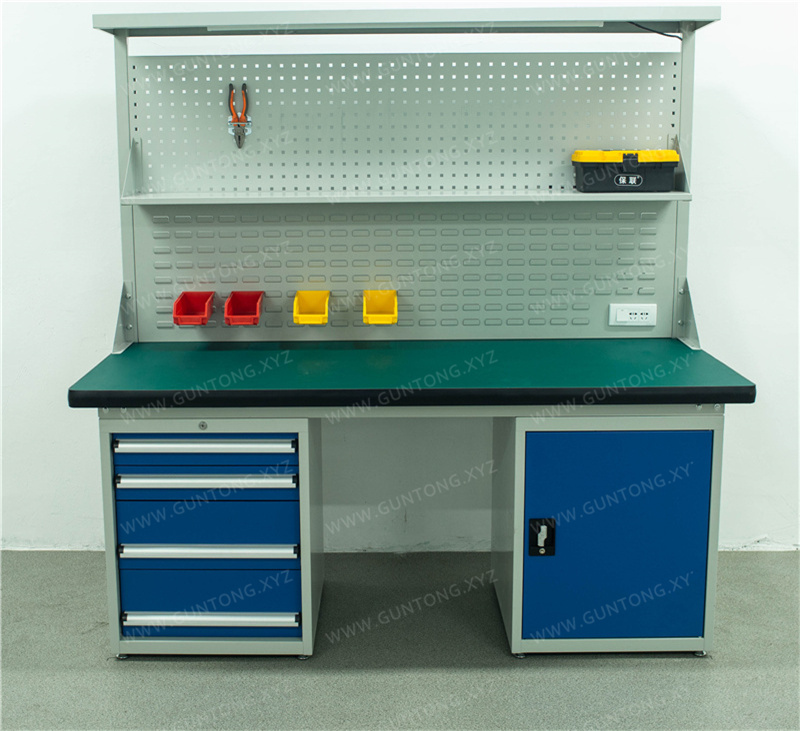
- Standard Dimensions: Common lengths include 1500mm, 1800mm, and 2100mm, typically paired with a 750mm depth and an 800mm working height. Choosing these standard specifications generally results in higher cost-efficiency and faster production lead times.
- Customization Boundaries: If your facility handles exceptionally large molds or has constrained aisle widths, non-standard customization is required. While this increases the initial investment and lead time, it prevents workflow bottlenecks and ensures compliance with workshop 6S management standards.
Tool Management and 6S Adaptation
Mold repair requires frequent switching between precision measuring tools, heavy wrenches, and power tools. A bare workbench is insufficient for efficient maintenance.
- Visual Management: Integrating a square-hole pegboard allows for the hanging of frequently used tools, keeping the primary steel surface clear for the mold itself.
- Secure Storage: Configuring the under-desk space with multi-drawer cabinets or floor cabinets ensures that heavy tooling is stored at an ergonomic height. Drawers with high load capacities are essential for storing heavy metal cutters and drill bits safely.
Decision Boundaries: When Steel is Not the Right Choice
While a raw steel plate workbench is ideal for hardware mold factories and heavy mechanical repair, it is not a universal solution.
- Environment Constraints: If the repair involves sensitive electronic components or requires an ESD (Electrostatic Discharge) protected environment, a raw steel top is unsuitable. In such cases, facility planners must pivot to anti-static workbenches.
- Corrosion Risks: For environments with high moisture or chemical exposure, standard cold-rolled steel frames and raw iron plates require rigorous maintenance to prevent rust; stainless steel alternatives should be evaluated instead.
Next Steps for Facility Planners
To finalize your workstation procurement, audit the maximum weight of the molds handled in your facility and map out the available floor space. Determine whether standard 1500mm to 2100mm configurations meet your spatial requirements or if non-standard dimensions are necessary for your specific workflow.