
How to Choose Heavy-Duty Workbenches for Maintenance Workshops: Configuration Trade-Offs and Budget Factors
Maintenance workshops demand workbenches that withstand impact, support heavy components, and keep tools organized within arm's reach. Unlike standard assembly stations, maintenance environments involve disassembly, diagnostic testing, and frequent reconfiguration of tools. Choosing the right heavy-duty workbench means evaluating how load capacity, desktop material, and modular accessories align with your specific repair tasks and budget constraints.
Defining the Maintenance Workshop Load Requirement
The first decision point is total load capacity. Workbenches are generally categorized into light-duty (up to 300 kg), medium-duty, and heavy-duty models rated for 1,000 kg or more. For maintenance workshops handling automotive parts, industrial motors, or hardware molds, a 1,000 kg rated frame is typically the baseline.
However, total capacity alone does not determine suitability. Consider how the load is distributed:
- Concentrated loads: Placing a 200 kg gearbox on one corner of the desktop requires a frame and top that resist localized deflection. C-type cold-rolled steel frames with reinforced cross-members handle this better than simple four-leg designs.
- Dynamic loads: Hammering, pressing, or impact testing generates forces that exceed static weight ratings. A composite desktop—such as a 5mm raw steel plate bonded to high-density fiberboard—absorbs shock while maintaining surface flatness.
- Drawer and shelf loads: If tools and parts are stored below the work surface, each drawer must independently support 50–80 kg without compromising overall frame stability.
Trade-off: Higher load ratings increase material cost and overall weight. If your heaviest single item stays below 400 kg, a medium-duty frame with a reinforced steel top may offer better value than a full 1,000 kg system.
Desktop Material Selection: Steel, Composite, and Stainless Options
The desktop surface directly affects durability, maintenance effort, and suitability for specific tasks.
| Desktop Type | Best For | Limitations | Relative Cost Factor |
|---|---|---|---|
| 5mm Raw Steel Plate + HDF Composite | Heavy impact work, vise mounting, general maintenance | Heavier; requires edge banding to prevent sharp edges | Mid-range |
| Solid Stainless Steel | Corrosive environments, food-grade or cleanroom maintenance | Higher cost; softer surface may dent under extreme impact | Premium |
| Anti-Static Laminate with Grounding | Electronics repair, diagnostic testing stations | Lower impact resistance; requires grounding infrastructure | Mid-to-high |
For general maintenance workshops, the 5mm steel plate composite top provides a practical balance. The steel surface resists cutting, welding spatter, and solvent exposure, while the underlying fiberboard dampens vibration. PVC edge banding protects operators from sharp borders.
Budget note: Stainless steel desktops can cost significantly more than carbon steel composites. Reserve stainless for environments where corrosion resistance is non-negotiable, such as chemical processing maintenance or marine equipment repair.
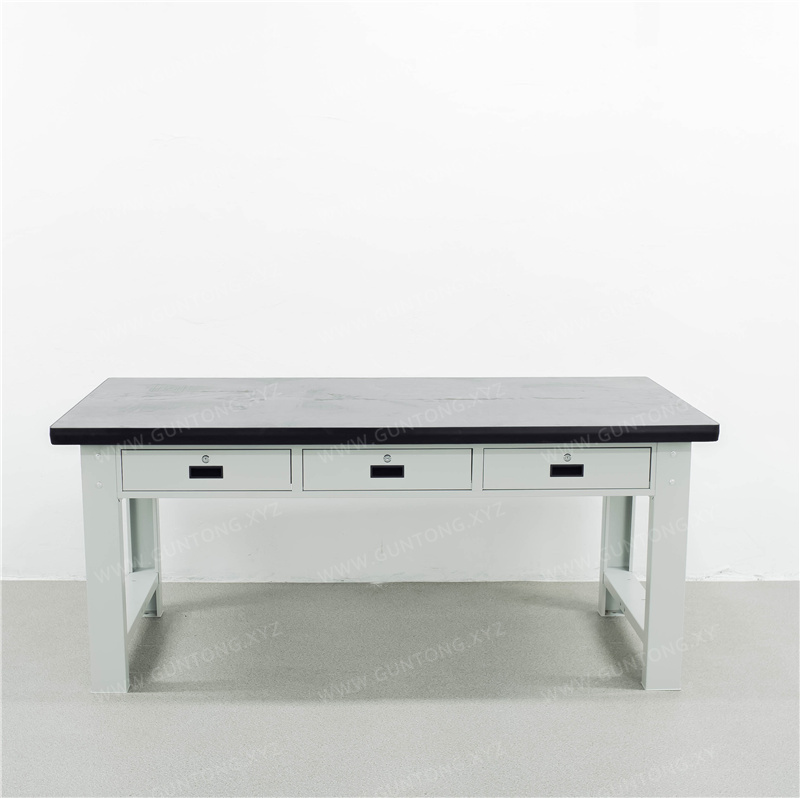
Modular Configuration: Drawers, Pegboards, and Power Integration
A bare workbench frame is rarely sufficient for maintenance work. The configuration of storage and accessory modules determines daily workflow efficiency.
Drawer and Cabinet Modules
A 4-drawer tiered layout allows technicians to separate fasteners, hand tools, and diagnostic instruments by category. Drawer heights of 100 mm and 200 mm accommodate different tool profiles. When drawers are mounted beneath the work surface, verify that leg clearance remains adequate for seated or standing operation.
Decision factor: Adding a single-door cabinet below the drawers provides enclosed storage for larger items or consumables, but reduces under-bench accessibility. Evaluate whether your maintenance tasks require frequent access to bulky parts before committing to a full cabinet module.
Pegboard and Tool Panel Integration
A square-hole pegboard mounted above the work surface enables visual tool management. Standard 500 mm pegboard heights accommodate hooks, bin rails, and small part holders. For maintenance shops with extensive tool inventories, a dual-sided pegboard or a full back panel with integrated power strips reduces reach time.
Trade-off: Pegboards add vertical height and may interfere with overhead lighting or crane access. In workshops with low ceilings or bridge cranes, consider a removable or fold-down pegboard configuration.
Power and Grounding Provisions
Maintenance tasks frequently require power tools, soldering stations, or diagnostic equipment. Workbenches with pre-drilled power holes at the desk corners simplify cable routing and keep the work surface clear. For electronics maintenance, anti-static grounding points must connect to a verified earth ground—this is a facility infrastructure requirement, not just a workbench feature.
Cost Drivers and Budget Allocation
Without publishing fixed prices, several factors predictably influence the total investment:
- Frame gauge and structure: Thicker cold-rolled steel (1.2 mm vs. 1.0 mm) and C-channel profiles increase material cost but extend service life under heavy use.
- Desktop thickness and composition: A 5mm steel + 45mm HDF composite top costs more than a simple 25mm particle board surface, but reduces replacement frequency in high-impact environments.
- Modular add-ons: Each drawer bank, cabinet, pegboard, or lighting module adds to the unit cost. Prioritize modules that address your most frequent maintenance tasks.
- Custom dimensions: Standard lengths of 1500 mm, 1800 mm, and 2100 mm are typically more cost-effective than custom sizes. Non-standard widths or heights require dedicated tooling and longer lead times.
- Surface treatment: Powder-coated finishes resist chipping and chemical exposure better than basic paint, with a moderate cost premium.
Budget strategy: Allocate the majority of your budget to the frame and desktop—the components that bear mechanical stress. Storage modules can often be added incrementally as workflow patterns become clear.
Implementation Boundaries and Risk Factors
- Floor loading: A fully loaded 1,000 kg workbench concentrates significant weight on four or six feet. Verify that your workshop floor can support the point load, especially on upper levels or mezzanines.
- Anchoring requirements: In seismic zones or facilities with overhead cranes, workbenches should be anchored to the floor to prevent tipping during lateral forces.
- Delivery and assembly access: Workbenches with 1800 mm or 2100 mm lengths may not fit through standard doorways. Confirm access routes before ordering, or request knock-down assembly if on-site welding is not feasible.
- ESD compliance: If your maintenance workshop services electronic assemblies, the workbench must be part of a broader ESD control program including flooring, footwear, and wrist strap grounding. A workbench alone cannot achieve compliance.
Next Steps for Workshop Planners
- Audit your heaviest and most frequent maintenance tasks to establish minimum load and surface requirements.
- Map your current tool inventory to determine drawer, pegboard, and cabinet needs.
- Measure available floor space and verify doorway clearances for delivery.
- Request a configuration quote based on standard dimensions first, then evaluate custom modifications only if standard sizes create workflow bottlenecks.
Guang'ErMei Precision Components provides heavy-duty workbenches with 1,000 kg load capacity, 5mm steel composite desktops, and modular drawer and pegboard configurations. Standard sizes include 1500×750×800 mm, 1800×750×800 mm, and 2100×750×800 mm, with non-standard customization available. Contact our engineering team to discuss your maintenance workshop layout and receive a configuration proposal tailored to your load, storage, and budget requirements.