How Drawers, Casters, Pegboards, and Load Capacity Affect Tool Cart Pricing
Procurement teams replacing or upgrading workshop tool carts often receive quotes that vary significantly across suppliers, even for units that look similar on the surface. The price gap is rarely arbitrary. It reflects measurable differences in drawer configuration, caster quality, pegboard integration, and structural load capacity. Understanding how each element contributes to cost helps buyers avoid both over-specification and under-performance. This guide breaks down the four primary pricing drivers for industrial tool carts, using real configuration signals from Guang'ErMei Precision Components' product range as reference points.
1. Drawer Count and Internal Structure
Drawers are the single largest cost variable in a tool cart. Each additional drawer adds material (steel gauge, slide rails, handles), assembly labor, and quality control steps. But the cost impact is not linear—drawer height and internal segmentation matter more than raw count. Signals to evaluate:
- A 4-drawer cart with two shallow drawers and two deep drawers costs differently than one with four uniform-height drawers, even if total internal volume is similar.
- Stamped drawer bottoms versus welded construction affect both price and long-term durability under repeated loading.
- Drawer slide rail rating directly influences rail cost and determines whether the cart can handle heavy wrenches, torque tools, or die components. Practical example: Guang'ErMei's 4-Drawer 1-Door Tool Cart with Pegboard uses a tiered drawer layout (two shallow drawers and two deep drawers) with stamped drawer bodies. This configuration balances organized retrieval for small hand tools with enough depth for larger items, at a moderate price point compared to all-heavy-duty drawer setups. Decision checkpoint: If your workshop stores mostly small to medium hand tools, a mixed-height drawer configuration offers better value than uniform heavy-duty drawers. Reserve higher-spec drawers for carts dedicated to CNC tooling or die maintenance.
2. Caster Specification and Mobility Requirements
Casters are often treated as an afterthought, but they represent a meaningful cost difference between a basic mobile cart and one designed for daily heavy use on uneven shop floors. Signals to evaluate:
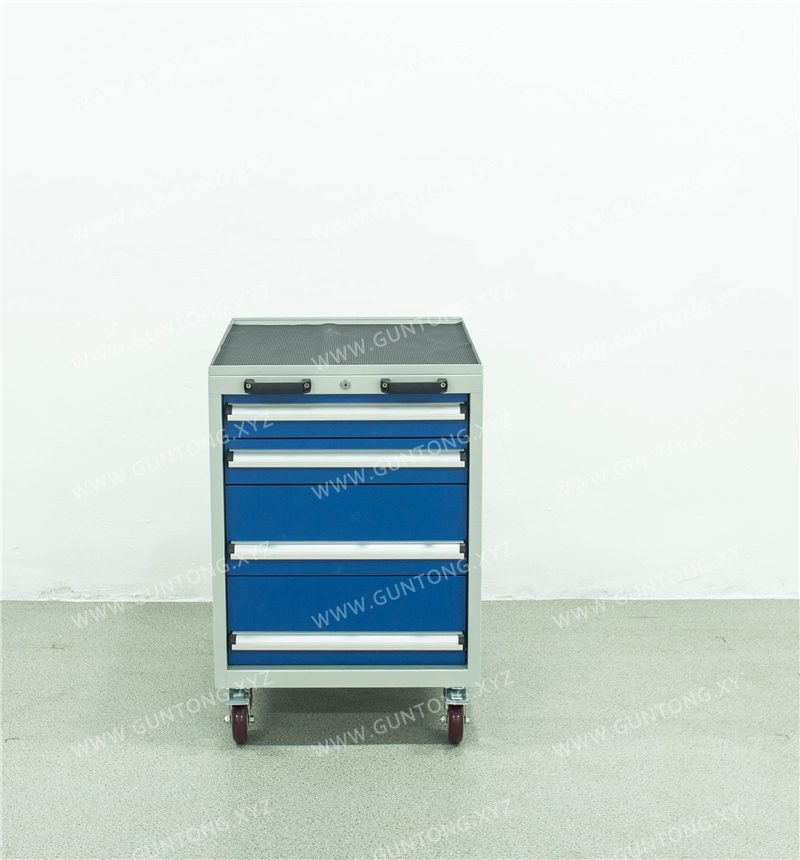
- Standard configurations typically use two fixed-direction casters at the front and two swivel casters with brakes at the rear. This setup provides stable pushing and secure stationary positioning.
- Caster wheel material (polyurethane, nylon, rubber) affects floor protection, noise, and rolling resistance. Polyurethane wheels on steel or epoxy floors command a higher unit cost but reduce long-term floor maintenance.
- Brake mechanism quality determines whether the cart stays put under vibration from nearby machinery. Low-cost brakes may drift over time, creating a safety and 6S compliance issue. Practical example: Guang'ErMei's tool cart designs specify high-strength casters with a front-fixed, rear-swivel-with-brake layout. The braking system is designed to prevent sliding once engaged, which is critical in environments where carts are positioned next to CNC machines or inspection stations. Decision checkpoint: If the cart will remain stationary most of the time, standard casters are sufficient. If it moves across multiple work zones daily, invest in higher-spec casters with reliable brakes—the replacement cost of cheap casters (including downtime and floor damage) quickly exceeds the initial price difference.
3. Pegboard Integration and Visual Management
Pegboard panels add both functional storage and visual management capability, but they also add material cost, welding or assembly steps, and surface treatment requirements. Signals to evaluate:
- A standard square-hole pegboard mounted on the cart rear or door allows flexible hook-based tool organization. The pegboard height directly affects material usage and shipping volume.
- Inner half-pegboard configurations—where the pegboard is mounted inside the cabinet door or on an interior panel—offer a more compact footprint but require more precise manufacturing.
- Surface treatment (powder coating versus paint) affects both appearance and corrosion resistance, particularly in humid or chemically exposed environments. Practical example: Guang'ErMei's Pegboard Storage Cabinet (Inner Half-Pegboard Type) uses a dual-layout approach: an upper interior pegboard section combined with pegboard panels on the cabinet door. This design improves retrieval efficiency without increasing the cart's external footprint, though it requires more complex door hinge and panel alignment during manufacturing. Decision checkpoint: If your facility follows 6S or lean visual management standards, pegboard integration is worth the added cost. If tools are stored in sealed drawers and the cart is used purely for transport, a pegboard adds unnecessary expense.
4. Load Capacity and Frame Construction
Load capacity is the most misunderstood pricing factor. Buyers often assume that a higher-rated cart costs proportionally more, but the relationship is not linear—it depends on frame design, material gauge, and joint reinforcement. Signals to evaluate:
- Frame type matters: C-type cold-rolled steel frames (as used in Guang'ErMei's steel plate workbenches) provide high rigidity at a lower weight than fully welded box-frame designs. This affects both material cost and shipping cost.
- Per-drawer load rating versus total frame load rating are different specifications. A cart may support a specific load per drawer but have a different total frame capacity.
- Reinforcement at stress points (caster mounting plates, drawer rail attachment points, pegboard mounting brackets) adds cost but significantly extends service life. Practical example: Guang'ErMei's Single Back Panel Single Door 4-Drawer Steel Plate Workbench uses a C-type cold-rolled steel frame with a high total load rating, combined with a 5 mm raw steel plate composite desktop. This configuration targets heavy-duty applications in hardware mold and automotive parts environments, where carts may support die components, torque wrenches, and inspection gauges simultaneously. Decision checkpoint: Match load rating to your actual worst-case scenario, not your average use. A cart rated close to your typical load will degrade faster than one with a higher margin. The incremental cost of higher load capacity is usually justified in heavy-industry settings.
Configuration Trade-Off Summary
| Configuration Element | Low-Cost Signal | Higher-Cost Signal |
|---|---|---|
| Drawers | Uniform height, light-duty slides | Mixed height, heavy-duty slides |
| Casters | Basic swivel, no brake | Fixed + swivel-with-brake, polyurethane wheels |
| Pegboard | No pegboard or thin add-on panel | Square-hole pegboard, inner half-pegboard layout |
| Load Capacity | Light-gauge frame | C-type or reinforced frame, high load rating |
Risks of Under-Specification
Choosing the lowest-cost configuration often leads to three recurring problems:
- Drawer slide failure under repeated heavy loading, requiring replacement within months.
- Caster drift or wheel flat-spotting on uneven floors, creating safety hazards and 6S non-compliance.
- Frame flex or joint loosening when load capacity is marginally above actual use, accelerating wear. These issues are rarely covered under standard warranties and typically cost significantly more than the initial price difference in maintenance and downtime.
Next Steps for Procurement Teams
Before requesting quotes, define the following for each tool cart application:
- Maximum single-drawer load and typical tool mix
- Daily mobility frequency and floor condition
- Whether pegboard visual management is required for 6S compliance
- Worst-case total load including cart body, drawers, pegboard hooks, and stored items With these parameters documented, you can compare configurations on a like-for-like basis and identify where higher specification delivers measurable return versus where standard configuration is sufficient. Guang'ErMei Precision Components provides both standardized tool cart models and non-standard customization for manufacturing, automotive, hardware mold, and maintenance environments. For configuration-specific pricing or on-site workstation planning support, contact the engineering team with your application parameters.