
Guang'ErMei Quality Assurance Training Event: Strengthening Inspection Standards for Workshop Workstation Equipment
Guang'ErMei Quality Assurance Training Event: Strengthening Inspection Standards for Workshop Workstation Equipment
Manufacturing enterprises, electronics producers, and automotive parts factories depend on workstation equipment that performs reliably under daily load. When a workbench drawer misaligns or a tool cabinet shelf sags, it disrupts workflow and compromises 6S management on the shop floor. To address these risks at the source, Guang'ErMei Precision Components recently held an internal quality assurance training event targeting inspection personnel across our workbench, tool cabinet, and tool cart production lines.
This article documents the key issues covered during the session, the corrective protocols reinforced, and what this means for customers sourcing workstation equipment from our Huizhou facility.
Why Quality Inspection Training Matters for Workstation Equipment
Workshop workstation equipment—ranging from heavy-duty steel plate workbenches to mobile tool carts with pegboards—is not a commodity purchase. Each unit must meet specific load-bearing requirements, dimensional tolerances, and surface finish standards that directly affect daily operations.
Common field complaints in this industry often trace back to three root causes:
- Inconsistent drawer slide alignment on tool cabinets and tool carts, leading to binding or premature wear.
- Insufficient weld penetration on C-type cold-rolled steel frames, reducing actual load capacity below rated specifications.
- Surface treatment defects such as uneven powder coating thickness, which accelerates corrosion in humid workshop environments.
Our quality assurance training event was designed to eliminate these failures before products leave the factory.
Common Failures Addressed During the Training
1. Drawer and Slide Rail Misalignment
Drawer systems on products like our 4-Drawer 1-Door Tool Cart with Pegboard and Single Back Panel 4-Drawer Steel Plate Workbench require precise alignment to function smoothly under load. During the training, inspection teams reviewed the following failure modes:
- Slide rails installed with uneven gap tolerances, causing drawers to bind when loaded to their 80 kg per-drawer rating.
- Mounting screws torqued inconsistently, leading to gradual loosening under vibration from nearby machinery.
- Drawer face panels not squared to the cabinet body, creating visual defects and interfering with adjacent units in multi-bench layouts.
Corrective action reinforced: Inspectors now verify slide rail parallelism using feeler gauges at three measurement points before approving drawer assemblies. Torque specifications for mounting hardware are checked with calibrated drivers, and face panel squareness is confirmed against a reference jig.
2. Frame Weld Integrity on Heavy-Duty Workbenches
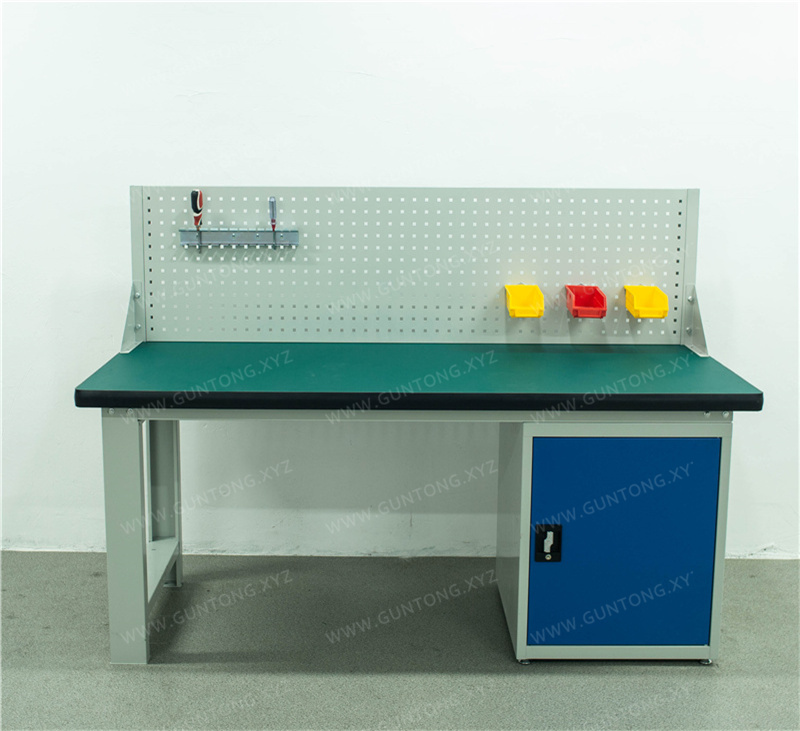
Our Single Back Panel Single Door 4-Drawer Steel Plate Workbench uses a C-type cold-rolled steel frame rated for 1000 kg total load capacity. Achieving this rating depends entirely on weld quality at critical stress joints.
The training addressed these weld-related risks:
- Porosity in MIG welds at frame-to-leg connections, which reduces shear strength.
- Undercut defects along thin-gauge steel edges, creating stress concentration points.
- Incomplete fusion at gusset plate joints, where load transfer is most demanding.
Corrective action reinforced: Weld inspection now includes visual examination under standardized lighting conditions, with spot-checks using dye penetrant testing on sample units from each production batch. Welders receive immediate feedback when defects are identified, and rework protocols require full re-inspection before the frame proceeds to powder coating.
3. Surface Coating and Edge Banding Defects
The composite desktop structure on our steel plate workbenches—featuring a 5mm raw steel plate bonded to 45mm high-density fiberboard with black PVC edge banding—requires careful handling through the finishing process.
Training participants reviewed these surface-related issues:
- Powder coating thickness falling below specification on interior cabinet surfaces, reducing corrosion protection.
- PVC edge banding applied with insufficient adhesive coverage, leading to peeling under thermal cycling in workshop environments.
- Scratches or dents introduced during assembly that are not caught before packaging.
Corrective action reinforced: Coating thickness is now measured with magnetic gauges on both exterior and interior surfaces of every batch. Edge banding adhesion is tested using a standardized peel-back check on sample desktops. A final visual inspection under bright-line lighting is mandatory before any unit is cleared for packaging.
How These Practices Translate to Customer Value
For manufacturing customers in electronics, automotive parts, hardware mold, and maintenance/testing sectors, consistent quality at the factory level means fewer disruptions after installation. Specifically:
- Reduced on-site adjustment time: Properly aligned drawers and square cabinets install faster and integrate more smoothly into existing workshop layouts.
- Longer service intervals: Weld integrity and surface treatment quality extend the time between maintenance requirements, supporting lean operations.
- Reliable load performance: Verified load-bearing capacity ensures that heavy tooling, mold components, or automotive parts can be stored safely without risk of structural failure.
Guang'ErMei's dual capability in standardized production and non-standard customization means these quality protocols apply equally to catalog products and project-specific designs. Whether you are ordering a single anti-static workbench for an electronics lab or a full set of automotive parts turnover racks for a new assembly line, the same inspection standards govern every unit.
Selection and Implementation Guidance
When sourcing workstation equipment, consider these practical checkpoints:
| Decision Factor | What to Verify |
|---|---|
| Load capacity | Confirm rated load matches your heaviest expected load with a safety margin |
| Drawer configuration | Match drawer heights to your tool and part dimensions |
| Surface material | Choose steel plate, stainless steel, or anti-static surfaces based on your workshop environment |
| Pegboard compatibility | Ensure square-hole spacing matches your existing hook and holder inventory |
| Dimensional fit | Verify overall dimensions against your allocated floor space and aisle clearance |
For non-standard requirements—such as custom dimensions, specialized load ratings, or integration with automated storage and retrieval systems—engage with the supplier's engineering team early in the planning process. Guang'ErMei supports on-site workstation planning, load-bearing design, and 6S adaptation as part of our full-chain service.
Boundaries and Risk Considerations
- Quality inspection training improves consistency but does not eliminate the need for proper installation and routine maintenance at the customer site.
- Load ratings assume evenly distributed loads; point loading from concentrated weights may require reinforced desktop or shelf specifications.
- Surface treatment durability depends on the actual workshop environment; highly corrosive conditions may require upgraded coating specifications beyond standard powder coating.
Next Steps
If you are evaluating workstation equipment for a new workshop layout, a production line expansion, or a facility upgrade, we recommend starting with a detailed requirements review. Share your load specifications, dimensional constraints, and environmental conditions so that product selection and customization can be aligned to your actual operating context.
Contact Guang'ErMei Precision Components to discuss your workstation equipment requirements or to request technical documentation on our quality inspection protocols.