
Guang'ErMei Custom Workbench Design Drawing Review Log: How We Validate Structural and Functional Details Before Product
Who This Review Log Applies To
Manufacturing buyers who request non-standard workbenches—such as heavy-duty fitter benches for hardware mold factories, anti-static stations for electronics assembly, or stainless steel workbenches for food-grade or cleanroom environments—need more than a catalog page. They need a verified design drawing that accounts for actual shop floor loads, tool storage logic, and 6S management requirements.
This log records the internal review checkpoints Guang'ErMei Precision Components applies before releasing a custom workbench drawing to the production floor. It is intended for procurement engineers, workshop planners, and facility managers who want to understand what gets checked, why certain design choices are made, and where customization boundaries exist.
Signals That Trigger a Full Design Review
Not every workbench order requires an engineering-level drawing review. Standard models—such as the 1500×750×800 mm single back panel steel plate workbench with a 5 mm raw steel plate composite desktop—ship from proven drawings. A full review is triggered when any of the following signals appear:
- Load requirement exceeds standard ratings. The standard C-type cold-rolled steel frame supports up to 1000 kg total load. Requests above this threshold require frame gauge recalculation and leg reinforcement review.
- Non-standard dimensions. Lengths beyond 2100 mm, widths outside the 750 mm norm, or height adjustments that shift the center of gravity demand stability analysis.
- Special desktop materials. Requests for anti-static laminate, stainless steel cladding, or chemical-resistant surfaces change the composite desktop structure (normally 5 mm raw steel plate + 45 mm high-density fiberboard + black PVC edge banding).
- Integrated storage configurations. Adding drawers, pegboards, or cabinet modules to a bench that was originally a flat-top design affects weight distribution and frame loading.
- Environment-specific constraints. Washdown areas, ESD-protected zones, or high-temperature forge shops each impose material and finish requirements that must be validated.
Evaluation Criteria in the Drawing Review
1. Load-Bearing Verification
The first checkpoint is structural. Reviewers calculate the distributed load across the desktop surface and the point load at each leg. For the standard 4-drawer steel plate workbench, the 5 mm raw steel plate bonded to 45 mm high-density fiberboard provides a rigid composite that resists deflection under heavy tooling or fixture clamping.
When a customer specifies a 1500 kg load—for example, to support a large hydraulic press fixture on a mold repair bench—the review log records:
- Frame gauge upgrade from standard 1.5 mm to 2.0 mm cold-rolled steel.
- Addition of cross-bracing members at mid-span.
- Leg base plate enlargement to distribute floor load.
- Desktop composite change: increasing steel plate thickness to 8 mm or switching to a full-steel welded top.
2. Drawer and Storage Module Integration
Drawer modules add concentrated mass below the desktop. The standard 4-drawer configuration (100 mm H × 2 + 200 mm H × 2) is rated at 80 kg per drawer. When a review identifies that drawers will store heavy dies or calibration instruments, the log captures:
- Drawer slide upgrade from standard 3-section ball-bearing slides to heavy-duty roller slides.
- Reinforcement of the drawer mounting frame to prevent sag under full extension.
- Verification that the combined drawer load plus desktop load does not exceed the frame's total capacity.
For tool cart configurations—such as the 4-drawer 1-door tool cart with a 500 mm square-hole pegboard—the review also checks the tipping moment when all drawers are fully extended simultaneously. Anti-tip interlocks are specified if the calculated moment exceeds the safety threshold.
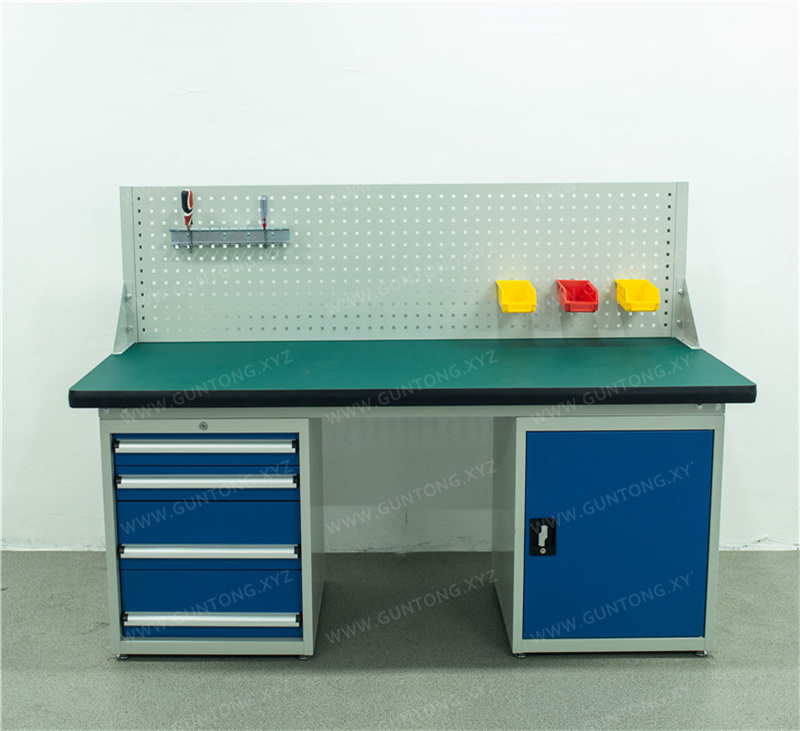
3. Pegboard and Vertical Storage Validation
Pegboards are common in 6S-managed workshops for visual tool management. The inner half-pegboard storage cabinet, for instance, uses a dual pegboard layout on the cabinet door plus an upper interior pegboard section. When a custom workbench incorporates a pegboard back panel, the review log verifies:
- Pegboard gauge (standard 1.0 mm or 1.2 mm cold-rolled steel) is sufficient for the intended hook load.
- Mounting brackets are welded to the frame, not merely bolted, when hook loads exceed 15 kg per linear meter.
- Square-hole pattern alignment matches the customer's existing hook inventory (standard 25 mm pitch).
4. Material and Finish Confirmation
The review log records material specifications against the operating environment:
| Environment | Desktop Material | Frame Finish | Notes |
|---|---|---|---|
| General machining | 5 mm steel plate + HDF | Powder-coated | Standard configuration |
| Electronics assembly (ESD) | Anti-static laminate + grounding lug | Conductive powder coat | Requires ground continuity test |
| Food processing / washdown | 304 stainless steel cladding | Stainless or zinc-rich primer | PVC edge banding omitted |
| High-temperature forge | Full welded steel top, no HDF | High-temp paint | HDF core cannot exceed 80°C |
5. Dimensional and Ergonomic Check
Standard workbench height is 800 mm (plus 500 mm for back panel/pegboard). The review confirms that custom height requests—such as a 900 mm bench for standing operators or a 650 mm bench for seated precision work—still allow knee clearance, monitor arm mounting, and under-bench drawer access.
Operating Logic: How the Review Flows
- Customer submits requirements. Dimensions, load, environment, storage needs, and any reference drawings.
- Application engineer drafts the design drawing. Selects base model, modifies frame, desktop, and storage modules.
- Internal review meeting. Structural, production, and quality engineers examine the drawing against the checklist above.
- Review log is completed. Each checkpoint is marked pass, conditional, or fail with corrective notes.
- Drawing is revised if needed. Conditional items trigger redesign; fail items are escalated to the customer for requirement adjustment.
- Approved drawing is released to production. The review log is archived with the project file for traceability.
Applicable Boundaries and Risks
- Load claims are valid only for static, evenly distributed loads. Dynamic impact (e.g., dropping a 200 kg mold onto the desktop) is not covered by the standard rating and requires a separate impact analysis.
- Anti-static configurations require a verified ground path. The workbench alone cannot guarantee ESD protection if the facility floor and wrist strap system are not properly grounded.
- Stainless steel cladding is bonded, not solid. For applications requiring full stainless structural integrity (e.g., corrosive chemical immersion), a different product category is needed.
- Non-standard dimensions may affect delivery lead time. Custom frame cuts and special desktop blanks require additional procurement cycles compared to standard models.
- Pegboard hook loads are rated per hook, not per panel. Overloading a single hook beyond its rated capacity can deform the square hole regardless of overall panel strength.
Practical Example: Automotive Parts Turnover Rack Integration
A recent project involved integrating a custom workbench with an automotive parts turnover rack system. The customer needed the bench to serve as a packing and inspection station adjacent to the rack. The review log captured:
- Desktop height matched to the rack's tote presentation height (750 mm) to minimize lifting.
- Frame depth reduced to 600 mm (from standard 750 mm) to fit the aisle clearance.
- A single back panel with square-hole pegboard was specified to hold packing tools and barcode scanners.
- Load requirement was moderate (300 kg), so the standard C-type frame was retained, but cross-bracing was added due to the reduced depth affecting lateral stability.
This example illustrates how the review log forces explicit documentation of every deviation from standard, ensuring that neither the customer nor the production team encounters surprises.
Next Steps for Buyers
If you are evaluating a custom workbench for your workshop, prepare the following before requesting a design drawing review:
- Actual maximum load (not estimated—weigh your heaviest fixture or tool set).
- Operating environment (temperature range, exposure to chemicals, ESD requirements).
- Storage inventory (list of tools, gauges, or parts to be stored in drawers or on pegboards, with approximate weights).
- Space constraints (aisle width, ceiling height, adjacent equipment clearances).
With these inputs, Guang'ErMei's application engineering team can produce a reviewed and logged design drawing that matches your shop floor reality.
Contact Guang'ErMei Precision Components to start your custom workbench design review →