
Floor Cabinet vs. Overhead Cabinet Workbenches: Selection and Configuration Guide
Manufacturing teams configuring workshop workstations often face a core decision: should tools and materials be stored in floor cabinets beneath the work surface, or in overhead cabinets mounted above it? This choice directly impacts operator efficiency, safety compliance, and long-term 6S management.
Guang'ErMei Precision Components designs and manufactures both configurations for industries including electronics, automotive parts, hardware molds, maintenance and testing, and vocational training centers. Below is a structured comparison to support procurement and layout decisions.
Core Differences at a Glance
| Criteria | Floor Cabinet Workbench | Overhead Cabinet Workbench |
|---|---|---|
| Typical Load Capacity | Heavy-duty models support substantial total loads; drawers rated for heavy tool storage | Lighter loads; suited for small parts, documents, ESD-sensitive components |
| Tool Access Pattern | Frequent retrieval of heavy or bulky tools at waist level | Occasional access to lightweight items above eye level |
| Floor Space Impact | Occupies footprint under desk; limits legroom but consolidates storage | Frees under-desk space; requires vertical clearance and wall/ceiling mounting |
| ESD Integration | Easily paired with grounded composite desktops and wrist strap points | Requires separate grounding paths for overhead metal components |
| 6S Visual Management | Drawer dividers and labeling support shadow boards and category sorting | Pegboard-backed overhead panels enable tool outline visibility |
When to Choose a Floor Cabinet Workbench
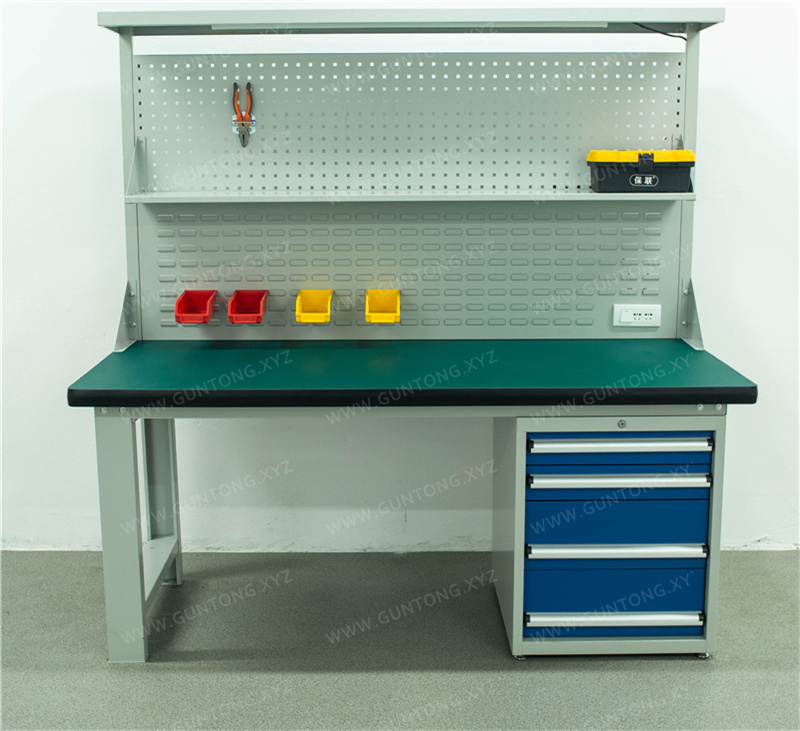
Floor cabinet workbenches are optimal when operators handle heavy tooling, dies, or multi-step assembly kits that must remain within arm's reach. The Single Back Panel Single Door 4-Drawer Steel Plate Workbench, for example, uses a raw steel plate composite desktop and C-type cold-rolled steel frame to support heavy-duty total loads. Its four-drawer tiered design allows categorized storage of wrenches, calipers, and torque tools—critical for fitter and maintenance stations.
Best suited for:
- Automotive parts assembly and inspection
- Hardware mold repair benches
- Heavy-duty electronics testing stations with oscilloscopes and power supplies
- Vocational training labs where tool accountability is mandatory
Constraints to verify:
- Ensure floor leveling and anti-vibration pads if precision measurement is performed on the same surface.
- Confirm drawer slide rating matches actual tool weight; overloaded drawers compromise safety and slide lifespan.
When to Choose an Overhead Cabinet Workbench
Overhead cabinets serve scenarios where under-desk space must remain clear for seating, material staging, or automated conveyor integration. They are common in lean production cells and cleanroom-adjacent electronics assembly lines.
Best suited for:
- Lightweight component kitting and SMT preparation
- Documentation and SOP reference storage above inspection benches
- ESD-safe environments where overhead ionizers and monitoring panels are mounted
Constraints to verify:
- Ceiling height and sprinkler clearance must accommodate cabinet depth.
- Overhead loading should remain within the rated shelf capacity to prevent mounting bracket fatigue.
- Operators of shorter stature may require step stools, introducing ergonomic and safety risks.
Hybrid Configurations: Combining Both for Complex Workflows
Many multi-industry workshops deploy hybrid stations: floor cabinets for primary tooling and overhead cabinets for consumables, PPE, or digital displays. Guang'ErMei supports such configurations through modular frame systems that accept both under-bench drawer units and top-mounted pegboard or shelf assemblies.
For example, a floor cabinet composite workbench can be paired with an overhead lighting and tool rail system, maintaining heavy-duty bench capacity while adding vertical storage for torque drivers and ESD wrist straps.
Decision Checklist for Procurement Teams
- Audit tool weight and retrieval frequency. If the majority of tools are heavy or accessed frequently throughout the shift, prioritize floor cabinets.
- Map operator posture and sightlines. Overhead cabinets should not obstruct lighting or force excessive neck extension.
- Validate ESD continuity. Metal overhead cabinets in ESD zones require dedicated grounding straps separate from the work surface.
- Confirm non-standard customization needs. Guang'ErMei provides on-site workstation planning, load-bearing design, and 6S adaptation services across Guangdong and nationwide delivery.
Next Steps
To validate which configuration fits your production cell, request a site assessment or share your current workstation layout drawings. Guang'ErMei's engineering team can simulate load distribution and recommend standardized or custom-built solutions backed by full-process after-sales support.