
Evaluating Guang'ErMei at the Industrial Equipment Exhibition: A Buyer's Checklist for Workstation Solutions
When manufacturing facility planners and procurement managers attend trade shows, they are often presented with generic claims about workshop efficiency. However, evaluating Guang'ErMei at the industrial equipment exhibition requires a shift in focus from marketing slogans to verifiable engineering details. For enterprises in electronics, automotive parts manufacturing, and hardware mold production, selecting the right workstation equipment is critical for operational stability and 6S management.
This guide provides a practical framework for buyers to assess our heavy-duty workbenches, tool carts, and storage cabinets on-site, ensuring that the equipment meets the rigorous demands of real-world production environments.
Why On-Site Evaluation Matters for Workstation Equipment
Catalog specifications often fail to capture the nuances of dynamic workshop environments. A workbench that looks robust in a brochure may deflect under continuous heavy loads, and a tool cabinet might lack the modular flexibility required for evolving assembly lines.
On-site evaluation allows facility planners to physically inspect material thickness, weld quality, and drawer slide mechanisms. Furthermore, it provides an opportunity to discuss non-standard customization requirements, such as specific anti-static treatments for electronics manufacturing or specialized load-bearing designs for hardware mold maintenance. In alignment with our strict exhibition standards, Guang'ErMei focuses entirely on showcasing verifiable product categories, practical application scenarios, and precise technical parameters. We strictly avoid using unverifiable expressions such as "industry leader" or "number one" in our exhibition materials, ensuring that all buyer consultations are grounded in factual engineering data and actual testing.
Core Showcase Highlights: What to Inspect on the Floor
When visiting our booth, buyers should direct their attention to the structural integrity and functional design of our core product lines. Here are the specific models and parameters to evaluate:
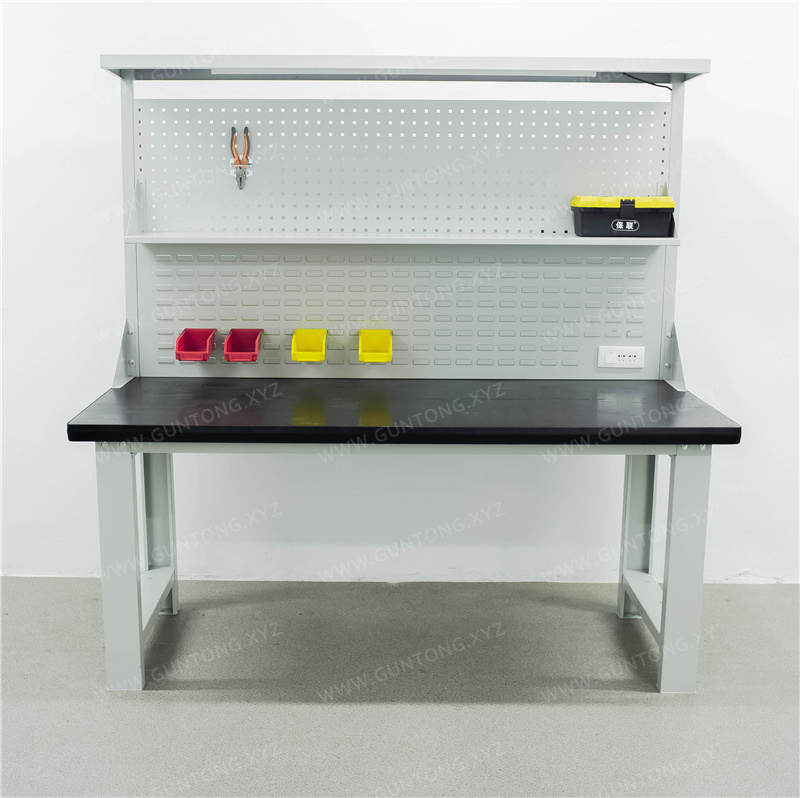
1. Heavy-Duty Workbenches for High-Load Scenarios
For hardware mold factories and automotive parts manufacturers, workbench deflection is a primary concern. Inspect the Single Back Panel Single Door 4-Drawer Steel Plate Workbench.
- Desktop Structure:*
- Verify the composite structure featuring a 5mm raw steel plate combined with a 45mm high-density fiberboard and black PVC edge banding.
- Load Capacity:*
- Examine the C-type cold-rolled steel frame, engineered to support a total load capacity of 1000kg.
- Storage Integration:*
- Check the 4-drawer tiered design and square-hole pegboard for organized tool storage and visual management.
2. Mobile Tool Management for Assembly Lines
Efficient tool retrieval directly impacts assembly cycle times. Evaluate the 4-Drawer 1-Door Tool Cart with Pegboard for on-site mobility and storage.
- Drawer Performance:*
- Test the stamped drawer slides, which offer an 80 kg load capacity per drawer while maintaining stable overall movement.
- Visual Management:*
- Inspect the 500 mm standard square-hole pegboard, which allows for flexible expansion and immediate tool identification.
3. High-Density Storage for Maintenance Facilities
For maintenance and testing institutions, organizing heavy spare parts requires robust shelving. Review the Pegboard Storage Cabinet (Inner Half-Pegboard Type).
- Material Specifications:*
- Confirm the use of 1.0 mm or 1.2 mm cold-rolled steel for the main body.
- Shelf Capacity:*
- Check the three adjustable shelves, each rated for a 100 kg load capacity, alongside the dual pegboard layout on the cabinet door for improved retrieval efficiency.
The Buyer’s Decision Checklist for Exhibition Sourcing
To maximize the value of your visit, use the following checklist when speaking with our technical representatives:
- Verify Load-Bearing Calculations: Ask for the specific load-bearing design parameters for your heaviest tools or molds. Do not rely on generic "heavy-duty" labels; request the exact steel thickness and frame structure details.
- Assess 6S Adaptability: Evaluate how the square-hole pegboards, drawer dividers, and label slots integrate with your facility's 6S management protocols.
- Discuss Non-Standard Customization Boundaries: If your workshop requires specific dimensions, anti-static surfaces, or automated storage and retrieval system (Miniload) accessories, clarify the technical constraints and lead times for custom designs on the spot.
- Review Full-Chain Service Capabilities: Confirm the scope of our on-site workstation planning, installation, and full-process after-sales service for your specific geographic region.
Next Steps for Facility Planners
Sourcing workstation equipment at an exhibition is the first step toward optimizing your workshop layout. By focusing on verifiable material specifications, load capacities, and practical 6S integration, you can make informed procurement decisions that directly enhance production efficiency.
If you are planning to visit Guang'ErMei at the industrial equipment exhibition or need to evaluate our workstation solutions for your facility, we recommend preparing a list of your heaviest equipment dimensions and current workflow bottlenecks. Contact our technical team to schedule an on-site consultation or request detailed configuration drawings tailored to your workshop layout.