
How to Evaluate a Single Pegboard 3-Drawer Composite Workbench: Selection Criteria for Maintenance Workshops
How to Evaluate a Single Pegboard 3-Drawer Composite Workbench: Selection Criteria for Maintenance Workshops
In automotive parts assembly lines and hardware mold repair bays, downtime often stems from inefficient tool retrieval and unstable work surfaces. Procurement teams frequently default to standard catalog listings without verifying whether a single pegboard 3-drawer composite workbench aligns with actual dynamic loads and spatial constraints. Evaluating this equipment requires moving beyond generic specifications and applying condition-based selection criteria.
Myth 1: All composite workbenches share identical load capacities.
Fact: Load rating is strictly determined by frame geometry and desktop layering, not just the material name.
Condition: A properly engineered unit utilizes a 100×50×1.5 mm cold-rolled C-steel frame paired with a 50 mm thick layered composite desktop. Under static loading, this configuration reliably supports up to 1,000 kg across the entire surface.
Exception: Dynamic impact loads—such as dropping heavy cast components or operating pneumatic torque wrenches continuously—can concentrate stress on localized joints. In these cases, the standard rating applies only when the workbench is floor-anchored and distributed loads do not exceed 80 kg per linear meter. For high-impact mold grinding stations, reinforced cross-bracing or a dedicated heavy-duty steel top becomes necessary.
Myth 2: Three drawers automatically optimize 6S workflow.
Fact: Drawer quantity does not guarantee retrieval efficiency; rail type and opening percentage dictate actual usability.
Condition: A horizontal three-drawer composite workbench equipped with single-extension rails typically allows approximately 85% drawer opening. This range accommodates most hand tools, fasteners, and calibration instruments while maintaining a compact footprint. Each drawer is rated for a maximum of 80 kg, which suits organized categorization rather than bulk storage.
Exception: When storing oversized jigs, long shafts, or dense metal blanks, the 80 kg per-drawer limit will be breached quickly, causing rail fatigue and misalignment. In such scenarios, replacing two lower drawers with adjustable shelving or integrating a separate tool cart improves both safety and cycle time. Additionally, drawer depth must be verified against the tallest stored item; standard depths assume a 500 mm cabinet footprint.
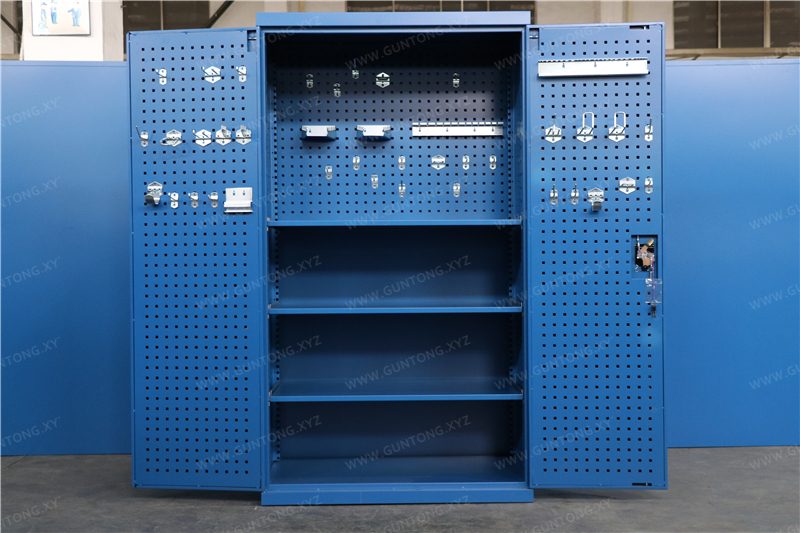
Myth 3: Standard pegboard heights fit every visual management requirement.
Fact: Fixed-height pegboards provide consistent sightlines but lack modularity for evolving tool sets.
Condition: A 450 mm square-hole pegboard mounted on the back panel positions frequently used wrenches, calipers, and marking pens within the natural eye-to-hand zone (900–1,200 mm from the floor). This height minimizes bending and supports lean manufacturing principles by making inventory instantly visible.
Exception: Facilities transitioning to automated storage and retrieval system accessories or larger fixture racks will find the 450 mm limit restrictive. Square-hole panels also require compatible hooks and bins; mismatched accessories reduce effective capacity by up to 30%. If your maintenance team uses predominantly digital tablets or lightweight sensors, a solid stainless steel back panel may offer better hygiene and cable routing than perforated steel.
Implementation & Delivery Boundaries
Selecting the correct configuration requires aligning physical dimensions with floor space and utility access. Standard composite desktop workbenches are available in common lengths (1,500 mm, 1,800 mm, 2,100 mm) with a fixed width of 750 mm. Non-standard lengths or integrated power/supply modules extend production cycles to 7–10 working days. Surface finishes typically undergo pickling, phosphating, and anti-static powder coating to resist oil and chemical exposure in machining environments.
Installation must account for floor flatness and anchoring points. Uneven concrete slabs can compromise drawer alignment and pegboard mounting integrity. For multi-station layouts, inter-unit spacing should maintain at least 800 mm clearance to allow safe cart movement and emergency egress.
Next Steps for Procurement Teams
Verify your actual peak load, tool dimensions, and utility requirements before finalizing a quote. Request a site survey or submit floor plans to validate clearances and anchoring conditions. Custom configurations for automotive assembly cells or mold maintenance bays are supported through detailed CAD mapping and load-testing documentation.