
How to Evaluate Cost and Value in Single Pegboard Workbenches: Configuration, Load, and 6S Integration
Scenario Introduction: The High-Frequency Access Station
In electronics assembly lines or automotive parts inspection stations, operators frequently retrieve small tools, fasteners, and testing probes within a confined footprint. The core problem is not just storage capacity, but retrieval speed and workspace organization. When evaluating a single pegboard workbench for these environments, the decision must move beyond unit price and focus on cost and value: how modular components like pegboards, drawers, and bottom rails reduce motion waste, support 6S visual management, and extend service life under daily industrial use.
Defining the Boundary: Mobile Tool Carts vs. Fixed Workstations
A common procurement confusion lies in overlapping mobile tool carts and fixed workshop workbenches. Mobile units excel at cross-station tool transport, while fixed workstations anchor repetitive tasks. For high-frequency access points, a fixed configuration with integrated vertical storage typically delivers higher long-term value. The boundary is clear: if tools are used by multiple shifts across different zones, prioritize casters and lightweight frames; if the station handles continuous assembly, calibration, or heavy component placement, anchor the system to a rigid frame with optimized drawer and pegboard integration.
Deconstructing the Configuration: Pegboard + Dual Drawers + Bottom Rail
The standard combination of a single pegboard, dual drawers, and a bottom rail addresses three distinct workflow needs:
- Vertical Visual Management (Pegboard): A square-hole pegboard panel allows rapid hanging of hand tools, cables, and gauges. Standard panels typically measure around 500 mm in height, providing ample surface area for shadow boards and 6S labeling without consuming desktop space.
- Tiered Storage (Dual Drawers): Drawer units separate items by size and frequency of use. Based on verified structural benchmarks, stamped steel drawers with heavy-duty guides typically support up to 80 kg per compartment. This limit ensures smooth operation without warping, making them ideal for medium-weight fixtures rather than bulk raw materials.
- Stability & Clearance (Bottom Rail): A reinforced bottom rail prevents lateral flex when drawers are fully extended and protects the cabinet base from forklift impacts or rolling loads. It also creates a cleanable gap that aligns with floor-level 6S standards.
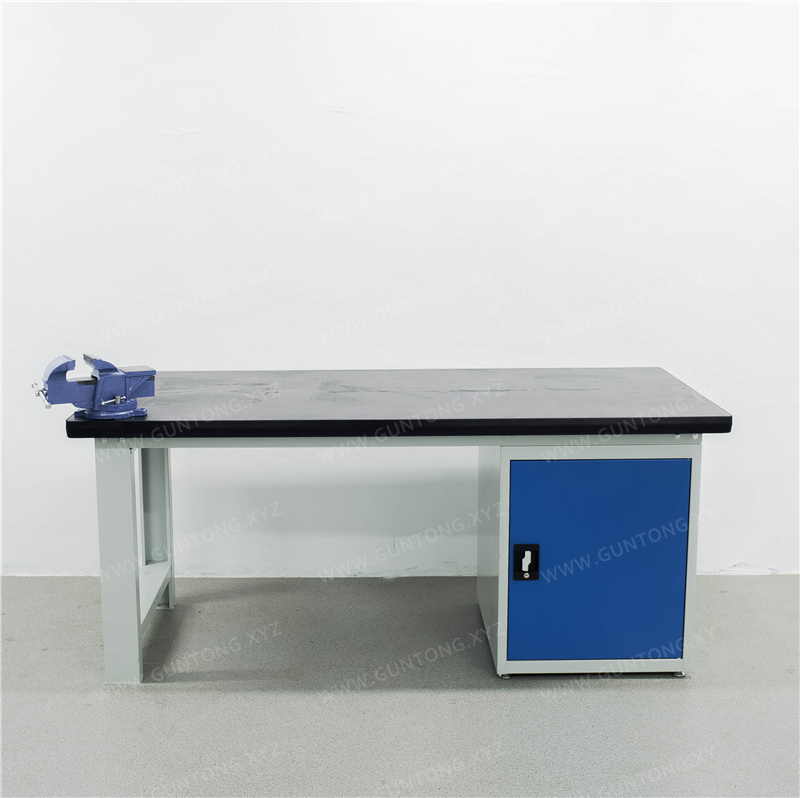
When assessing cost and value, verify that the desktop structure matches the intended workload. Composite desktops combining a 5 mm raw steel plate base with a 45 mm high-density fiberboard top offer excellent vibration dampening and tool protection, while maintaining a total frame load capacity suitable for precision assembly.
Material Selection: Composite Desktop vs. Stainless Steel for Specific Environments
Environment dictates material ROI. For general manufacturing, vocational training centers, or dry warehousing, a composite desktop paired with a C-type cold-rolled steel frame provides optimal stiffness-to-cost ratio. The frame geometry distributes weight evenly, supporting standardized workloads without excessive material thickness.
In contrast, logistics hubs, chemical handling areas, or outdoor-adjacent workshops require corrosion resistance. Here, stainless steel cladding (such as 201-grade stainless wraps) outperforms painted steel in longevity, though it carries a higher initial cost. The value calculation should factor in cleaning frequency, chemical exposure, and replacement cycles rather than upfront price alone.
Acceptance Criteria and Non-Standard Customization Workflow
Before finalizing a purchase, apply these acceptance criteria:
- Load Verification:*
- Confirm per-shelf and per-drawer ratings against actual inventory weights. Do not exceed rated limits to preserve guide integrity.
- Frame Geometry:*
- Ensure C-channel or equivalent cold-rolled steel framing matches the specified thickness and weld quality.
- Surface Finish:*
- Verify edge banding, powder coating consistency, and pegboard hole alignment for tool compatibility.
For facilities requiring layout-specific solutions, Guang'ErMei Precision Components supports non-standard customization. The process begins with client-provided inputs: workshop floor plans, maximum expected loads, ergonomic height requirements, and specific 6S or safety protocols. Upon receipt, engineering teams generate 3D layout drawings and detailed configuration lists for review. This approach eliminates guesswork, ensures spatial fit, and aligns procurement with actual operational constraints.
Conclusion
Evaluating a single pegboard workbench requires shifting focus from isolated specs to systemic value. By matching drawer capacities, pegboard dimensions, and frame materials to your exact workflow, you secure a workstation that reduces motion waste, supports compliance, and scales with production demands. When standard catalogs do not align with your facility’s footprint or load profile, structured customization bridges the gap between budget and performance.
Next Steps
Review your current station layouts and document peak tool retrieval frequencies and maximum part weights. Share your floor plan and usage scenarios with our engineering team to receive a tailored 3D configuration proposal and transparent cost breakdown. Contact Guang'ErMei Precision Components today to align your workshop equipment with measurable operational value.