
Drawings for Custom Storage Cabinets: What to Specify Before Ordering
Who Needs to Prepare Drawings for Custom Storage Cabinets
Procurement teams in manufacturing, maintenance, and warehousing often start with a standard product list, then realize that existing models do not fit the available floor space, tool types, or workflow sequence. At that point, custom drawings become necessary. Typical buyers include electronics assembly plants, automotive parts workshops, hardware mold factories, maintenance and testing institutions, and vocational training centers that need storage cabinets integrated with workbenches or tool carts.
If your facility is replacing older cabinets or upgrading to a 6S-compliant layout, the drawing stage is where most specification errors happen. Getting the drawing requirements right before production avoids costly rework, delayed installation, and mismatched load capacity.
What to Specify on the Drawings
1. Overall Dimensions and Clearance
Start with the exact width, depth, and height of the cabinet, measured against the available wall or aisle space. Common standard sizes for storage cabinets include 1000×500×1800 mm and 1000×600×1800 mm, but custom orders often require non-standard widths or reduced depths to fit between existing equipment. Always specify whether the dimensions include or exclude protruding elements such as handles, pegboards, or casters.
2. Load Capacity per Shelf and per Drawer
This is the most frequently misunderstood parameter. Buyers should specify the expected load per shelf and per drawer separately. Based on Guang'ErMei's product data, standard adjustable shelves in storage cabinets are rated at 100 kg per shelf, while drawers with stamped single-rail guides typically support 80 kg per drawer. If your tools, molds, or parts exceed these values, the drawing must call for reinforced shelf brackets, thicker cold-rolled steel, or upgraded rail systems. Do not assume all drawers in the same cabinet share the same rating.
3. Internal Layout: Shelves, Drawers, and Pegboards
The drawing should clearly show the combination of shelves, drawers, and pegboard sections. For example, a typical inner half-pegboard storage cabinet may include two 100 mm-high drawers in the middle section, two adjustable shelves below, a square-hole pegboard on the upper back panel, and a half-pegboard on the door. Specify the number of adjustable shelves, their spacing range, and whether the pegboard uses square-hole or louvered patterns. These choices directly affect tool retrieval efficiency and 6S compliance.
4. Material Thickness and Surface Treatment
Material thickness affects both load capacity and long-term durability. Standard cabinet bodies use 1.0 mm or 1.2 mm cold-rolled steel, while drawer fronts typically use 1.5 mm cold-rolled steel. Rail thickness and guide rail specifications should also be noted on the drawing. If the cabinet will be used in environments with moisture, chemical exposure, or frequent cleaning, specify the surface treatment type, such as powder coating grade or stainless steel construction.
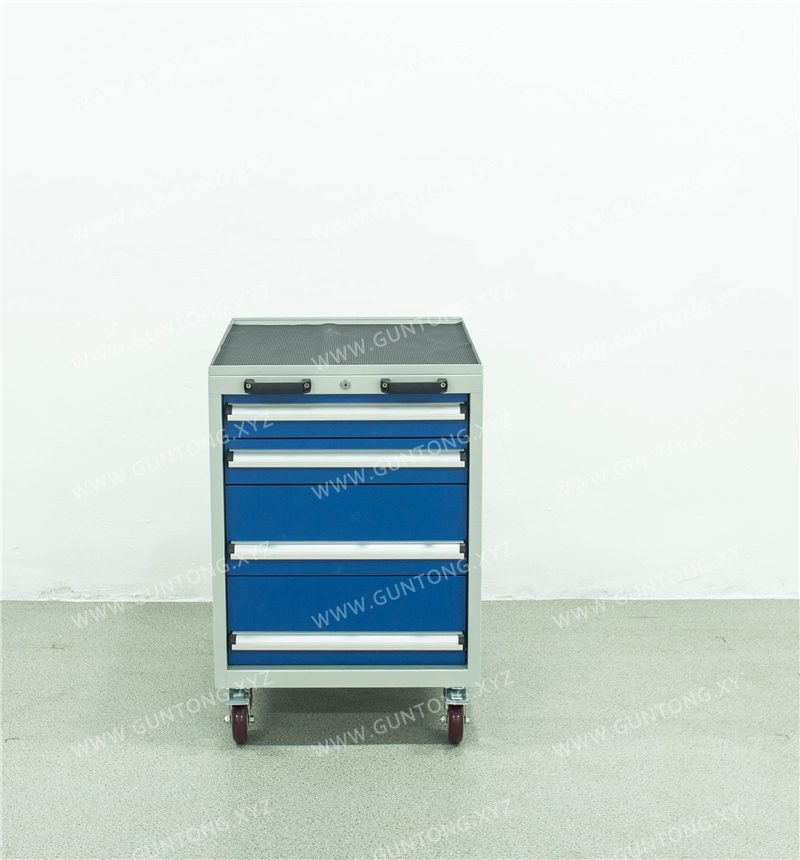
5. Integration with Workbenches and Tool Carts
If the storage cabinet will be placed adjacent to or combined with a workbench or tool cart, the drawing should show the connection interface. For example, a single back panel single door 4-drawer steel plate workbench can be paired with a matching storage cabinet to create a continuous workstation. Specify the height alignment, gap tolerance, and whether shared pegboard panels are required.
Supplier Evaluation: What to Ask Before Confirming the Drawing
When reviewing supplier responses, check whether they provide:
- A confirmed drawing with all dimensions, load ratings, and material specs clearly labeled.
- A breakdown of which components are standard and which require non-standard tooling or lead times.
- Clarification on whether the quoted load capacity applies to evenly distributed loads or point loads.
- Installation requirements, including floor anchoring, wall mounting, or leveling adjustments.
Guang'ErMei provides one-stop workstation equipment solutions covering design, production, installation, and after-sales service. Their product range includes storage cabinets with various internal configurations, and they support both standard and non-standard customization based on confirmed drawings.
Risk Boundaries and Common Procurement Mistakes
Mistake 1: Assuming All Drawings Are Production-Ready
A sketch from your facility layout is not a production drawing. The supplier must convert it into a detailed manufacturing drawing with tolerances, weld points, and finish specifications. Always request a final confirmation drawing before production begins.
Mistake 2: Overlooking Drawer and Shelf Load Differences
Some buyers specify a single load value for the entire cabinet, but drawers and shelves have different structural limits. A drawer rated at 80 kg may fail if loaded with 100 kg of dense metal parts, even if the shelf below it is rated at 100 kg. Separate load specifications prevent premature failure.
Mistake 3: Ignoring Pegboard Compatibility
If the drawing includes a pegboard section, confirm the hole pattern and spacing. Standard square-hole pegboards use 500 mm width sections, but custom widths may require non-standard tooling. Pegboard hooks and accessories must match the hole pattern specified on the drawing.
Mistake 4: Not Specifying Installation Conditions
Storage cabinets over 1800 mm in height may require floor anchoring or anti-tip brackets, especially in seismic zones or high-traffic areas. The drawing should note these requirements, and the supplier should confirm whether they are included in the installation scope.
Next Steps for Buyers
- Prepare a preliminary layout showing cabinet placement, adjacent equipment, and access paths.
- List the tools, parts, or materials to be stored, with approximate weights and dimensions.
- Request a detailed quotation drawing from the supplier, confirming all dimensions, load ratings, material specs, and internal layout.
- Review the drawing against your actual site conditions before approving production.
- Confirm installation requirements and after-sales service terms, including warranty coverage and response times.
For buyers in Huizhou, Guangdong Province, and nationwide, Guang'ErMei supports full-process customization from drawing confirmation to on-site installation. Contact the team to discuss your storage cabinet requirements and receive a detailed specification drawing tailored to your workshop layout.