
Does 1000kg Load Capacity Apply to All Workbench Models? A Buyer's Configuration Guide
Decision Memo: Workbench Load Capacity Selection
Objective: Determine whether a 1000kg load capacity is standard across all workbench models and identify the configuration factors that determine actual load ratings for workshop procurement.
Primary Audience: Manufacturing facility planners, workshop managers, and procurement specialists in electronics, automotive parts, hardware mold, and maintenance/testing operations.
The Short Answer
No, 1000kg load capacity does not apply to all workbench models. Industrial workbenches are typically classified into light-duty (approximately 300kg), medium-duty, and heavy-duty (1000kg or above) categories. The actual load rating depends on three interconnected factors: the frame structure and steel gauge, the desktop material and thickness, and the overall configuration including drawers, cabinets, and accessories.
Evidence: What Determines Load Capacity
1. Frame Structure and Material
The load-bearing frame is the primary determinant of workbench capacity. Heavy-duty models rated for 1000kg typically use C-type cold-rolled steel uprights with specifications such as 100×50×1.5mm. This structural profile provides the rigidity required for sustained heavy loads in environments like mold maintenance bays or automotive parts assembly stations.
Light-duty frames use thinner gauge steel or alternative profiles, limiting capacity to around 300kg. These are suitable for electronics assembly, inspection stations, or light packaging operations where heavy tooling or components are not present.
2. Desktop Material and Construction
Desktop composition directly affects both load distribution and surface durability:
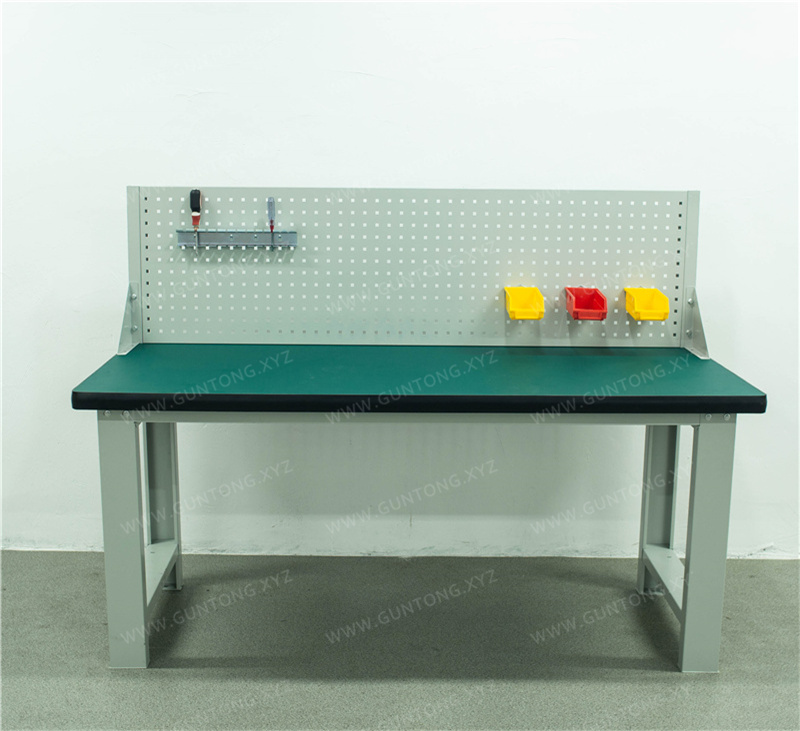
- Steel plate composite desktops: A 5mm raw steel plate bonded to 45mm high-density fiberboard provides high load capacity and impact resistance. This configuration supports the full 1000kg rating when paired with appropriate heavy-duty frames.
- Composite desktops: 50mm thick green composite surfaces offer good general-purpose performance and are commonly specified for 1000kg-rated benches in assembly and maintenance applications.
- Anti-static desktops: Specialized ESD surfaces are available for electronics manufacturing environments. These maintain conductivity requirements while supporting standard load ratings appropriate to the application.
3. Configuration and Accessories
Adding drawers, cabinets, pegboards, and overhead structures affects the overall load calculation:
- Drawer load ratings: Individual drawers in heavy-duty configurations typically support 80kg per drawer with single-rail slides that open 85% for full access.
- Pegboard panels: Square-hole pegboards (commonly 450mm height) add tool storage without significantly impacting the primary load rating.
- Overhead cabinets and lighting: These accessories add distributed weight that must be factored into the total capacity calculation.
Alternatives: Matching Capacity to Application
| Application Scenario | Recommended Load Class | Typical Configuration |
|---|---|---|
| Electronics assembly, ESD-sensitive work | Light to Medium (300–500kg) | Anti-static desktop, pegboard, light fixtures |
| General maintenance, repair, testing | Medium to Heavy (500–1000kg) | Composite or steel desktop, 2–4 drawers, pegboard |
| Mold maintenance, heavy equipment service | Heavy (1000kg+) | 5mm steel plate desktop, reinforced C-channel frame, heavy-duty drawers |
| Automotive parts assembly, turnover | Heavy (1000kg) | Steel or composite desktop, integrated storage, turnover rack compatibility |
Risk Boundaries and Specification Guidance
Do not assume uniform capacity across a product line. Even within a single manufacturer's catalog, workbenches with similar appearances may have different load ratings based on frame gauge and desktop specification.
Key specification checkpoints for procurement:
- Confirm frame specifications: Request the exact steel profile dimensions (e.g., 100×50×1.5mm C-channel) rather than accepting generic "heavy-duty" claims.
- Verify desktop construction: Specify material layers and thickness (e.g., 5mm steel plate + 45mm HDF composite).
- Clarify distributed vs. point load: A 1000kg rating typically refers to uniformly distributed load. Concentrated point loads from heavy equipment may require localized reinforcement.
- Account for dynamic loading: Impact from heavy components being placed on the surface requires additional safety margin beyond static load ratings.
- Document configuration details: Drawer count, pegboard inclusion, and overhead accessories all affect the final installed capacity.
Recommendation
For workshop planners specifying workbenches across mixed-use environments, adopt a tiered approach: assign heavy-duty 1000kg models to stations handling mold work, heavy assemblies, or equipment maintenance, while deploying medium-duty configurations for general assembly and light-duty models for electronics or inspection areas. This avoids over-specification costs while ensuring safety margins where they matter.
When requesting quotations, provide the specific application scenario, expected maximum load, and any dynamic loading conditions. This enables the manufacturer to recommend the appropriate frame, desktop, and accessory combination rather than defaulting to a single specification.
Next Steps
Guang'ErMei Precision Components provides workbench configurations across light, medium, and heavy-duty load classes, with standard dimensions including 1500×750×800mm, 1800×750×800mm, and 2100×750×800mm. Custom configurations for specific load requirements and workshop layouts are available.
Contact our engineering team with your application details for a load-capacity assessment and configuration recommendation tailored to your workshop environment.