Custom Manufacturing Workflow: From Requirement to Mass Production
Custom Manufacturing Workflow: From Requirement to Mass Production
For procurement managers and engineering leads in electronics, automotive, and hardware mold industries, selecting a workstation equipment supplier is not just about comparing unit prices. It is about evaluating the manufacturing workflow that transforms a specific operational need into a durable, standardized, or customized physical asset.
Guang'ErMei Precision Components operates with a dual capability: producing standardized items (like steel plate workbenches) and executing non-standard customization (such as tailored tool carts or automated storage accessories). This guide breaks down the typical workflow from requirement to mass production, helping you assess suitability, service scope, and decision criteria.
1. Requirement Analysis & Feasibility Check
The process begins when a client defines their operational constraints. Unlike off-the-shelf products, custom workflows require a detailed mapping of:
- Load Requirements:*
- e.g., A fitter’s workbench may need a composite desktop (5mm raw steel + high-density fiberboard) supporting significant loads, while a light assembly station might only need standard laminate.
- Spatial Constraints:*
- Workshop layouts often dictate dimensions. For instance, common configurations include lengths of 1500mm, 1800mm, or 2100mm, with consistent widths like 750mm.
- Functional Needs:*
- Integration of pegboards, drawer configurations (4-drawer tiered systems), or specialized materials (stainless steel for hygiene/corrosion resistance).
Decision Criterion: Does the supplier have experience in your specific industry? Guang'ErMei applies its designs across electronics, automotive parts, and warehousing logistics, ensuring the "one-stop" solution addresses sector-specific pain points like 6S management adaptation.
2. Design & Prototyping (Non-Standard Projects)
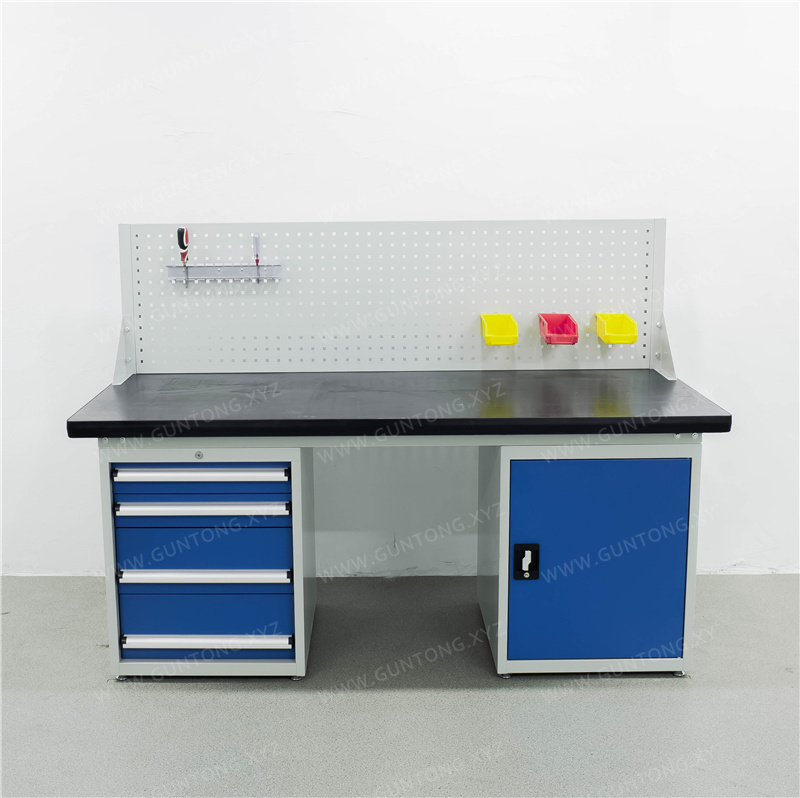
For non-standard requests, such as a 4-Drawer 1-Door Tool Cart with Pegboard, the workflow moves to engineering design.
- Structural Planning:*
- Engineers calculate load paths. For instance, a tool cart requires a stable overall structure and specific material thickness (e.g., cold-rolled steel) to support heavy drawers.
- Visual Management Integration:*
- Designs often incorporate square-hole pegboards for flexible expansion, allowing tools to be visually managed on-site.
- Prototyping/Validation:*
- While mass production uses molds or jigs, custom projects may involve reviewing CAD drawings or small-batch prototypes to verify fit and function before full-scale production.
Trade-off: Customization adds lead time but reduces long-term operational friction. Standardized products offer faster delivery but less flexibility.
3. Material Sourcing & Production Preparation
Once the design is approved, the supply chain activates. Key considerations include:
- Material Specification:*
- Selecting the right grade of steel plate, aluminum profiles (lean pipes), or stainless steel based on environmental conditions (e.g., anti-static requirements for electronics).
- Process Selection:*
- Determining whether components are cut, welded, bent, or assembled using lean pipe connectors.
- Tooling Setup:*
- For mass production of standardized items (like the Single Back Panel Single Door 4-Drawer Steel Plate Workbench), production lines are set up for efficiency. For custom orders, individual fabrication processes are scheduled.
4. Quality Control & Assembly
Quality assurance is embedded in the workflow.
- In-Process Inspection:*
- Checking weld integrity, surface treatment quality, and dimensional accuracy against the approved drawing.
- Load Testing:*
- Verifying that shelves or drawers meet stated capacities (e.g., 100kg per shelf in a Pegboard Storage Cabinet).
- Final Assembly:*
- Ensuring all components (drawers, doors, pegboards) fit together seamlessly without interference.
5. Delivery, Installation & After-Sales
The final stage involves logistics and on-site implementation.
- Packaging:*
- Protecting surfaces during transit, especially for coated or polished finishes.
- Installation Support:*
- Providing guidance or on-site installation services to ensure the equipment integrates correctly with existing workshop infrastructure.
- After-Sales Service:*
- Addressing any adjustments needed post-installation, such as leveling or minor modifications.
Comparison: Standardized vs. Non-Standard Workflows
| Feature | Standardized Products | Non-Standard Customization |
|---|---|---|
| Lead Time | Shorter (Ready stock or quick production) | Longer (Design, approval, fabrication) |
| Cost | Lower unit cost due to economies of scale | Higher unit cost due to unique setup |
| Flexibility | Fixed dimensions/specifications | Tailored to exact spatial/functional needs |
| Best For | High-volume, repetitive setups | Unique constraints, specialized tasks |
Next Steps for Buyers
To evaluate a supplier effectively:
- Define Your Specs: Clearly document load, size, and functional requirements.
- Request Case Studies: Ask for examples of similar industry applications (e.g., automotive parts turnover racks).
- Verify Capabilities: Confirm if they handle both design and manufacturing, ensuring accountability throughout the workflow.
- Discuss Trade-offs: Understand the impact of customization on lead time and budget.
For detailed specifications on products like the Single Back Panel Single Door 4-Drawer Steel Plate Workbench or Pegboard Storage Cabinets, consult our product catalog or contact our engineering team for a feasibility assessment.